The United States continues to assert its naval presence in the Caribbean, with an updated map as of February 12 revealing at least two major U.S. Navy units stationed in the area. This deployment occurs amid significant geopolitical tension and increasing strategic pressure on Cuba.
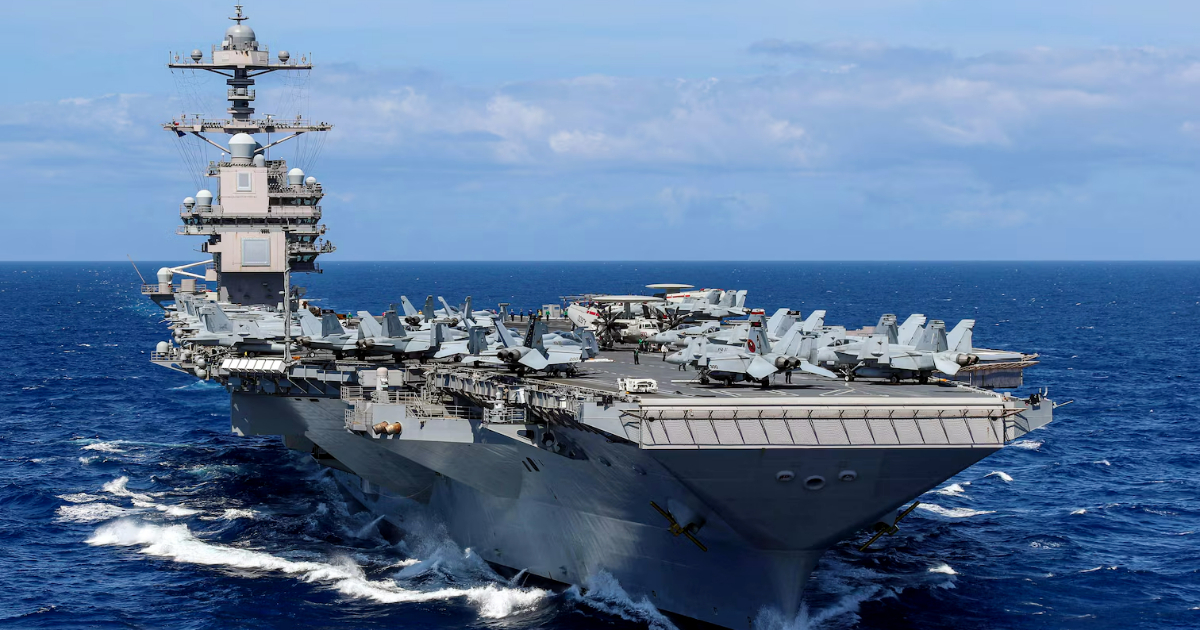
The most striking development for Havana is the presence of the USS Gerald R. Ford (CVN-78) in Caribbean waters, operating under the command of the 4th Fleet. This vessel, the most modern and technologically advanced aircraft carrier in the U.S. Navy, leads a new generation of ships designed to project air, sea, and electronic power on a global scale.
According to the U.S. Navy's deployment map for strike groups and amphibious groups, the USS Gerald R. Ford is explicitly marked as "Caribbean, 4th Fleet," indicating that its presence is part of a structured operation within the regional theater, rather than a temporary assignment.
USS Gerald R. Ford: A Leap in Naval Technology
The CVN-78, as the first carrier of the Ford class, is designed to gradually replace the Nimitz class. It features an Electromagnetic Aircraft Launch System (EMALS), cutting-edge radar systems, and increased electrical generation capacity for future directed-energy weapons.
The carrier can operate dozens of aircraft, including embarked fighters, early warning planes, and helicopters, and is built to support sustained operations over extended periods. Its presence in the Caribbean represents an unprecedented level of military capability close to Cuba compared to previous years.
While Washington frames these deployments under Operation Southern Spear—aimed at intercepting sanctioned vessels and reinforcing maritime control—the continued presence of such a sophisticated carrier sends a clear strategic message within the current regional scenario.
The Amphibious Component: USS Iwo Jima
Another significant element in the Caribbean is the USS Iwo Jima (LHD-7), depicted on the map as part of the amphibious group under SOUTHCOM and also linked to the 4th Fleet.
The USS Iwo Jima is an amphibious assault ship capable of carrying Marines, vehicles, helicopters, and vertical take-off aircraft. It is designed for landing operations, evacuations, humanitarian aid, or rapid response actions.
The combination of a Ford-class carrier and an operational amphibious group in the same region is noteworthy. From a military standpoint, it allows for the simultaneous availability of:
- Long-range embarked air capabilities.
- Projection of ground forces from the sea.
- Expanded maritime control in the western Caribbean.
Strategic Caribbean Waters
This deployment coincides with increased maritime interdictions against the so-called "dark fleet" transporting sanctioned oil from Venezuela to Cuba, as well as the recent reshaping of the regional political landscape following the capture of Nicolás Maduro.
The continued presence of these naval units in the Caribbean strengthens U.S. control over key maritime routes connecting the Gulf of Mexico, the Florida Straits, and the Antillean archipelago.
Though there are no official reports of incursions into Cuban territorial waters—which extend up to 12 nautical miles from the coastal baseline according to UNCLOS—the proximity of high-tonnage, offensive-capable military vessels heightens strategic pressure on Havana.
For the Cuban regime, heavily reliant on external energy supplies, maritime control in the region takes on critical importance. The combination of sanctions, naval interdictions, and the presence of high-tech units significantly alters the balance of power in the Caribbean.
Practically speaking, the map as of February 12 makes it clear: the U.S. maintains a state-of-the-art aircraft carrier and a fully operational amphibious group in the Caribbean, in close proximity to Cuban territory, marking a phase of heightened surveillance and military deterrence in the region.
Key Questions on U.S. Naval Presence Near Cuba
What is the significance of the USS Gerald R. Ford's presence in the Caribbean?
The USS Gerald R. Ford is the most advanced aircraft carrier in the U.S. Navy, representing unparalleled military capability close to Cuba, and its presence serves as a strategic signal in the region.
Why is the USS Iwo Jima important in this deployment?
The USS Iwo Jima is an amphibious assault ship that can deploy Marines and support rapid response operations, enhancing the U.S. military's capability to project power in the Caribbean.