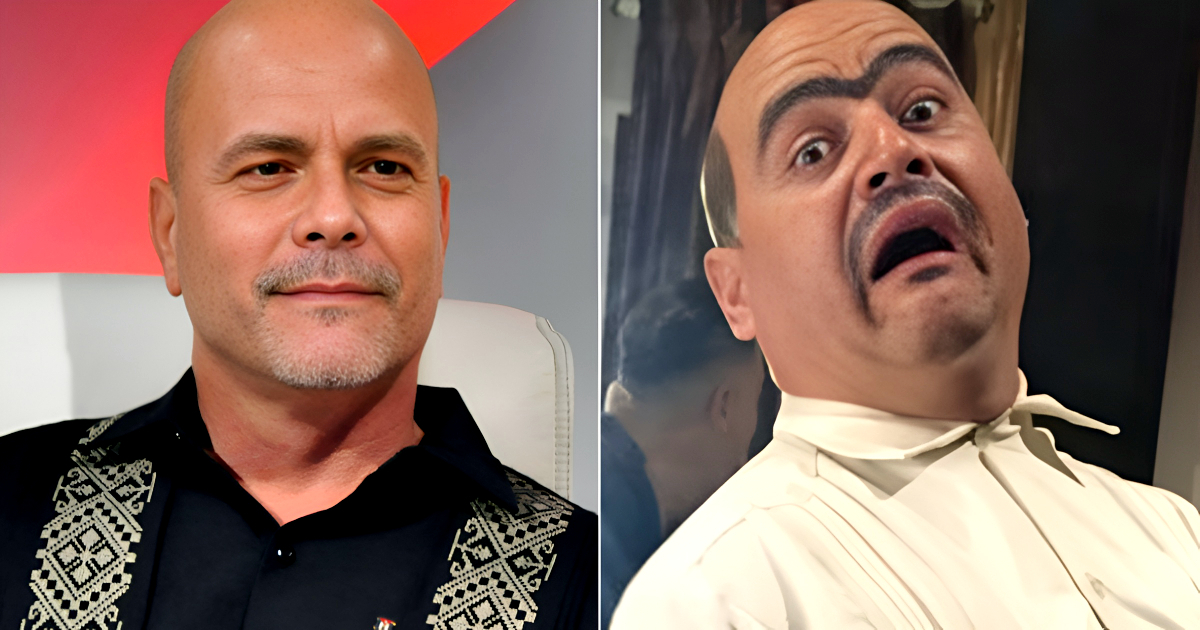
This week, the realm of Cuban social media was once again ignited by satire after actor and comedian Andy Vázquez, famed for his portrayal of Facundo Correcto on the TV show 'Vivir del Cuento', shared a humorous image titled “New Cuban National Currency” on his Facebook page.
Vázquez's post featured a 50-peso bill adorned with Donald Trump's face alongside a 5-peso coin inscribed with “Patria y Vida – 2026”, again showcasing the Republican mogul on one side. Accompanying the image was a brief yet ironic caption: “Look at that.”
However, Vázquez's blend of humor, current events, and subtle critique provoked the ire of Gerardo Hernández Nordelo, the national coordinator of the Committees for the Defense of the Revolution (CDR) and a former spy from the failed Wasp Network.
From his official account, Hernández Nordelo launched into a tirade, accusing Vázquez and other exiled artists of being "sycophants, opportunists, and lackeys." Although he did not name Andy directly, the message was clearly aimed at him:
“Some Cuban artists choose to 'cross the pond'—for whatever reason—and upon reaching Miami, they attempt to live peacefully off their art, avoiding letting 'zealots' damage their dignity too much. Some succeed. But unfortunately, this is inevitable: the more sycophantic and opportunistic they were in Cuba, the more they will grovel for the rest of their lives, trying to renew, day by day, the forgiveness of their inquisitors, to be able to live off the story.”
The post sparked a wave of reactions. Many users defended Andy, reminding that his departure from Cuba in 2019 was a direct result of state censorship after being suspended from television for a satirical video about the opening of the Cuatro Caminos market.
Others pointed out the hypocrisy of Hernández Nordelo, who from an official position uses social media to publicly attack independent and exiled artists.
Comments like “Shut up, sir, this guy is a walking meme!”; “You make more from Facebook than your government pays you”; “With dignity, one doesn't eat, you fool!” were among the nearly 500 responses directed at Hernández Nordelo.
Meanwhile, Vázquez chose not to respond directly to the attack. His original post—garnering thousands of interactions—remained without additional comments, which many interpreted as the comedian allowing irony to speak for itself.
This incident once again highlighted the price many Cuban artists have paid for exercising their creative freedom. Andy Vázquez was ousted from national television in 2019 after making humor about a daily topic the authorities deemed “politically sensitive.”
The censorship not only stripped him of his professional platform but also marked the beginning of a forced exile. Vázquez left for the United States fearing he would be “regulated”—prevented from re-entering Cuba—leaving behind a well-established career, his family, and the country where he had developed his popular character.
His journey mirrors that of thousands of Cubans who cross borders in search of something as fundamental as the right to speak without fear.
Thus, Hernández Nordelo’s jibe—from the safety of his position and the comfort of his power and privileges, calling a man who lost everything for thinking differently a “lackey”—comes off as spiteful and malicious.
The irony is that while Andy Vázquez has had to rebuild in exile with hard work, talent, and humor, the marshal of “neighborhood informants” clings to a worn-out narrative that even those few who applaud him no longer believe.
The ex-spy, turned mediocre enforcer of Castroist repression, mocks those who “live off the story,” without realizing that the real story is his: of a so-called “revolution” that ceased to be credible decades ago, sustained only by insults, slogans, and fear.
In contrast, humor remains the most potent tool for challenging the regime's decaying narrative. Andy knows this well. That’s why his “imaginary currency” ended up being more valuable than Gerardo the Bitter's bile: because sarcasm, when rooted in truth, always holds more weight than propaganda.
Questions About Cuban Satire and Artistic Freedom
Why did Andy Vázquez leave Cuba?
Andy Vázquez left Cuba due to state censorship after he was suspended from television for a satirical video, which resulted in him fearing further restrictions on his freedom.
How did Gerardo Hernández Nordelo react to Andy Vázquez's satire?
Gerardo Hernández Nordelo harshly criticized Andy Vázquez and other exiled artists, accusing them of being sycophants, opportunists, and lackeys in a social media post.
What was the public's reaction to Gerardo Hernández's comments?
Many people defended Andy Vázquez, pointing out the hypocrisy in Gerardo Hernández's comments and criticizing him for using his position to attack independent and exiled artists.