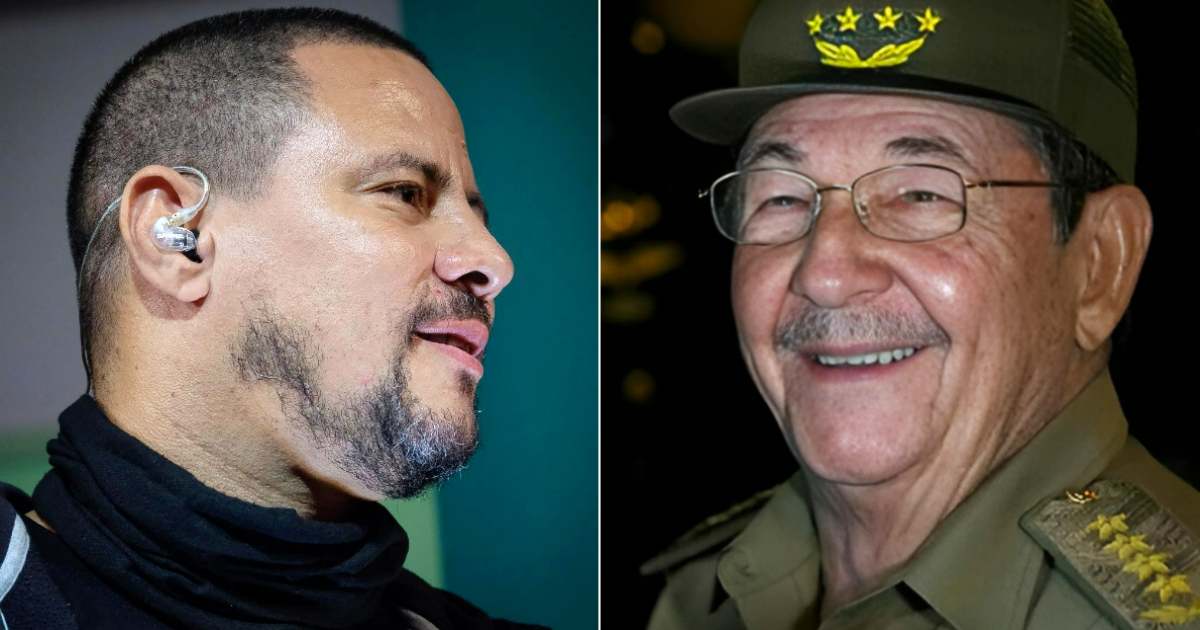
Israel Rojas, the frontman of the duo Buena Fe and a prominent cultural spokesperson for the Cuban regime, has subtly attempted to quell the storm he ignited with his controversial statement, claiming he wouldn't sacrifice his blood "for a president, nor for a venerable elder, nor for his family."
Following the uproar sparked by CiberCuba's coverage of his remarks, Rojas issued a new message two days later. This time, he adopted a reflective and moralizing tone, drawing inspiration from the self-help wisdom of Brazilian author Paulo Coelho. "I believe in deeds more than words... Regardless of their appropriateness, opinions come and go. An ounce of action is worth a ton of words," the singer-songwriter declared, echoing Coelho's sentiment that "the world changes by your example, not by your opinion."
Though he didn't directly address his previous comments, Rojas' statement served as an implicit retraction. It was his way of acknowledging—without explicitly admitting—that his earlier patriotic outburst was an uncharacteristic misstep, an impulsive opinion amid his larger body of work dedicated to the so-called "revolution."
From Revolutionary Zeal to Delicate Balancing Act
In his original message, Rojas didn't intend to detach himself from Castro's power but to position himself above it, portraying himself as a pure patriot fighting for a "sovereign Cuba," for Martí's ideals, and for human dignity, beyond any political figure.
It was a moral self-declaration: the troubadour who serves causes, not leaders. However, in his effort to sanctify himself as the most revolutionary among revolutionaries, he let slip the forbidden phrase.
By stating that he wouldn't die "for a venerable elder, nor for his son or grandson, nor for his family," he inadvertently touched on a taboo: indirectly referencing the Castro dynasty and its inherited power structure. While not rebellious, his gesture was discordant. In an environment where nuances are suspicious, this discordance was enough to raise alarms.
The Note, the Outrage, and the Retraction
On February 4, CiberCuba published an article interpreting Rojas' text as an act of "metaphorical insubordination" and an attempt to salvage the myth of the revolution by sacrificing its saints.
The musician reacted immediately and angrily with a post attacking the outlet with insults and sarcasm ("Cibermierda is getting more discredited every day..."). This verbal explosion only confirmed his discomfort.
Hours later, Rojas seemed to realize he had lost control of the narrative. In his signature style, he sought to regain composure with lyrical moral musings that wrapped his obedience and cowardice.
The new text, centered on the idea that "actions speak louder than words," functioned as a calculated retreat: he didn't apologize but acknowledged that his words might have been "inappropriate." It was, in essence, a veiled self-criticism wrapped in ethical superiority, further burying his inflamed discourse and reopening the door to ambiguity, a tactic he used to label his followers who misunderstood his lyrics as "abnormal."
The Troubadour's Dilemma
This episode has left Israel Rojas in an ambiguous position. His initial text portrayed him as a man who considers himself the keeper of the nation's sacred fire; his second, as a soaked chick eager to explain without clarifying anything, a typical reaction of the faint-hearted burdened with guilt.
And between the two, a public insult to an independent media outlet that exposed what his rhetoric sought and seeks to hide: the fragility of one who relies on the power he sings about.
In just three days, Rojas transitioned from epic patriotism to moral retreat, attempting to salvage his credibility amid a controversy that revealed his deepest contradiction: an artist who wants to appear free while remaining an officialist.
There is no defiance in his words, but there is a symptom: the weariness of a discourse that no longer excites or convinces, not even those who repeat it out of habit.
Understanding Israel Rojas' Controversy
What did Israel Rojas say that caused controversy?
Israel Rojas stated he wouldn't sacrifice his blood "for a president, nor for a venerable elder, nor for his family," indirectly referencing the Castro dynasty, which sparked controversy.
How did Israel Rojas respond to the backlash?
Rojas initially reacted with anger towards the media coverage and later issued a reflective statement emphasizing actions over words, subtly retracting his previous comments.
Why are Rojas' comments significant in Cuba?
Rojas' comments are significant as they challenge the narrative surrounding the Castro family's power, a sensitive subject in Cuba, and highlight the tension between personal beliefs and officialist loyalty.