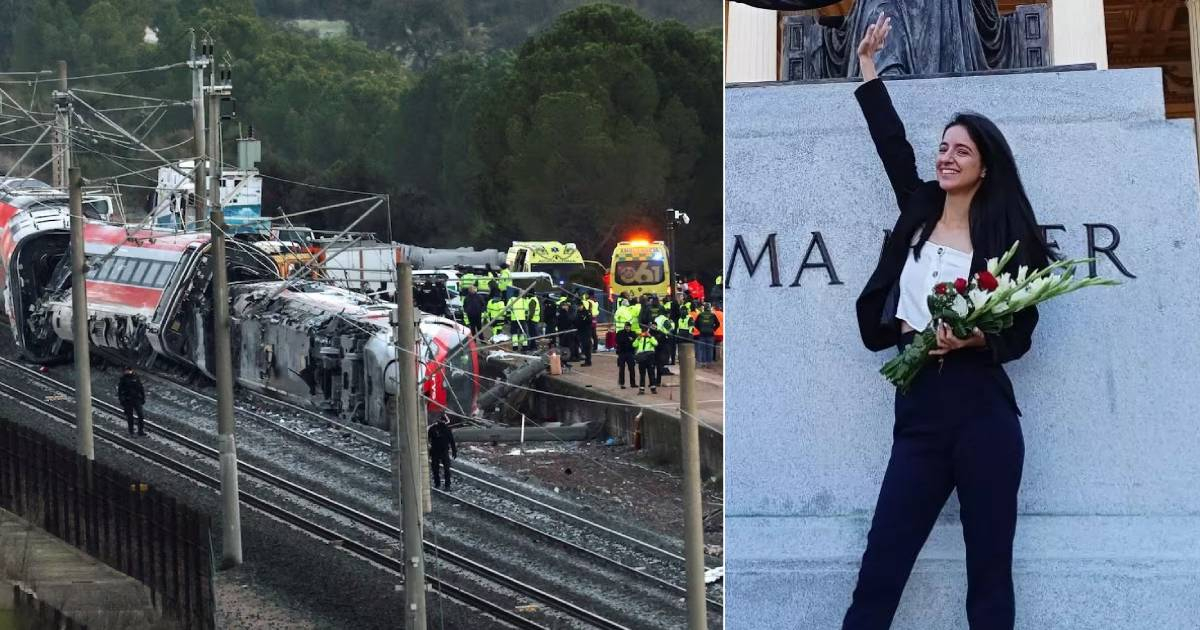
The excitement that Daniela Arteaga Martínez felt as she departed Cuba for Spain nearly turned into a tragedy. The 28-year-old Cuban designer was injured in a catastrophic train accident that occurred on Sunday in Adamuz, Córdoba, where a collision between two high-speed trains resulted in at least 40 fatalities and over 150 injuries.
Daniela was traveling on the Alvia train route from Madrid to Huelva, just hours after arriving at Barajas Airport. She had earned a scholarship from the International University of Andalusia (UNIA) to pursue a master's degree in Communication and Audiovisual Education, an academic venture she embraced with "great enthusiasm," as noted by the institution.
"She was extremely happy to come to Huelva," confirmed María de la O Barroso, director of the Ibero-American Headquarters at La Rábida, in statements to the local outlet Huelva 24.
The initial hours following the accident were filled with anxiety. Since Sunday night, the UNIA academic community had been trying unsuccessfully to locate the student.
Concern heightened when the railway company confirmed that Daniela was in the second carriage, one of the most severely impacted, which was thrown off after the collision. "It was impossible to contact her," Barroso told Huelva Información, the first media outlet to report the case, as the search extended through hospitals and emergency care centers.
The uncertainty was compounded by a crucial detail: Daniela has no family in Spain. Her relatives followed the developments from Cuba, thousands of miles away, with no clear information about her whereabouts. The university engaged with authorities and health services, navigating what was described as an "endless" night at Huelva's train station.
By Monday morning, awaited news finally arrived. According to Huelva 24, the young Cuban was found alive and admitted to the Reina Sofía Hospital in Córdoba. "Despite the severity, she is stable," confirmed Barroso, who, along with the UNIA rector, visited the hospital to provide support.
Further details about her condition were later provided by OnCuba. A close friend cited by the outlet mentioned that Daniela sustained fractures in several ribs and head contusions, although her life is not in danger.
Her family learned of her involvement in the accident after recognizing her face among televised images of the rescued individuals, a moment both heart-wrenching and crucial for establishing contact from the Island.
The academic community also sent messages of support filled with emotion. Ignacio Aguaded, director of the master's program Daniela was set to join, wrote to faculty and students about the young woman arriving "with the great excitement of starting the academic project of her life" and now fighting to recover after being trapped "in a tangle of metal." "Here she will be cared for as if she were family," he assured.
Daniela's case is not isolated among Cubans affected by the tragedy. Tamara Margarita Valdés, a resident of Huelva, is reported missing following the collision, as stated by El País.
Her husband was searching desperately for her in Adamuz hours after the accident, a scene that underscores the human drama left by this catastrophe as families grapple with waiting and uncertainty.
The disaster unfolded when an Iryo company train traveling from Málaga to Madrid derailed and crossed onto the opposite track, colliding with the Alvia train heading to Huelva. The first two carriages of the latter suffered the most damage, falling down an embankment.
Spanish authorities have declared three days of official mourning as rescue efforts continue and investigations into the causes proceed.
Key Questions on the Spanish Train Collision
What caused the train collision in Adamuz, Córdoba?
The collision occurred when a train from the Iryo company, traveling from Málaga to Madrid, derailed and entered the opposite track, colliding with the Alvia train heading to Huelva.
How many people were affected by the train accident?
The accident resulted in at least 40 fatalities and over 150 injuries, marking it as a significant tragedy in the region.
How is Daniela Arteaga Martínez recovering from the accident?
Daniela is in stable condition despite suffering fractures in several ribs and head contusions. She is receiving treatment at the Reina Sofía Hospital in Córdoba.