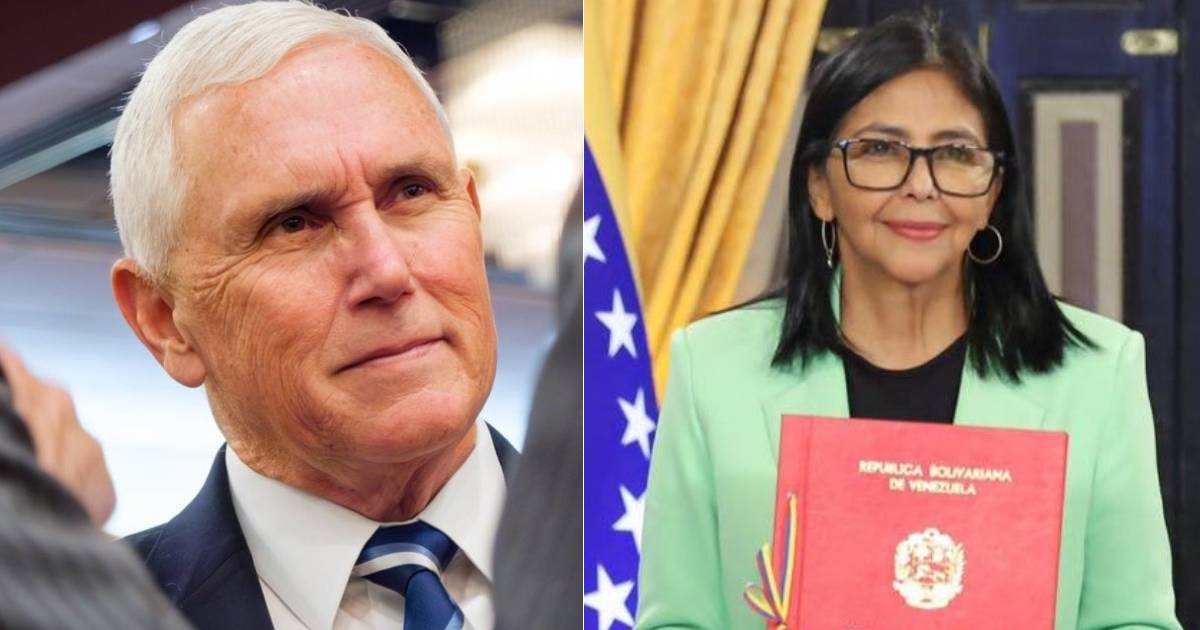
Recent comments by former U.S. Vice President Mike Pence have stirred up controversy regarding Washington's strategy towards Venezuela. This comes at a time when Donald Trump has strengthened his ties with Delcy Rodríguez, endorsing her as a pivotal figure in the transitional government following the capture of Nicolás Maduro.
In an interview with Jake Tapper on CNN's State of the Union, Pence, who was deeply involved with the Venezuelan issue during his tenure in the White House, issued a stark warning. While acknowledging the removal of Maduro as a "historic and significant" milestone, he underscored that the subsequent direction is equally critical, asserting that the United States is currently on the wrong path.
"Delcy Rodríguez is not the right leader for Venezuela," Pence declared emphatically. He conceded that an interim stabilization period might be necessary, but insisted that Washington's primary goal should be to expedite the restoration of fundamental freedoms and steer the nation towards free and fair elections.
According to Pence, opposition figures like María Corina Machado, or any leadership emerging from popular elections, better embody the Venezuelans' yearning for freedom.
Contrasting Views on Leadership
Pence's statements sharply contrast with Donald Trump's current narrative. In recent weeks, Trump has depicted Rodríguez as an "ally," a "fantastic person," and a leader willing to meet U.S. conditions, particularly concerning energy and security.
Trump has openly advocated for the U.S. to oversee Venezuelan oil, manage its revenues, and ensure a "controlled" transition, aiming to prevent a chaotic aftermath similar to Iraq post-Saddam Hussein's fall.
Democracy at Stake
For Pence, however, the danger lies not in immediate chaos but in abandoning the democratic commitment that has been the cornerstone of U.S. policy towards Venezuela for years.
He reminded that before the rise of Chavez, Venezuela was one of the hemisphere's most prosperous countries and that the current devastation has led to the exodus of eight to ten million people. In this context, Pence warned that supporting recycled Chavista figures in the transitional phase could send the wrong message to both Venezuelans and the broader region.
The former vice president also hinted at a broader critique of the new isolationism within Trump's circle, which he believes threatens to weaken America's historic role as a democracy advocate in the hemisphere. "America remains the leader of the free world and must act as such, especially in our region," he emphasized.
The Wider Implications
Meanwhile, Delcy Rodríguez continues to be a polarizing figure both in Caracas and abroad. For some, she represents a pragmatic solution after Maduro's fall; for others, she is merely a new face of the same power structure.
In this ongoing debate, Pence's remarks resurrect an uncomfortable question: if Venezuela's transition proceeds under Washington's control, who truly dictates the nation's future?
For millions of Cubans, both on and off the island, the outcome of this situation is far from irrelevant. Venezuela has long been an economic and political lifeline for the regime in Havana, and any shift in power dynamics in Caracas, whether democratic or controlled, directly impacts everyday life in Cuba, a country currently grappling with blackouts, economic turmoil, and mass migration.
Frequently Asked Questions about U.S. Policy on Venezuela
Why does Mike Pence oppose Delcy Rodríguez as a leader?
Mike Pence believes Delcy Rodríguez does not represent the aspirations for freedom of the Venezuelan people and argues that leadership should emerge from popular vote rather than recycled figures from the existing power structure.
How does Trump's view on Venezuela differ from Pence's?
Trump sees Delcy Rodríguez as an ally willing to comply with U.S. conditions, particularly in energy and security, advocating for U.S. oversight of Venezuelan resources, while Pence warns against abandoning democratic principles and supporting former Chavista figures.
What impact does Venezuela's situation have on Cuba?
Venezuela has been a key economic and political supporter of Cuba. Changes in Venezuelan leadership, whether democratic or controlled, can significantly affect Cuba's economy and political landscape, especially during its current crises.