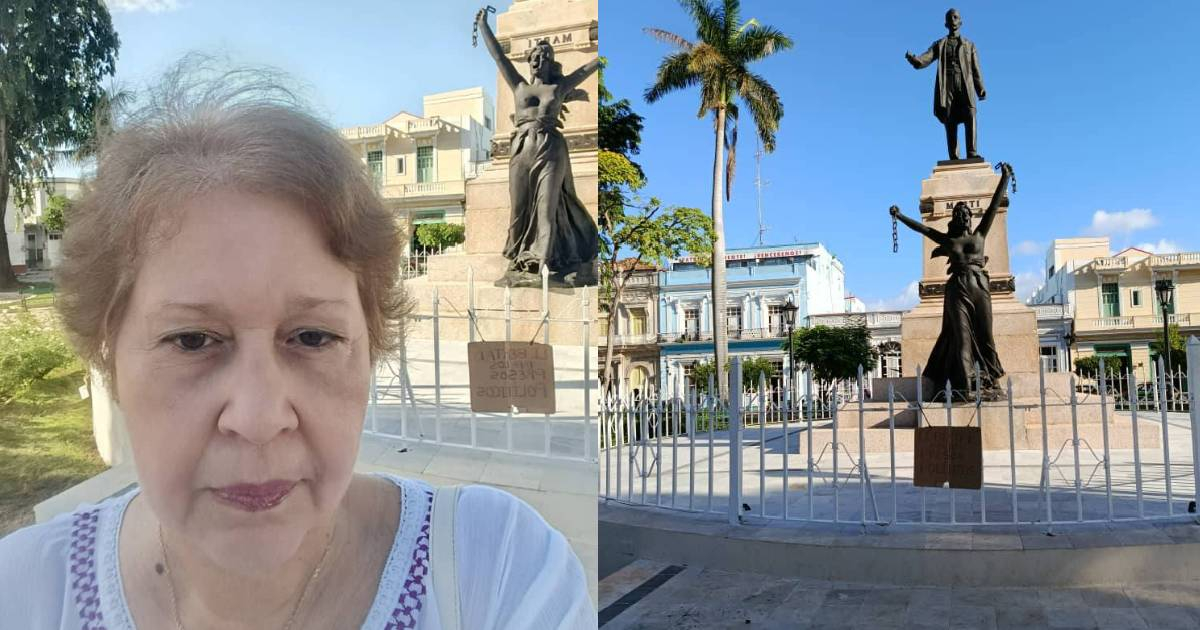
Alina Bárbara López Hernández, a Cuban historian and activist, has raised concerns over whether the government has suspended constitutional rights following its approval of plans for a transition to a "War State." This official decision is shrouded in legal ambiguity and a lack of transparency.
The inquiry was posed by López Hernández on her Facebook profile, primarily directed at legal experts, following a session of the National Defense Council that sanctioned "plans and measures for the transition to a War State" as part of Defense Day activities.
"Are constitutional rights suspended when a state of war is declared?" the academic questioned, amid an environment characterized by the systematic repression of peaceful protests.
The discussion sparked numerous comments. Silvia Jácome Alfonso cautioned that implementing war plans could de facto suspend rights, potentially leading to greater police abuses.
Journalist José Raúl Gallego clarified an important point: a formal War State has not been declared; rather, plans and measures for a potential transition to such a scenario have been approved.
Some users saw the announcement as a preparatory move for repression in anticipation of possible social unrest. Vladimir González suggested that the regime is gearing up to suppress protests more violently, while López Hernández emphasized that any formal suspension of rights would need to be publicly acknowledged, which has not happened.
"Since they haven't done so, I assume not, and continue my activities without worry," she remarked, referring to her peaceful civic actions on the 18th of each month in Matanzas.
Attorney Fernando Almeyda provided a direct legal interpretation: if a War State is declared, the National Defense Law would be immediately activated. Article 10 of this law allows the National Defense Council to regulate fundamental rights differently, including freedom of expression, assembly, and detention protocols.
López responded that without an explicit public declaration, one cannot technically speak of a suspension of rights.
This debate arises amid ongoing harassment against López Hernández herself, who has been detained multiple times while attempting to protest peacefully in Matanzas' Liberty Park, advocating for the release of political prisoners.
Despite the 2019 Constitution recognizing the right to peaceful protest, the necessary regulatory law has never been enacted, violating the constitution itself.
The National Defense Council session was reported by official outlets like Granma and Cubadebate, which highlighted the approval of "War State" plans and the symbolic role of Raúl Castro, who "remained informed" about the meeting.
The announcement did not detail specific measures or practical implications, nor did it clarify the legal status of constitutional rights.
Human rights organizations have repeatedly accused the Cuban regime of criminalizing peaceful protests, ignoring its own constitutional guarantees, and using preventive repression as a tool of social control.
In this context, López Hernández's question is far from rhetorical: it highlights the legal and communicational void that the government exploits to repress without facing explicit political repercussions.
In a nation deeply entrenched in a crisis of food, electricity, and basic services, the "War State" announcement is interpreted by many citizens not as a defensive measure, but as a veiled threat against the population itself.
Key Questions on Cuba's Political Climate
What is the significance of the "War State" plans in Cuba?
The "War State" plans are significant because they indicate a potential shift in government policy that could lead to the suspension of constitutional rights, increasing the risk of state repression against peaceful protests.
How does the Cuban Constitution address the right to protest?
The 2019 Cuban Constitution acknowledges the right to peaceful protest. However, the implementing law for this right has not been passed, which constitutes a breach of the constitutional promise.
Why is there concern about the lack of a public declaration regarding the War State?
Concern arises because, without a public declaration, the government can potentially alter fundamental rights without accountability, allowing for repression without legal transparency.