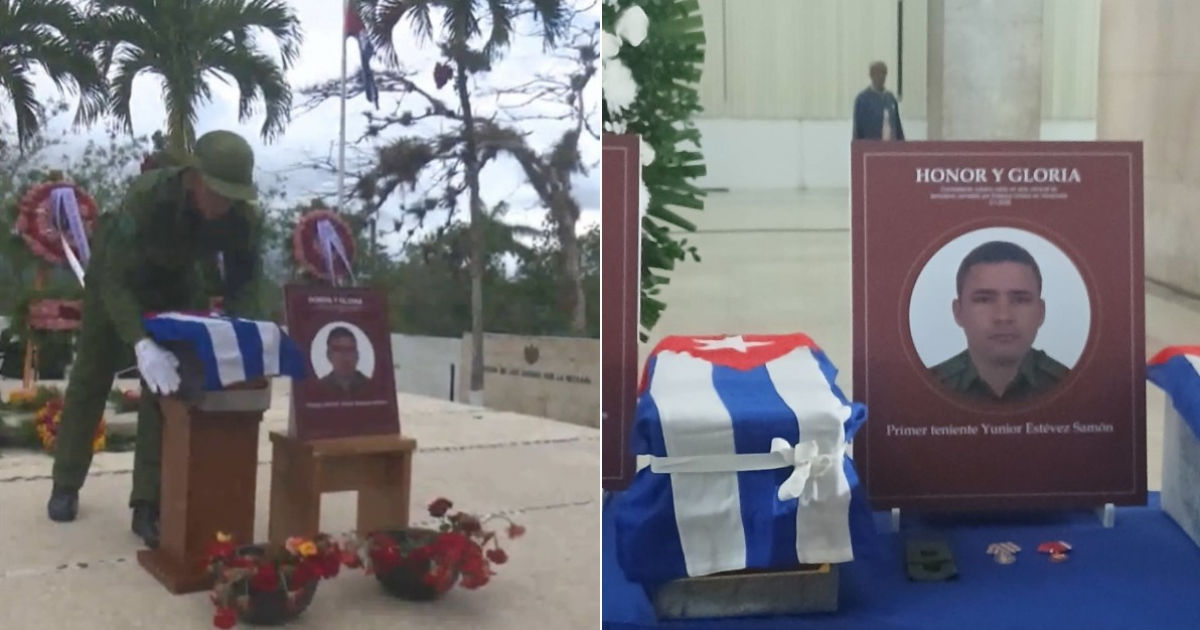
A former classmate of Captain Yunior Estévez Samón, one of the 32 Cuban nationals who perished in Venezuela during the operation leading to Nicolás Maduro's capture, has shared a poignant personal story. This narrative exposes the harsh reality of how the Cuban regime exploits young people as mere disposable parts in its political-military machinery.
Digital content creator Marcos RL reflected on Facebook about his schooldays with Yunior at the Vocational Pre-University Institute of Exact Sciences in Guantánamo. To Marcos, Yunior wasn't just a distant name or a face on an official mural; he was a friend with whom he shared classrooms, talks, and youthful dreams.
Years later, Yunior accepted an offer that would alter his life dramatically: a place in the Ministry of the Interior, with a guaranteed university education, no entrance exams, and even a trip to Russia. The catch was simple but absolute: unwavering obedience.
Rising through the ranks, he became a lieutenant, and then a captain, of State Security, eventually joining the Personal Security Directorate of the Ministry of the Interior, responsible for safeguarding government officials.
According to Marcos, Yunior's allegiance to the regime wasn't solely out of convenience but also conviction. He bought into the propaganda entirely: that the 'revolution' was the path for farmers' children to become university graduates, that sacrifice was rewarded, and that it was all worthwhile.
Even months before his death, Yunior was active on social media, passionately defending the dictatorship. He spoke not with the cold detachment of a bureaucrat but with the genuine belief of someone indoctrinated by the system. "I recall his tone: loyal, convinced, grateful," Marcos shared.
Unveiling the Irony: The Regime's Hypocrisy
Today, the very regime that once denied the presence of Cuban military personnel in Venezuela is organizing solemn tributes across the country to honor them.
"Yunior is gone now," lamented his former classmate, questioning the regime's shift from denial to public commemoration.
As the government turns these funerals into propaganda spectacles, it becomes clear that Yunior died not for Cuba, nor its people, nor any noble cause, but while guarding a foreign dictator sustained by force. He perished defending Nicolás Maduro, as part of the security apparatus upholding the political power of Chavismo.
Marcos RL's account does not celebrate Yunior's death. Quite the opposite—it mourns it.
He condemns the false heroism portrayed by a system that indoctrinates, recruits, and sacrifices. A ruling elite that never sends their own offspring to the front lines but uses the children of the populace instead.
"This wasn't bravery. It was the cowardice of the Cuban leadership that never dispatches their sons. It was also induced ignorance and submission, of young people becoming cannon fodder to sustain dictators," Marcos stated.
"While Yunior was dying, the children of the elite live abroad, attending prestigious universities, enjoying the capitalism they claim to despise. Others, like Sandro Castro, live in Havana amidst luxury, alcohol, and excess, as the country falls apart," Marcos emphasized.
The True Culprits: Unmasking the Regime's Role
Marcos is unequivocal: it wasn't Donald Trump who recruited Yunior. It wasn't Trump who indoctrinated him, promised him a career for loyalty, or denied the presence of Cuban troops in Venezuela for years. It was the Cuban regime. The same regime now using his death as a symbol.
Yunior's story isn't one of epic heroism but of victimhood. A victim of a system that turns young people into tools, convinces them that dying for dictators is glorious, and then wraps them in flags when they can no longer speak.
"I hope this serves as a wake-up call for other young people. To realize it's not worth dying for those in power. That the 'revolution' is not a mother but a recruiter. And when the system trembles, the first to fall are always the same," Marcos stressed.
"Yunior wasn't a hero. He was another victim of Castroism," he affirmed.
At 32, Yunior Estévez Samón, a Guantanamo native and captain in the Ministry of the Interior's Personal Security Directorate, lost his life far from home, defending a power that would never lift a finger for him. His death doesn't glorify the regime; it lays it bare.
Understanding Yunior's Story and the Cuban Regime's Role
Who was Yunior Estévez Samón?
Yunior Estévez Samón was a Cuban captain in the Ministry of the Interior's Personal Security Directorate, who died in Venezuela while defending Nicolás Maduro's regime.
Why is Yunior's story significant?
Yunior's story highlights the Cuban regime's exploitation of young citizens as disposable tools in its political-military agenda, revealing the true cost of its oppressive tactics.
How does the Cuban regime use Yunior's death?
The Cuban regime utilizes Yunior's death as propaganda, organizing tributes while ignoring its role in his indoctrination and the broader implications of its policies.
What message does Marcos RL convey about the regime?
Marcos RL emphasizes the regime's hypocrisy and the need for young people to awaken to the dangers of blindly supporting a system that exploits their loyalty and sacrifices their lives.