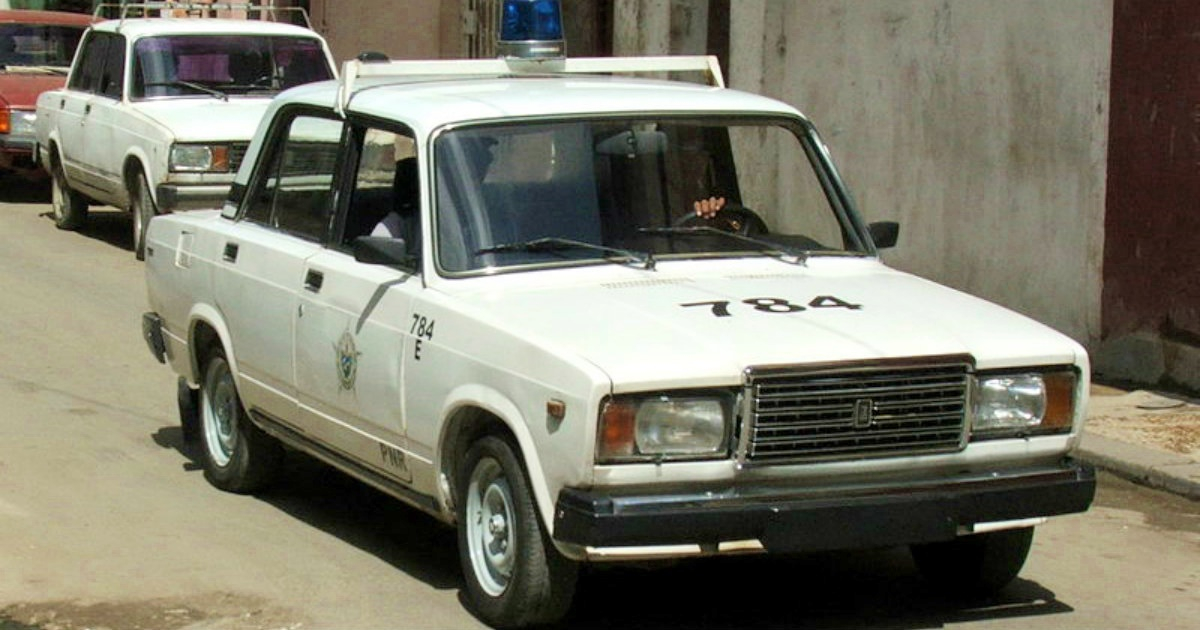
A brief report recently surfaced on the pro-government Facebook page "Con Todos la Victoria," announcing the arrest of a 29-year-old man in Matanzas. The individual is accused of attempting to transport 30 liters of what was described as "jet fuel."
Despite the lack of images or further details, this announcement triggered a wave of reactions on social media. Many users questioned, mocked, and used the incident to highlight the moral and social collapse occurring in Cuba.
30 Liters, Six Bags, and an Arrest
The official report named the suspect as Bryan Carlos Castillo Noda, an employee at Matanzas Fuel Marketing Company. He was reportedly caught by police with six plastic bags containing 30 liters of a substance identified as "jet fuel," allegedly stolen from his workplace.
The post claimed that the arrest was part of a "ZERO TOLERANCE" policy against illegal activities, ending triumphantly with the statement: "Not even the most powerful 'turbo' can outrun the law."
Technical Jokes: Is It Really Jet Fuel?
One of the main points of ridicule was the technical inaccuracy of the term "jet fuel." Numerous commenters pointed out that jet engines do not run on gasoline but on Jet A-1, a highly refined type of kerosene.
Users humorously corrected, "Jet engines burn kerosene, not gasoline," while another clarified, "Not gasoline or kerosene, it's called Jet-A1." An industry insider elaborated, stating, "Jet A-1 is a kerosene-based fuel used in commercial aircraft (Boeing, Airbus), executive jets, and turbine helicopters."
This mislabeling by the official source led to sarcastic comments like, "Where was he parking the plane?" and "30 liters wouldn't even warm the engines."
Another Theft in a Broken Country
Many downplayed the incident's severity, placing it within the broader context of Cuba's desperate situation. "30 liters isn't much; in this country, they steal by the truckload," remarked one user.
Another speculated, "Maybe he did it to buy milk for his child since the state doesn't sell milk for young children." Some were more forthright, "In Cuba, if you work with crap, you steal crap. If you don't, your family starves," one commenter expressed.
Another added, "That young man they call a thief is an example of someone who has never been in trouble with the law, and his family suffers from this injustice."
One user, outraged, concluded, "30 liters of fuel is what the bosses have in tanks at home for beach trips. It's unjust and incoherent."
Justice or a Double Standard?
As often happens, the news led to polarization. Some users supported the police's actions, echoing the official "zero tolerance" stance. "Instead of criticizing these people, criticize those giving out two pounds of rice from last year," suggested one commenter.
A woman close to the detained shared, "Did you know... very illegal... he lives with his 90-year-old grandmother, and we have nothing to light the charcoal."
Many comments highlighted the human cost of this arrest. "Another young man marked for life in Cuba, where everything is illegal," criticized one. "If this is true, they should be ashamed to publish this. With a decent salary, desperation wouldn't reach this level," another remarked.
While the official post aimed to showcase a justice victory, it instead unlocked a torrent of social grievances, technical critiques, inequality denunciations, and most prominently, mockery of the official narrative.
The tale of the young man accused of carrying "jet fuel" in plastic bags transformed from a minor report into a symbol of a fractured society, where for many, the true crime isn't stealing fuel but living in a country that forces such measures for survival.
While some hail the arrest as a triumph of order, others see it as evidence of state failure and the desperation of those who can no longer heat their food.
Understanding the Impact of Fuel Theft in Cuba
What sparked the social media debate regarding the arrest?
The arrest of a young Cuban man for allegedly stealing "jet fuel" sparked debate due to the technical inaccuracies and the broader context of the country's economic struggles, leading to public criticism and mockery.
Why was the term "jet fuel" ridiculed?
The term "jet fuel" was ridiculed because it inaccurately described the substance, as jet engines typically use Jet A-1, a refined kerosene, rather than gasoline.
How did the public perceive the severity of the theft?
Many in the public perceived the theft as minor, especially when compared to larger-scale thefts in Cuba, and viewed it as indicative of the dire economic circumstances many face.
What does this incident symbolize for Cuban society?
The incident has become a symbol of the fractured state of Cuban society, where the real crime is seen as the necessity to resort to theft for basic survival due to systemic economic failures.