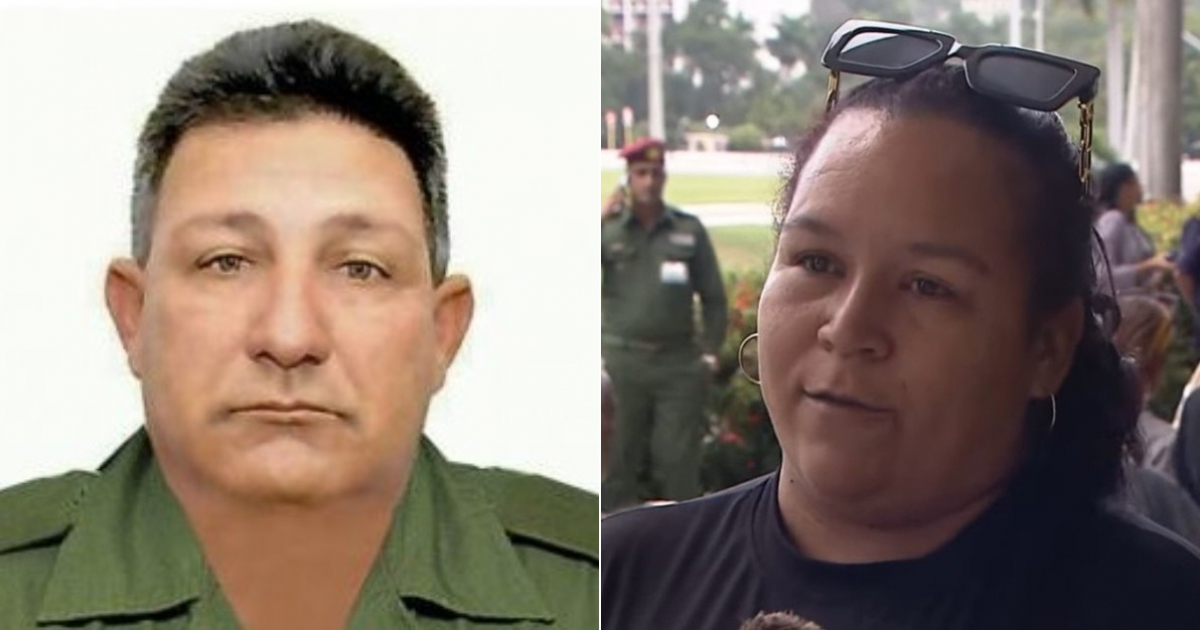
The widow of Luis Manuel Jardines Castro, a Cuban soldier who perished in Caracas on January 3rd, recently shared her feelings, which have been echoed by the state media as part of a heroic narrative crafted by the regime about the 32 soldiers dispatched to Venezuela.
“I know it wasn’t the best of times for him to die, but he did so with pride and courage,” she stated to the cameras, defending her husband’s mission as an act of loyalty to the Revolution.
She added, “If he were here, he would say, ‘If I had to do it again, I would,’ because those were his beliefs.”
Jardines Castro served as a driver for the Revolutionary Armed Forces (FAR) and was nearing his 60th birthday on January 30th.
His widow shared that he had been stationed in Venezuela for a year and was “very happy” and eager to continue his work there. "Whenever we spoke, he always conveyed joy and pride in the work he was doing."
She emphasized that he had gone there of his own volition, “ready to do whatever was necessary,” and there was never a complaint from him.
“He fulfilled his duty, as expected,” she stressed.
Despite the challenging time, she mentioned that “the whole family is proud of him,” a sentiment that aligns seamlessly with the official narrative, which seeks to portray the fallen as convinced, content, and grateful for their mission.
However, beyond the emotional tone of the testimony and the genuine grief, there’s a point the official discourse avoids highlighting: these soldiers did not die defending Cuba or its people but were safeguarding a foreign regime, Nicolás Maduro's, during an operation that ended with their capture.
In an interview, the journalist inquired about the Cuban people's reaction to the tributes. The widow noted that she observed in people “almost the same pain we, the family members, feel,” and many waited “until the last minute to pay their respects.”
State media coverage has particularly emphasized that the public attended the tributes voluntarily, repeatedly portraying spontaneous crowds, endless lines, and genuine popular support.
This emphasis is no accident: it comes at a time when the government is experiencing its most severe credibility crisis in decades, with the country suffering from blackouts, food and medicine shortages, inflation, and profound social unrest.
In this context, the regime needs to showcase images of support and unity.
The Reality Behind the Heroic Narrative
Moreover, it’s crucial for the regime that the families of the deceased speak in the same tone. Emotional phrases and gratitude to the people function as pieces of a political stage intended to counteract the accumulated societal discontent.
Meanwhile, the overlooked reality is that Cuba sent men to die far from home to support a dictator, not to defend a national cause or humanitarian emergency.
The epic being constructed by the official media contrasts starkly with the fact that most Cubans today live in extreme precarity, lacking stable basic services and without a real voice in decisions affecting them.
The contrast between the genuine grief of a widow and the political exploitation of that pain is evident. The widow speaks from her personal loss; the regime speaks from its need for propaganda.
Thus, the widow’s statement—“He didn’t die at the best moment, but he did so with pride and courage”—remains caught between two planes: the legitimate human aspect of a woman defending her husband’s memory, and the propagandistic one, where this death becomes another piece of the regime's discourse.
The state narrative speaks of “patria,” yet the facts confirm that Cuban soldiers were deployed in Caracas as part of the security apparatus of the Venezuelan political power.
Testimony from a Wounded Colonel
On Thursday, Colonel Pedro Yadín Domínguez, wounded in the same military operation, appeared on state television, frankly confirming he was in Caracas "on a mission" during the American attack.
He recounted that the group of Cuban soldiers was engaged in supporting presidential security, with minimal weaponry, when they were caught off guard by a massive air operation. He reported that the attack involved planes, bombs, drones, and helicopters, resulting in at least 11 comrades losing their lives in that location.
The colonel’s testimony sheds light on something the government usually handles with extreme caution: Cuban officers were directly involved in protecting the Venezuelan political power.
His words confirm that Cuba’s presence in Venezuela was not symbolic or limited to advisory roles, but operational, linked to the security of the Maduro regime.
They also affirm that the human cost of this alliance transcends speeches, manifesting in deaths, injuries, and broken families.
While television insists on the epic, the wounded colonel’s testimony exposes the real dimension of Cuba’s military commitment to Chavismo and how decisions made outside the Island continue to claim Cuban lives.
Understanding Cuba's Military Involvement in Venezuela
What was the mission of Cuban soldiers in Venezuela?
Cuban soldiers were deployed in Venezuela to support the security of Nicolás Maduro's regime, rather than defending Cuba or its people.
How does the Cuban regime use the narrative of fallen soldiers?
The regime uses their stories to create a heroic narrative, portraying them as loyal and content with their mission, to foster an image of support and unity.
What challenges is the Cuban government facing?
The Cuban government is dealing with a severe credibility crisis, marked by blackouts, shortages of food and medicine, inflation, and deep social unrest.