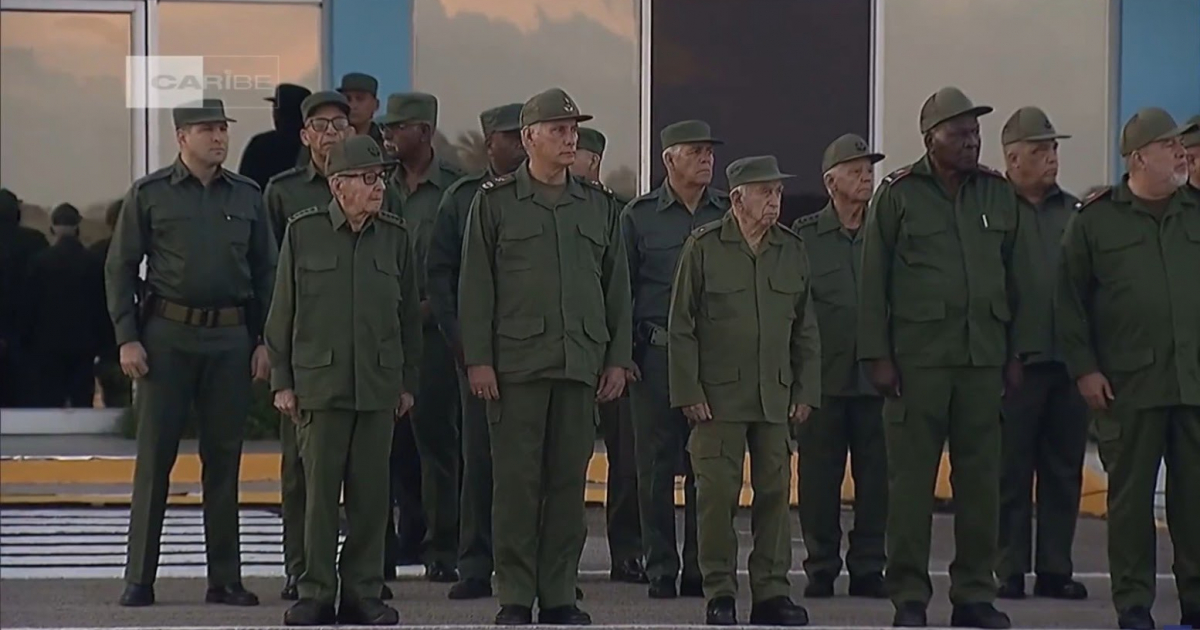
The Cuban military elite made a calculated political statement with their presence at José Martí International Airport on Thursday, dressed in austere olive-green uniforms.
Beyond mourning the loss of 32 soldiers in Venezuela, the event was a symbolic display of discipline and hierarchy within the regime.
Raúl Castro, Miguel Díaz-Canel, José Ramón Machado Ventura, along with senior government and Revolutionary Armed Forces (FAR) officials, wore identical uniforms: closed jackets, campaign caps, and shoulder boards with military ranks embroidered in black, devoid of any medals or decorations.
This seemingly minor detail adheres to an internal military code. Only Miguel Díaz-Canel's shoulder board bore the colors of the Cuban flag, marking him as the chief leader, flanked by the Army General on his right and Commander Machado on his left.
His Commander-in-Chief of the National Defense Council (CDN) insignia on his cap underscores his role as a successor within the military framework, being the sole identifiable rank when the group was in formation.
Machado Ventura's shoulder board also displayed his commander symbol, with red and black colors emblematic of the dictatorship, inspired by the 26th of July Movement's flag.
For Raúl Castro, the General of the Army insignia in black was visible, which some analysts interpret as a symbol of mourning and authoritative command.
Symbolic Uniform and Message of Sobriety
The embroidered ranks on the shoulder boards, captured by state television cameras, reinforce the message of authority. This attire corresponds to a training uniform used by the FAR for solemn internal events like state funerals, Revolutionary anniversaries, or military ceremonies.
This is a simplified version of a dress uniform, devoid of badges and decorative ribbons, highlighting institutional unity and sober representation.
In such events, the lack of medals does not imply dishonor but is a deliberate choice. The high command reserves decorated uniforms for international representation or higher protocol events.
The "clean" uniform projects an image of revolutionary humility and historical continuity with the Rebel Army's origins.
Political Theater in Uniformity
The coordinated uniform usage by the entire ruling elite was no accident. Amidst internal crisis, diplomatic isolation, and waning Venezuelan support, the regime relied on the visual language of the Armed Forces to project cohesion, discipline, and revolutionary continuity.
Raúl Castro's silent, front-line presence reaffirmed power within the military elite.
Thus, the ceremony welcoming the remains of the soldiers fallen in Venezuela was also a choreography of institutional loyalty. Every garment, gesture, and insignia bolstered the narrative of a military leadership striving to appear unscathed, both domestically and in the eyes of the international media.
Understanding the Symbolism in Cuban Leadership's Uniforms
What message did the Cuban military uniforms convey at the airport ceremony?
The uniforms conveyed a message of discipline, hierarchy, and revolutionary continuity amidst the internal and external challenges facing the Cuban regime.
Why did the leaders' uniforms lack medals and decorations?
The absence of medals was a deliberate choice to emphasize institutional unity and a sober representation, often reserved for solemn internal events.
What significance did Raúl Castro's presence have at the ceremony?
Raúl Castro's presence served to reaffirm power within the military elite and project a sense of continuity and authority.