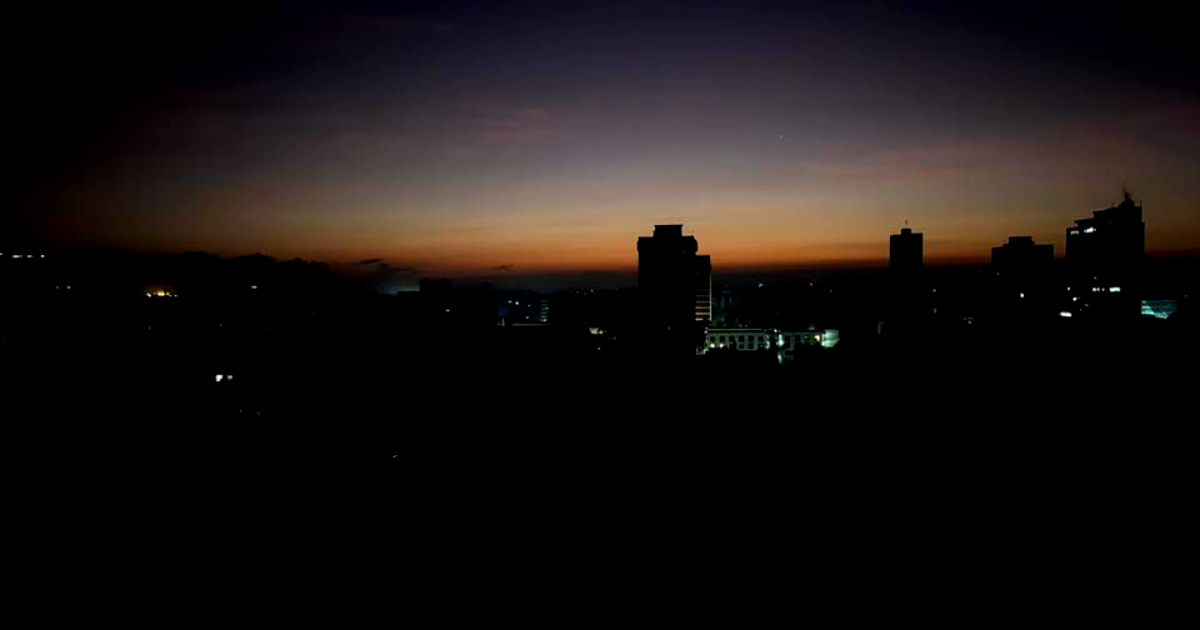
The Cuban electrical grid is experiencing one of its most challenging days of the year, with widespread power outages and a shortfall exceeding 1900 megawatts (MW), as acknowledged by the Cuban Electric Union (UNE) in their January 15, 2026, report.
"Yesterday, the service was disrupted for 24 hours, and the issue persists," the state-run company conceded, confirming that the maximum shortage due to capacity deficit reached 1770 MW at 6:40 p.m. on Monday.
The current availability of the National Electric System (SEN) stands at a mere 1300 MW, against a demand of 2150 MW, resulting in an 837 MW deficit from early morning.
During the evening peak hours, the shortfall could rise to 1945 MW, making this Thursday one of the most severely affected days in 2026.
Extended Blackouts in Havana
In the capital city of Havana, residents endured nearly 12 hours without electricity. Reports from the Havana Electric Company (EELH) indicated an outage lasting 11 hours and 56 minutes, peaking at 277 MW offline by 6:40 p.m.
Power was restored shortly after 10:00 p.m., though the company admitted not adhering to the scheduled plan and had to implement an emergency disconnection of 100 MW.
Limited Impact of Solar Parks
Despite official rhetoric about renewable energy advancements, the UNE reported that the 37 new solar photovoltaic parks contributed only 2872 MWh throughout the day, with a peak output of 563 MW during daylight hours. This is insufficient against the national peak demand, which exceeds 3000 MW.
Underlying Causes of the Power Crisis
Key factors in the electrical collapse include failures in unit 5 of the CTE Mariel, units 1 and 2 of the CTE Felton, and unit 3 of the CTE Antonio Maceo, alongside scheduled maintenance at plants in Santa Cruz del Norte and Cienfuegos.
The UNE further acknowledged that over 1100 MW remain offline due to a lack of fuel and lubricants, impacting 102 distributed generation stations and the barges at Melones and Regla. In total, 169 MW are halted due to lubricant shortages, a persistent problem in recent weeks.
While the regime continues to emphasize its "commitment to clean energy," the harsh reality for the country is defined by prolonged blackouts, damaged appliances, and a weary populace. With no new investments, crumbling thermoelectric plants, and the absence of Venezuelan oil, Cubans appear destined to live amidst blackouts and government propaganda.
Understanding Cuba's Electrical Crisis
What are the primary reasons for Cuba's current power outages?
The main reasons include equipment failures at several power plants, scheduled maintenance, and a lack of fuel and lubricants.
How are the solar parks in Cuba impacting the electricity supply?
The solar parks have a limited impact, contributing only 2872 MWh, which is insufficient compared to the national demand during peak hours.
How long did the power outage last in Havana?
In Havana, the power outage lasted for nearly 12 hours, affecting residents significantly.