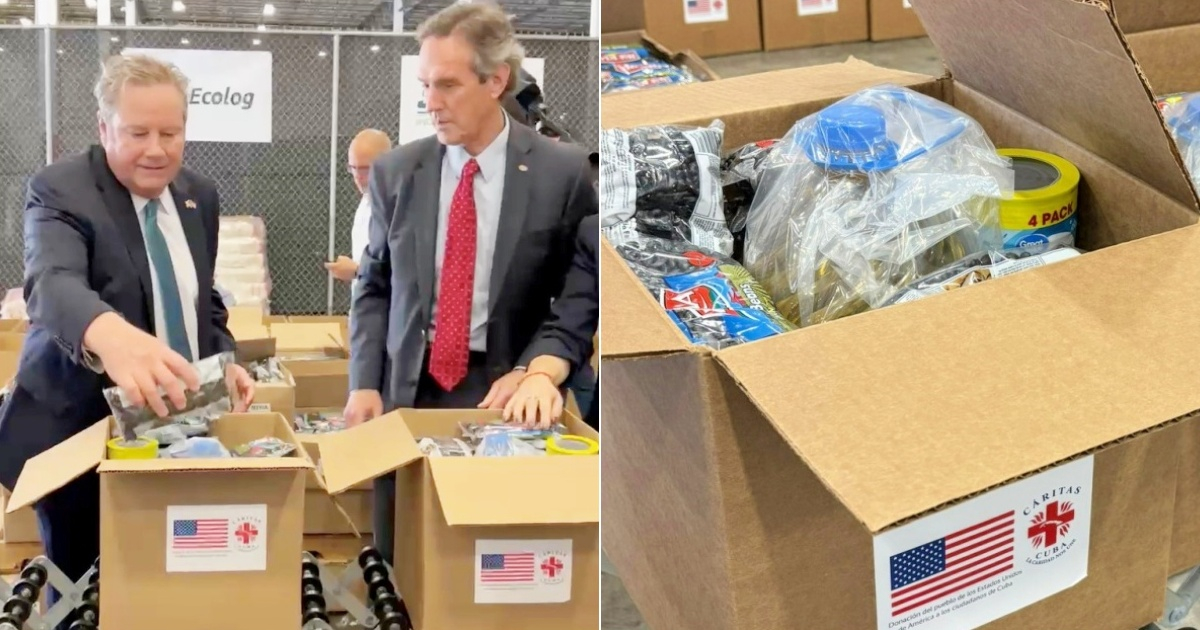
The Cuban government has fiercely criticized the recent delivery of humanitarian aid from the United States to those affected by Hurricane Melissa. They argue that the operation is driven by "political manipulation" and opportunism, even though the goods are received and distributed in the affected communities in the eastern part of the island.
In an official statement released by the Ministry of Foreign Affairs (MINREX) on January 14, Cuban authorities accused Washington of exploiting the hurricane-induced tragedy to bolster its political narrative and discredit the Havana government. "The U.S. government is leveraging what appears to be a humanitarian gesture for opportunistic and political manipulation purposes," stated MINREX.
Uncoordinated Aid Delivery Draws Criticism
The Cuban government's document highlights that despite public announcements from the U.S. Department of State regarding the aid dispatch, there was no official communication channel between the governments to coordinate the operation. They criticized that the Cuban authorities learned of the initiative through the Cuban Catholic Church, which informed them that the U.S. Conference of Catholic Bishops would act as the conduit for delivering material assistance funded by the Trump Administration.
"As a principle, Cuba does not oppose assistance from governments or organizations, as long as it benefits the people and is not used to politically capitalize on the needs of the affected under the guise of a humanitarian gesture," emphasized the statement. The Cuban government reiterated that all humanitarian contributions, regardless of origin, must go through designated official channels for reception, organization, and distribution. This process also involves organizations like the Catholic Church and other entities with proven experience in emergency situations.
U.S. Humanitarian Operation: Flights, Kits, and Tensions
The humanitarian aid sent by the U.S. includes an initial batch of 528 food kits and 660 hygiene kits, with water treatment supplies, which arrived at Holguín International Airport on Wednesday. Caritas Cuba is responsible for the distribution, coordinating with humanitarian organizations linked to the Catholic Church. According to plans announced by the Department of State, the initiative is part of a three-million-dollar disaster assistance package pledged by President Donald Trump's administration.
Deliveries will be made via charter flights and boats, aiming to reach around 6,000 families in the most affected provinces: Holguín, Santiago de Cuba, Granma, and Guantánamo. The plan includes basic food items (rice, beans, oil, and sugar), essential goods like pots, sheets, blankets, and solar-powered flashlights, as well as supplies for purifying and storing water. Caritas stated that the distribution would adhere to their principles of safeguarding, emphasizing dignity, transparency, and beneficiary protection.
Washington justified the operation by stating that “extraordinary measures” were taken to ensure the aid reaches the Cuban people directly, without interference or diversion by the "illegitimate regime," a phrase that has sparked backlash in Havana. "The State Department may continue to lie about Cuba, but it cannot alter the facts," MINREX retorted defiantly.
Political Tensions Rise: Cuban-American Lawmakers Support Exclusion of Cuban Regime
The controversy has been further fueled by statements from Cuban-American lawmakers such as Carlos Giménez and María Elvira Salazar, who expressed support for the humanitarian aid but demanded that the Cuban government have no access or control over the donations. "For years, we have known that the murderous dictatorship in Cuba steals donations and then resells them to the people at exorbitant prices," Giménez alleged. Salazar, on her part, described the U.S. action as a strategy to "bypass the regime" to directly support the Cuban people.
"The United States has always been generous with those fighting for freedom and democracy, including the oppressed people of Cuba. By bypassing the regime, we support their fight for freedom, not their oppressor," the Republican legislator declared. These statements reinforce Washington's intent to separate the aid from the Cuban state apparatus, contrasting sharply with the island government's view that official channeling of any form of international cooperation is essential.
Disaster Context and Prolonged Emergency
Hurricane Melissa, a Category 3 storm, struck eastern Cuba on October 29, 2025, leaving thousands displaced and causing severe damage to infrastructure, crops, power grids, telecommunications, and water pumping systems. The situation further exacerbated the humanitarian crisis on an island already suffering from chronic food shortages, widespread blackouts, and economic decline.
Following the hurricane, various countries and international organizations began sending emergency aid. The arrival of U.S. donations, beyond their quantitative dimension—which represents only a fraction of the national and international effort according to the Cuban government—now becomes a new diplomatic flashpoint between Havana and Washington, in a context where both sides maintain irreconcilable narratives.
Recurring Tensions Over International Aid
This episode harkens back to previous conflicts regarding international aid to Cuba, where mutual distrust and disaster politicization have shaped the tone of relations. While Cuba insists on the sovereignty of its distribution mechanisms, the United States pushes for actions that exclude the Cuban State, under the justification of preventing diversions or manipulations.
Beyond the exchanged statements, the fact remains that Hurricane Melissa's victims continue to need urgent and sustained assistance, irrespective of the political interests at play.
Frequently Asked Questions about U.S. Humanitarian Aid to Cuba
What prompted the U.S. to send humanitarian aid to Cuba?
The U.S. sent humanitarian aid to Cuba in response to the severe damage caused by Hurricane Melissa, which left thousands displaced and damaged critical infrastructure in the eastern part of the island.
Why did the Cuban government criticize the aid delivery?
The Cuban government criticized the aid delivery as they view it as a politically motivated operation by the U.S., lacking official coordination channels and intended to undermine the Cuban authorities.
Who is responsible for distributing the aid in Cuba?
The aid is being distributed by Caritas Cuba, in coordination with humanitarian organizations affiliated with the Catholic Church, following principles of dignity, transparency, and protection of beneficiaries.