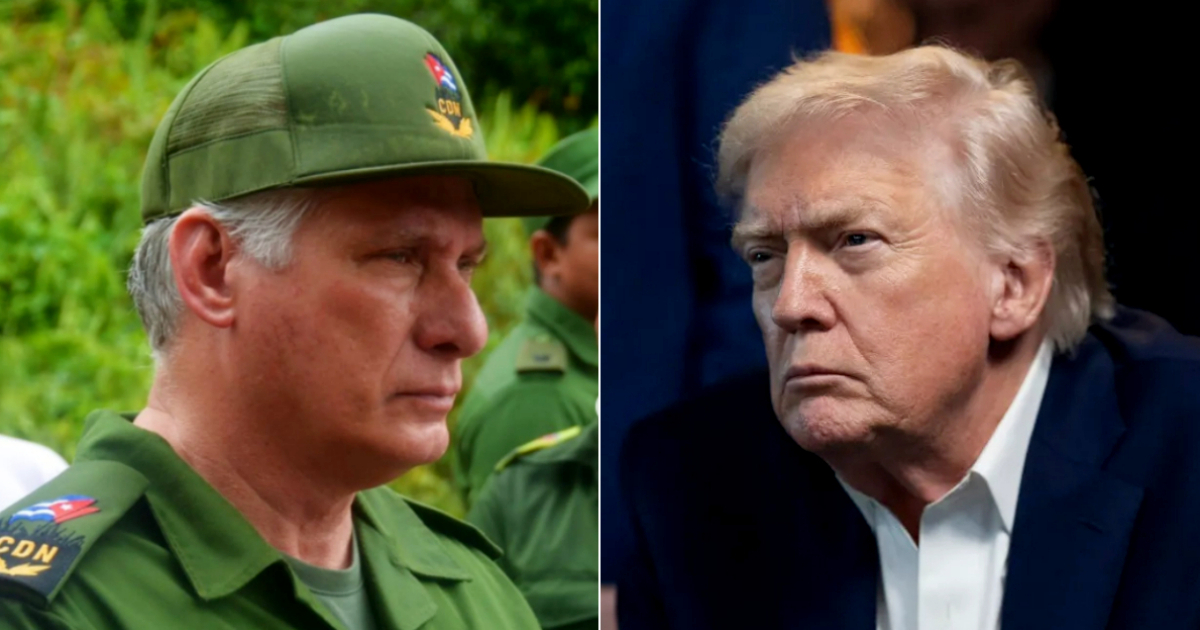
Miguel Díaz-Canel, Cuba's leader, reverted to the classic rhetoric of Castroism this Sunday in reply to recent warnings from former U.S. President Donald Trump. These warnings, along with accusations from several Washington officials, claim that Havana supports security and espionage networks in Venezuela.
Through a series of posts on his X account (formerly Twitter), Díaz-Canel accused the United States of lacking the moral authority to criticize Cuba. He asserted that critics of the regime are "driven by rage over this people's sovereign choice of political model."
"#Cuba is a free, independent, and sovereign nation. No one dictates our actions. Cuba does not attack; it has been attacked by the U.S. for 66 years. We do not threaten; we prepare, ready to defend our homeland to the last drop of blood," the designated leader declared, adopting a combative tone.
These statements emerged following Trump's message on Truth Social, where he claimed that Cuba "has lived off Venezuela's oil and money for years" and urged Havana to "strike a deal before it's too late."
The remarks also respond to recent comments from Republican Congressman Carlos Giménez, who warned that "Cuba's puppet dictator is next," aligning with Washington's increasingly stringent stance, which holds the Cuban regime accountable for its direct involvement in Venezuela's repressive structure.
The Regime's Narrative: Shifting Blame to the U.S.
Facing this scenario, Havana's power hierarchy has united around a narrative designed to shift blame for the crisis onto the United States, using the threat as ideological fuel.
In a manner reminiscent of his political mentor Raúl Castro and Fidel himself, Díaz-Canel employed the old language of "imperialist aggression," "besieged dignity," and "heroic homeland." However, today's context starkly contrasts with the bipolar confrontations of past decades: there is no longer a socialist bloc for support, no subsidies from Moscow, and no oil from Caracas.
Rhetoric vs. Reality: The Fragility of a Regime
Despite attempts to project authority, Díaz-Canel's rhetoric exposed the weakness of a regime that relies more on slogans than on sound arguments.
Claiming that the Cuban people "chose their political model" is a historical distortion: the current system was not freely chosen but imposed by force after Fidel Castro consolidated power and violently eliminated all internal dissent.
Instead of plural elections, Castroism built a single-party model where citizens do not decide but comply. Instead of debate, it established an ideological liturgy that conflates the state, the party, and the nation, arrogating the right to speak "on behalf of the people."
A Narrative of Decline
Díaz-Canel perpetuates this tradition, reiterating the dogma that Cuba is "free and independent," while in reality, the country is mired in poverty, repression, and isolation.
His insistence on blaming the U.S. embargo for all domestic shortcomings—"they should be ashamed to speak," he said—deliberately overlooks the devastating effects of corruption, incompetence, and the state's total economic control.
The "strangulation" he denounces arises not only from Washington but from a system that stifles initiative and criminalizes individual prosperity.
The Futility of Old Slogans
Ultimately, Díaz-Canel's tweets seem more like an exercise in political survival than a strategic response. They attempt to keep alive the heroic narrative of sacrifice at a time when the country faces one of the most critical periods in its recent history.
While Trump adopts a tougher stance and Washington increases pressure, the Cuban regime chooses to entrench itself in past rhetoric. However, slogans like "Homeland or Death" and "To the last drop of blood" no longer inspire fear or admiration but exhaustion.
The dictatorship continues speaking of a "sovereign people" as if its outdated political discourse could explain the current reality... while more Cubans demonstrate daily—through exodus, activism, opposition, and protests—that the nation demands a new social contract, a regime change, and the establishment of a democratic state governed by the rule of law.
Understanding the Cuban Regime's Rhetoric
What are the main accusations against Cuba from the U.S.?
The United States has accused Cuba of maintaining security and espionage networks in Venezuela and of benefiting from Venezuelan oil and financial support.
How does Díaz-Canel justify his position against U.S. criticism?
Díaz-Canel argues that the Cuban people have chosen their political model sovereignly and accuses the U.S. of hypocrisy and aggression towards Cuba for 66 years.
What historical context does Díaz-Canel's rhetoric resemble?
Díaz-Canel’s rhetoric mirrors the old Castroist language of "imperialist aggression" and "besieged dignity," reminiscent of Cold War-era confrontations.