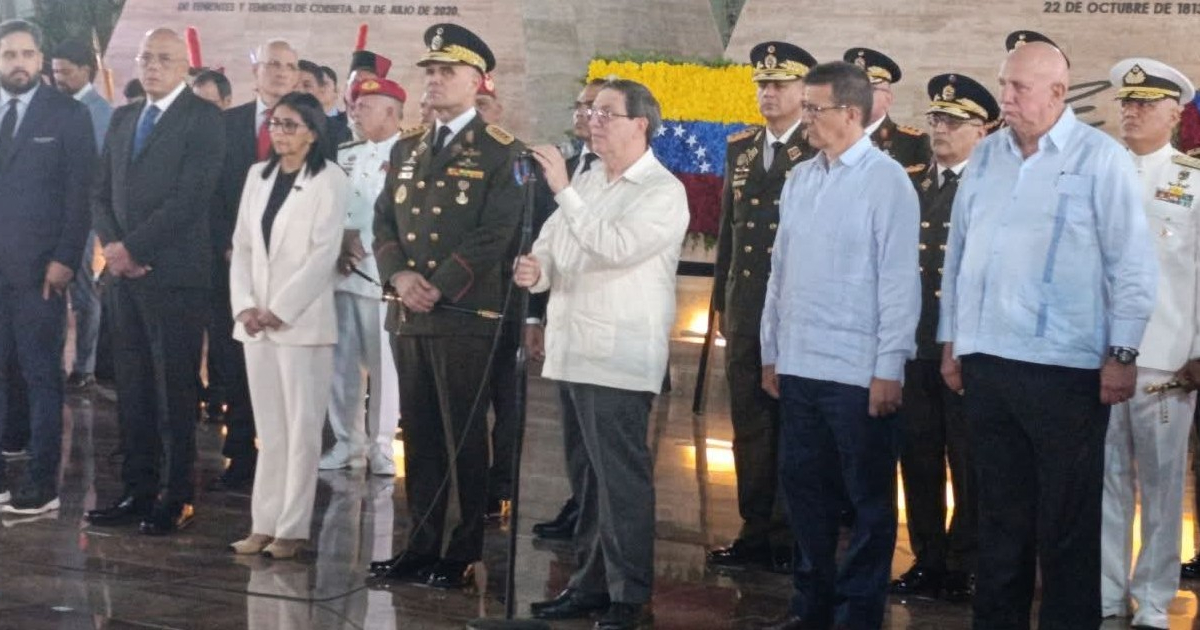
As Venezuela's interim government extends a gesture of tribute and support to the families of those who perished during the U.S. operation that led to the capture of Nicolás Maduro, in Cuba, discontent grows among families who claim to lack clear information or the assurance of being able to recover the remains of their loved ones sent to the Venezuelan nation.
This week, the acting Venezuelan president, Delcy Rodríguez, led an official ceremony honoring those who fell on January 3rd, the day U.S. military forces apprehended Maduro.
In her speech, Rodríguez announced the establishment of a commission to provide comprehensive support to the families of the fallen combatants, promising that the Venezuelan state would not abandon them.
Furthermore, she revealed plans to erect a monument to commemorate those who, according to her narrative, died defending their country against a "foreign aggression."
"A monument to honor our heroes, heroines, and martyrs. Honor and glory to the men and women who died in battle. No one surrendered here; there was a fight!" she emphasized.
Delcy described the deceased as "heroes and heroines of the homeland of Simón Bolívar," explicitly including the 32 Cuban combatants who died during the operation, referring to them as "brothers of Cuba" who fought alongside Venezuelans "as one people."
Meanwhile, in Cuba, following the capture of Maduro, the government released for the first time the identities of the 32 military personnel who died in Caracas.
All belonged to the Revolutionary Armed Forces or the Ministry of the Interior and, according to the official account, were fulfilling "missions at the request of Venezuela's counterpart agencies."
The publication included names, photographs, and ranks, thus acknowledging a Cuban military presence that had been denied by Havana for years.
However, beyond the national mourning declared by Miguel Díaz-Canel, several families have begun to report a scenario marked by a lack of precise information, opacity, and uncertainty about the fate of their relatives' remains.
The case of Captain Adriel Adrián Socarrás Tamayo of the MININT, aged 32, has put a human face on this situation.
Socarrás Tamayo, originally from Yara, Granma, was part of a Matanzas unit and had been deployed in Venezuela for two years. His relatives were unaware that he was part of Maduro's direct security scheme.
After being notified of his passing, authorities informed his family that it would not be possible to repatriate or deliver his body due to the warlike context and alleged operational limitations at Venezuelan airports.
However, the family claims they have not received clear details about the circumstances of his death nor direct confirmation that the body is under official custody.
"No one has taken the bull by the horns or said, 'We have the body, he died this way, he died that way.' We still lack clarity on that," a relative told Martí Noticias.
According to military commanders, the captain reportedly died "shot by shot" while part of Maduro's security perimeter.
Socarrás regularly sent money to his mother and wife from Caracas and had spent his last vacation period in Cuba last year.
The contrast between the two scenarios is stark.
While in Venezuela, the official discourse seeks to demonstrate institutional support for the victims, in Cuba, the families of the fallen lament a limited response characterized by silence and a lack of certainties that prevent them from finding closure.
Both countries operate under authoritarian regimes, yet the disparity in public treatment towards the families of the deceased has exposed a painful gap.
Understanding the Treatment of Fallen Soldiers' Families in Venezuela and Cuba
How is Venezuela supporting the families of fallen combatants?
Venezuela has announced the creation of a commission to provide comprehensive support to the families of fallen combatants and plans to build a monument in their honor.
What issues are Cuban families facing regarding their deceased relatives in Venezuela?
Cuban families are facing a lack of information, uncertainty about the fate of their relatives' remains, and limited response from the government, which prevents them from achieving closure.