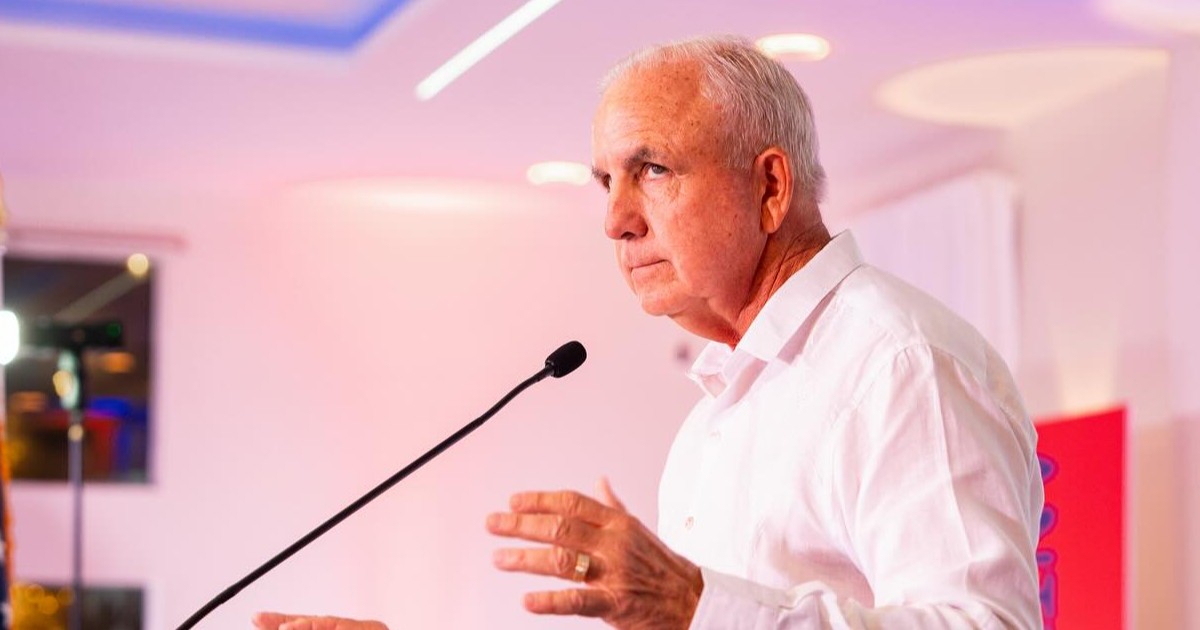
Republican Congressman Carlos A. Gimenez has issued a stern warning to the Mexican government regarding its oil shipments to Cuba, expressing that "in the U.S. Congress, we are profoundly disturbed by Mexico's pathetic subsidies to Cuba's narco-terrorist dictatorship."
On his X account, the Cuban-American legislator criticized President Claudia Sheinbaum's policy, suggesting that instead of gifting oil to a declining regime, it could be better utilized to benefit the Mexican people.
"We want to maintain a strong alliance with our friends in Mexico, but if this troubling trend continues, my colleagues and I will have no qualms about imposing severe consequences on the Mexican government," he cautioned.
In a subsequent tweet, the congressman claimed that the president is overly "generous" with the Mexican people's resources, but that Congress is working to halt these "pathetic gifts that attempt to undermine U.S. policy."
"We are Mexico's largest partner and won't tolerate this great betrayal," he asserted.
Finally, the politician accused Claudia Sheinbaum of seeking enmity with the United States to benefit Cuba's narco-terrorist regime, highlighting the severe consequences for the Mexican people, who face shortages.
Changing Energy Dynamics in Cuba
Gimenez's warnings align with a historical shift in Cuba's energy supply following the capture of Nicolas Maduro. In recent months, Mexico has emerged as the island's primary crude supplier.
Data from Kpler and the Financial Times show that in 2025, Mexico exported an average of 12,284 barrels daily, accounting for about 44% of Cuba's total imports—a 56% increase from the previous year. In contrast, Venezuela provided just 9,528 barrels daily, a 63% decline from 2023.
Pemex, through its subsidiary Gasolinas Bienestar, confirmed average daily shipments of 17,200 barrels of crude and 2,000 of refined products during the first nine months of 2025, valued at nearly $400 million.
President Sheinbaum defended the operation, stating that everything was conducted legally and under pre-existing agreements or humanitarian aid. "We're not sending more oil than has been historically sent. There's no special shipment," Sheinbaum said last Wednesday in response to questions about whether the administration had increased crude volumes to Cuba.
Nevertheless, she acknowledged that Mexico has become a key supplier amid the sharp decline in Venezuelan supplies and Cuba's ongoing energy crisis.
U.S. Alarm Over Oil Shipments
The growing reliance of Cuba on Mexico has raised alarms in Washington. Recently, Senator Marco Rubio described these shipments as a "red line" that could jeopardize bilateral relations, accusing Mexico's administration of "sustaining a criminal dictatorship with oil."
Experts in hemispheric policy suggest the shipments could further strain regional cooperation, especially at a time when the United States holds strategic control over Venezuela following Maduro's capture.
Cuba's Energy Crisis Deepens
Meanwhile, the Cuban regime faces a critical energy situation: frequent blackouts and increasing dependency on external supplies have forced the government to concentrate its crude reserves in vessels operated by GAESA.
Satellite images reveal at least six tankers anchored in Matanzas Bay, with a seventh en route, possibly redistributing strategic reserves to ensure power generation in the coming days.
This scenario highlights the urgency and fragility of Cuba's energy supply, now heavily reliant on Mexican support.
In this context, Gimenez's warnings are more than just rhetoric; they are a direct political and economic message to Mexico, linking oil shipments with the renegotiation of the USMCA, and underscoring that the U.S. administration is closely monitoring any action that could bolster the Cuban regime.
The pressure comes at a time of high geopolitical sensitivity, with the Caribbean island facing its worst energy crisis in decades, and the United States scrutinizing each move that could impact regional stability.
FAQs on U.S.-Mexico Oil Dispute Over Cuba
Why is the U.S. concerned about Mexico's oil shipments to Cuba?
The U.S. is concerned because these shipments are seen as supporting Cuba's regime, which the U.S. views as a threat due to its ties to narco-terrorism. This could undermine U.S. policy and affect regional stability.
What is the significance of Mexico becoming Cuba's main oil supplier?
Mexico's role as Cuba's primary oil supplier marks a significant shift in energy dynamics, especially after the decline of Venezuelan support. This change affects Cuba's energy security and has geopolitical implications.
How does the U.S. Congress plan to respond to Mexico's actions?
Congressman Carlos Gimenez and his colleagues have suggested that if Mexico continues its oil shipments to Cuba, they will not hesitate to impose severe consequences on the Mexican government, potentially impacting trade agreements like the USMCA.