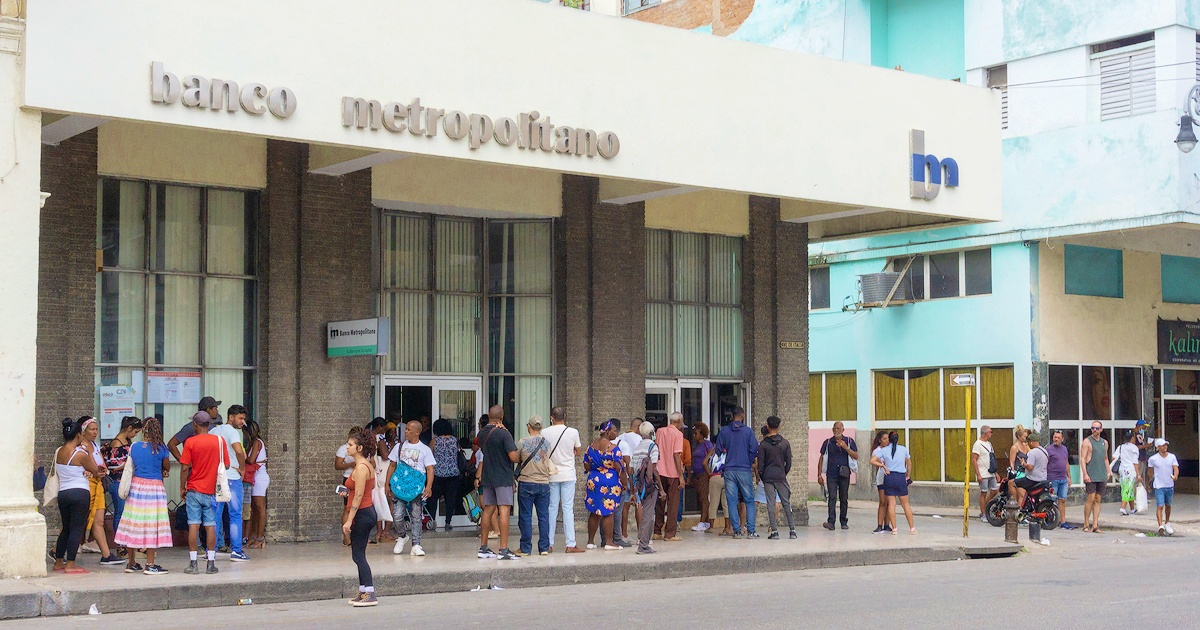
On Friday, Metropolitan Bank announced that its banking channels are now available for small, medium, and micro-enterprises (SMEs) and non-agricultural cooperatives to request foreign currency purchases. This move aligns with the new foreign exchange market framework approved by the Central Bank of Cuba (BCC).
The bank clarified via its Facebook page that these transactions will adhere to the conditions set by the recently sanctioned market design by the BCC.
Currency sales will occur monthly with a cap, calculated at 50% of the average income in the applicant's fiscal account over the past three months, divided by the current exchange rate of Segment III (floating exchange rate).
This process is governed by Resolution 128 of 2025, which details the Foreign Exchange Market Regulations, as well as Circular No. 3 of 2025 from the Central Bank's vice president.
All transactions must be conducted via banking methods, meaning payments in Cuban pesos will be made from the fiscal account, while acquired foreign currencies will be credited to the non-state economic actor's foreign currency account.
Requests should be exclusively processed through the Metropolitan Online service, using the bank's Remote Banking platform.
Prior to any transaction, the bank will perform necessary identity, account, and traceability checks, complying with the control and due diligence requirements outlined in current regulations.
The applicable exchange rates will be those set by the Central Bank of Cuba for Segment III on the transaction day, including authorized commercial margins.
For further inquiries, Metropolitan Bank advised customers to reach out via email or the institution's dedicated phone lines.
The activation of these operations follows the recent enactment of Decree-Law 113/2025, which has introduced a partially institutionalized dollarization of the Cuban economy.
This regulatory package, presented by the government as a "transitional" measure, represents a clear departure from the unsuccessful Monetary Reorganization started in 2021, by officially recognizing a multi-currency system and granting the state authority over who can transact in foreign currencies and under what conditions.
A crucial aspect of this new framework is that access to foreign currency is not envisioned as an open market mechanism but as a managed capacity.
Through tools like the Foreign Currency Access Capacity Allocation (ACAD) and monthly purchase limits, the state maintains control over the flow of dollars and euros.
This introduces structural segmentation between economic actors who can access foreign currency and those confined to the Cuban peso circuit, directly impacting competitiveness, pricing, and economic inequality.
Understanding Cuba's New Foreign Exchange Framework
What are the conditions for SMEs and cooperatives to purchase foreign currency?
SMEs and cooperatives can purchase foreign currency once a month with a maximum amount determined by 50% of their average fiscal account income over the last three months, converted using the Segment III exchange rate.
How does the new framework affect economic actors in Cuba?
The framework creates a division between those who can access foreign currency and those restricted to the Cuban peso, influencing competitiveness, pricing, and economic inequality.
What is the role of the Foreign Currency Access Capacity Allocation (ACAD)?
ACAD is a tool that allows the state to control access to foreign currency, determining who can purchase it and under what conditions, thus managing the flow of dollars and euros.