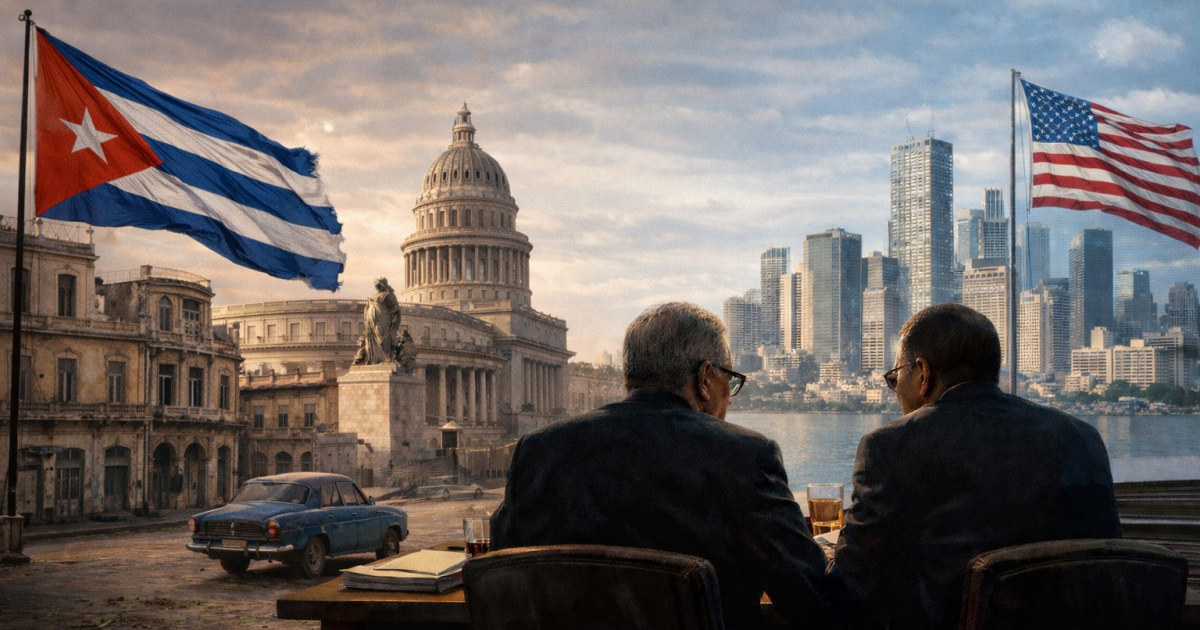
The apprehension of Nicolás Maduro was not merely a warning for Cuba; it signaled the dismantling of the last economic pillar propping up the Cuban regime. It underscored how Havana's room to maneuver is shrinking by the day.
The developments in Venezuela force the Cuban elite to make a strategic decision they have delayed for years: initiate a controlled transition now, or wait for circumstances—or even external force—to impose change.
Regardless of the path, change in Cuba is inevitable. The key difference lies in who will control the process and at what personal cost those in power will pay.
Venezuela: The End of Economic Lifeline
For over two decades, Venezuela served as Cuba's economic safety net. During the prosperous years of Chávez, the subsidized oil flow reached up to 90,000-100,000 barrels daily, covering nearly 90% of Cuba's energy consumption. Even as Venezuelan production collapsed, the trickle continued—around 30,000 barrels a day, crucial for keeping the lights on and transportation running in Cuba.
With Maduro's fall, this lifeline is at risk of ending. No new power in Caracas will bear the political and financial burden of subsidizing Cuba under Washington's sanctions. Alternative suppliers won't risk providing oil on credit or facing the U.S. Treasury Department's consequences for propping up the Cuban regime.
The reality is straightforward: without Venezuelan oil, Cuba faces increased blackouts, reduced electricity generation, decreased production activity, and a rapid deterioration of an already strained infrastructure.
Beyond Energy: A Structural Crisis
The issue extends beyond energy; it's a structural crisis. The Cuban economy has been contracting for years: GDP has fallen by 11% since 2019, official inflation exceeds 15% annually (though the real cost of living has quadrupled since 2020), and over 2.7 million Cubans—about a quarter of the population—have left the country since 2020.
Official projections for 2026 suggest a 1% growth, a figure that fails to compensate for accumulated losses and inspires skepticism even within the island. In this context, losing Venezuelan support isn't just a setback; it's a blow that could hasten an ultimate collapse.
Cuba's Role in Regional Repression
The U.S. military operation against Maduro left another uncomfortable legacy for Havana: confirmed and documented evidence of Cuba's structural role in sustaining the Venezuelan regime. For years, this role was downplayed or ignored by major international media, which preferred to highlight Russia, China, or Iran as strategic allies of Caracas. However, the death of 37 Cuban agents during the Venezuelan operation, officially acknowledged by Diaz-Canel's government, forced a reevaluation of the narrative.
Journalistic investigations and UN missions have documented how two secret agreements signed in 2008 gave Cuba unprecedented access to Venezuelan military and intelligence services. Cuban advisors were integrated into the General Directorate of Military Counterintelligence (DGCIM), the Bolivarian Intelligence Service (SEBIN), the Ministry of Defense, ports, airports, and even the national identification system.
Their mission was not merely to train or advise but to design and operate a surveillance architecture that guaranteed troop loyalty and preemptively suppressed dissent.
The Shift in International Perception
What matters is not just that this happened, but that the world now knows and discusses it, linking it directly to Cuba. Media outlets like Fox News, CNN, Reuters, The New York Times, and Al Jazeera have dedicated extensive reports to explaining Cuba's infiltration in Venezuela. Politicians, analysts, and international organizations have stopped viewing Cuba as a minor player or a sanctions victim, now treating it as an active exporter of repression and a key supporter of regional dictatorships.
This narrative shift has consequences. It hardens the diplomatic climate, reduces the possibility of soft negotiations, and places Havana at the center of Washington's confrontational rhetoric. Marco Rubio, a hardline Cuban-American and Secretary of State, has been clear: "If I were in Havana and part of the government, I'd be worried, at least a little." Donald Trump was even more direct: "Cuba seems ready to fall."
Closing Negotiation Windows
The lesson for the Cuban elite should be clear: transition is inevitable. What remains at stake is how and at what cost. The time to choose is now, while there's still room to negotiate.
A controlled transition, initiated from within and strategically guided, could incorporate elements that protect the interests of those currently in power: selective amnesties for those who haven't committed severe crimes, safe exits into exile with legal guarantees, preservation of part of the accumulated wealth, and even a supervised institutional role during a transition period. Studies on negotiated transitions indicate that when old regime elites facilitate change rather than obstruct it, they maintain influence, avoid massive judicial persecutions, and participate in designing the new political order.
The negotiated transition model requires, at a minimum, four steps: release of all political prisoners (Cuba currently has 1,187, the highest number ever recorded); full legalization of opposition parties and organizations, which exist but are criminalized; genuine economic opening to allow private investment and reactivation of productivity; and a transparent electoral calendar, with international supervision, allowing Cubans to freely choose their future.
In exchange, those facilitating the process could obtain legal protections, non-extradition guarantees, access to foreign accounts, and the possibility of retiring from public life without facing courts or media lynching. That is the difference between a negotiated exit and an imposed collapse: in the former, actors still have the capacity to set conditions; in the latter, they are entirely at the mercy of what others decide to do with them.
But this window has an expiration date. Each month without signs of openness diminishes the regime's negotiating power. The economy will continue deteriorating, protests will keep growing, emigration will further deplete the active population, and international pressure will intensify. At some point, the accumulation of crises will cross a threshold where change is no longer negotiable but inevitable and disorderly.
The Role of the Armed Forces
In any scenario of transition in Cuba, the role of the Revolutionary Armed Forces (FAR) will be crucial. The FAR is not just an army; it is the most powerful institution in the Cuban state, controlling nearly 60% of the active economy (especially foreign currency-generating sectors), having territorial presence throughout the country, monopolizing legitimate use of force, and enjoying a level of institutional prestige far surpassing that of the Communist Party.
Historically, the FAR has demonstrated adaptability. It survived the collapse of the Soviet Union, transformed into economic managers during the Special Period, and has been the main driver of gradual reforms over the past three decades. Analysts agree that in a transition scenario, the FAR is more likely to survive than the party, and could play a key role as order guarantors, dialogue facilitators, and executors of a controlled opening process.
The question is whether the FAR's top commanders recognize that their best strategic option is to facilitate an orderly transition rather than betting on repression and resistance. In the first case, they could preserve their institutional role, avoid a chaotic collapse leaving them without control, and negotiate guarantees for both themselves and the country. In the second case, they risk ending up like Venezuelan military: demoralized, fragmented, and eventually forced to surrender or flee when pressure becomes unsustainable.
Washington's Calculations
Since the Trump administration, the approach to Latin America has revived the Monroe Doctrine, a 19th-century vision considering the Western Hemisphere as an exclusive area of U.S. influence. The operation against Maduro was explicitly framed under this doctrine: Trump declared that "American dominance in the Western Hemisphere will never again be questioned."
Cuba fits perfectly into this narrative. Marco Rubio, architect of Trump's Latin America policy, has made clear he sees Cuba as responsible for sustaining Maduro and views the fall of the Venezuelan regime as an opportunity to weaken Havana. Official rhetoric suggests Washington's patience is limited: if Cuba shows no signs of change, pressure will increase. This pressure could take many forms: tightening sanctions, blocking remittances, energy supply interdiction, supporting internal opposition groups, and even—in an extreme scenario—direct military intervention.
Trump has publicly suggested that he doesn't see a need for intervention in Cuba because "it seems to be falling on its own." But this stance could change if the Cuban crisis leads to unintended consequences for the United States: a new massive migration wave, a power vacuum allowing hostile actors (China, Russia) to enter, or an internal violence episode demanding humanitarian response.
The calculation for the Cuban elite should be obvious: the longer the delay in change, the higher the likelihood that change will be imposed from outside, with all the implications that entails for those currently governing.
Three Paths, One Outcome
Change is coming to Cuba. That's no longer up for debate. The question is how and at what cost. The options are:
First option: a negotiated and controlled transition. Release of political prisoners, legalization of opposition, gradual economic opening, supervised electoral calendar. In return: amnesties for those without serious crimes, safe exits, legal guarantees, partial preservation of assets. Outcome: the country moves toward democracy with less trauma, elites exit protected, and Cuba has a chance for reconstruction without massive vendettas.
Second option: collapse under internal and external pressure. The regime resists, the economy continues declining, protests grow, repression intensifies, Washington increases sanctions, and eventually supports internal forces or intervenes indirectly. Outcome: inevitable change, but chaotic, with high risk of violence, institutional fragmentation, and zero capacity for the elite to negotiate protections.
Third option: direct military intervention. Scenario akin to Venezuela or Panama 1989: special forces operation, capture of key leaders, temporary occupation. Outcome: the country is freed, but regime leaders face U.S. courts, imprisonment without guarantees, total asset confiscation, and global public exposure. Zero negotiation margin, zero protections.
All three paths lead to the same final destination: a Cuba without the current regime. The difference lies in the level of control the Cuban elite retains over the process and the personal cost for having waited too long.
Act Now or Face Consequences
Following Maduro's fall, the public exposure of Cuba's role in Venezuela, the loss of the oil subsidy, and the explicit declarations from Trump and Rubio, the room for maneuver has shrunk dramatically. Each month without signs of openness reduces options. Each week with more blackouts, scarcity, and repression fuels internal pressure. Each day Havana insists on resisting increases the likelihood that the transition will be imposed under the least favorable terms for the current rulers.
Recent history is clear: leaders who bet on holding out to the end rarely succeed, and when they fall, they do so without a safety net. Gaddafi was executed in a ditch. Milošević died in prison. Maduro is in a New York cell awaiting trial. All had opportunities to negotiate dignified exits. All rejected them. All paid the highest price.
Cuba can choose a different path. But only if it acts now, while it's still possible to negotiate. Because the time for change has come. The only question that remains is whether that change will be controlled by those still in power, or imposed by those no longer willing to wait.
Cuba's Transition: Questions and Answers
What was the significance of Nicolás Maduro's capture for Cuba?
The capture of Nicolás Maduro was a critical signal for Cuba, indicating the dismantling of its economic support system and highlighting the diminishing maneuverability of the Cuban regime.
How did Venezuela economically support Cuba?
Venezuela provided Cuba with a steady flow of subsidized oil, which at its peak reached up to 100,000 barrels daily, covering a significant portion of Cuba's energy needs.
What role did Cuba play in the Venezuelan regime?
Cuba played a structural role in supporting the Venezuelan regime, providing advisors and operatives who helped design and implement a surveillance and repression architecture within Venezuela.
What are the potential paths for Cuba's transition?
Cuba faces three potential paths: a negotiated and controlled transition, collapse under pressure, or direct military intervention. Each path has different outcomes and costs for the current regime.