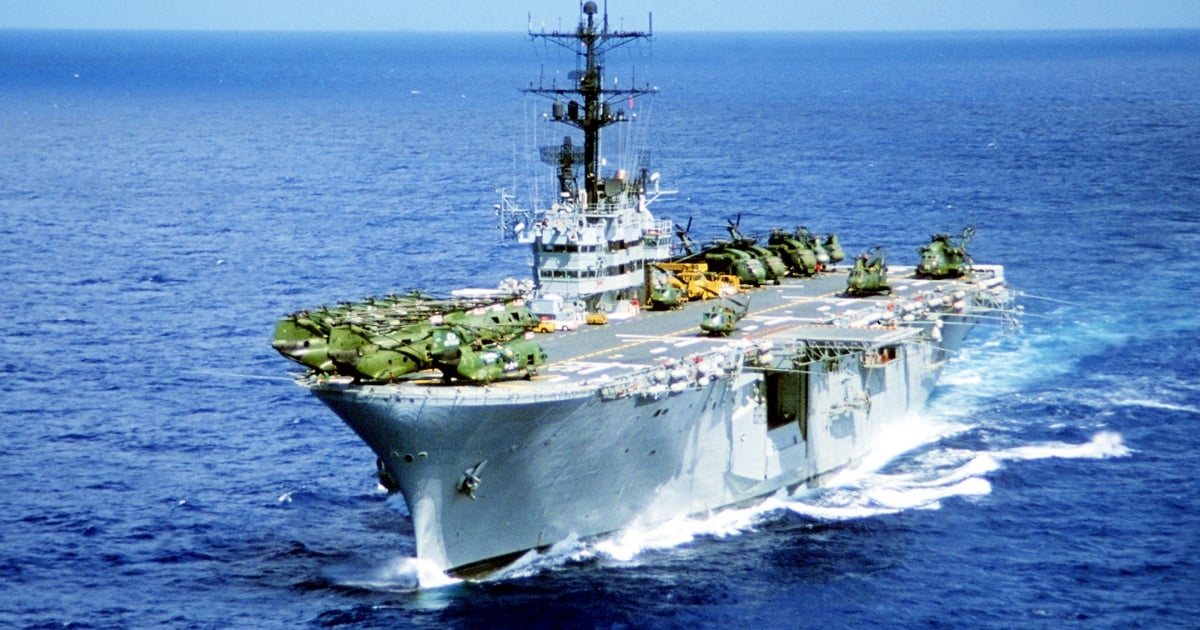
In a remarkable military maneuver, the United States has redeployed part of its naval power just miles from Cuba after capturing former Venezuelan leader Nicolás Maduro. This move signifies a shift in regional dynamics, heightening pressure on the area.
The amphibious ships USS Iwo Jima and USS San Antonio, instrumental in the operation that led to Maduro's capture, have been repositioned to the Atlantic, off Cuba's northern coast.
While the majority of U.S. military forces in the Caribbean have started to withdraw, this strategic placement indicates a new phase: less visible but equally impactful.
The Washington Post recently reported that these vessels remain under the command of U.S. Southern Command and can be relocated as circumstances demand.
This repositioning comes as the Trump administration considers deploying ground troops to Venezuela amidst a tense regional atmosphere, with Cuba—a long-standing ally of Caracas—remaining under close military watch.
The Symbolic Shift: From the Caribbean to North of Cuba
The transfer of the Iwo Jima and San Antonio to the north of Cuba follows closely on the heels of the operation culminating in Maduro's capture by U.S. Army Delta Force members. The former leader was apprehended on Venezuelan soil, flown to the Iwo Jima, and then transported to New York, where he faces federal narcotics charges.
These ships, capable of deploying Marines, aircraft, and heavy military equipment, are under the operational jurisdiction of Southern Command and could swiftly return to the Caribbean if needed.
Analysts interpret the decision to position them near Cuba as a subtle message to the Cuban government, closely linked to the Chavismo movement and deemed a hostile geopolitical actor by Washington.
Maintaining Strategic Control Despite Military Reduction
According to official sources cited by The Washington Post, the U.S. troop presence in the region has decreased by several thousand, leaving approximately 12,000 personnel.
This partial withdrawal indicates a tactical shift following the operation's success but does not suggest a complete pullback or easing of strategic control.
"Any ground deployment would be temporary, focusing on safeguarding oil infrastructure," a Pentagon official noted, emphasizing that Trump has not entirely ruled out a presence on Venezuelan soil.
In addition to the naval movements, some key air resources, such as special operations CV-22s and refueling MC-130s, have been withdrawn. These aircraft supported the operation against Maduro by providing transport and extraction capabilities.
Operation's Scale: Sea and Air Coordination
The scope of the mission was highlighted by General Dan Caine, Joint Chiefs of Staff, who disclosed that more than 150 aircraft were deployed from 20 different locations, including sea-based units, as part of the military strategy.
“Among the fighter jets involved were F-18s and EA-18s,” Caine confirmed, noting that these models were stationed aboard the aircraft carrier USS Gerald R. Ford.
The Iwo Jima and Gerald R. Ford were pivotal in the operation, as confirmed by senior Pentagon officials.
Naval Encirclement and Military Build-Up
The military build-up commenced during the summer when the Iwo Jima was deployed with Marines from the 22nd Marine Expeditionary Unit, alongside the San Antonio and USS Fort Lauderdale.
In October, the presence intensified with the arrival of the Gerald R. Ford, redirected from Europe to the Caribbean.
Simultaneously, President Donald Trump ramped up his rhetoric and operational stance, announcing a total blockade of sanctioned Venezuelan oil tankers and authorizing the interception of vessels at sea.
“Venezuela is completely surrounded by the largest naval force ever assembled in South American history,” Trump claimed on social media, although experts considered this an overstatement.
Nevertheless, several real interceptions were confirmed, including two tankers seized this week.
Adapting Military Presence to Regional Dynamics
Though the most visible operational phase has ended, the relocation north of Cuba underscores that the U.S. maintains an active response capability in the Caribbean.
The proximity to Cuba, a symbolic center of Washington's historical opposition in Latin America, suggests tight surveillance in a region where balances can shift abruptly.
“Their presence under Southern Command near Cuba is more than a sign of withdrawal—it’s a quiet warning,” a military analyst told the cited media.
With regional tensions still high and uncertainty surrounding the Trump administration's next moves in Venezuela, the continued presence of these military assets near Cuban shores reinforces the notion that the Caribbean remains a priority on the U.S. national security agenda.
Key Questions About U.S. Naval Movements and Regional Tensions
Why were the USS Iwo Jima and USS San Antonio relocated near Cuba?
The relocation of these ships to the north of Cuba is a strategic maneuver to maintain a presence in the region and send a message to Cuba, a known ally of Venezuela and seen as a geopolitical adversary by the U.S.
What implications does the U.S. withdrawal of some troops have on regional security?
While the U.S. has reduced its troop presence, this does not indicate a full withdrawal. The remaining forces are strategically placed to ensure continued surveillance and readiness to respond to regional tensions.
How does the capture of Nicolás Maduro affect U.S.-Cuba relations?
Maduro's capture is likely to strain relations further, as Cuba has been a key supporter of his regime. The U.S. military presence close to Cuba serves as a reminder of ongoing tensions and the potential for geopolitical conflict.