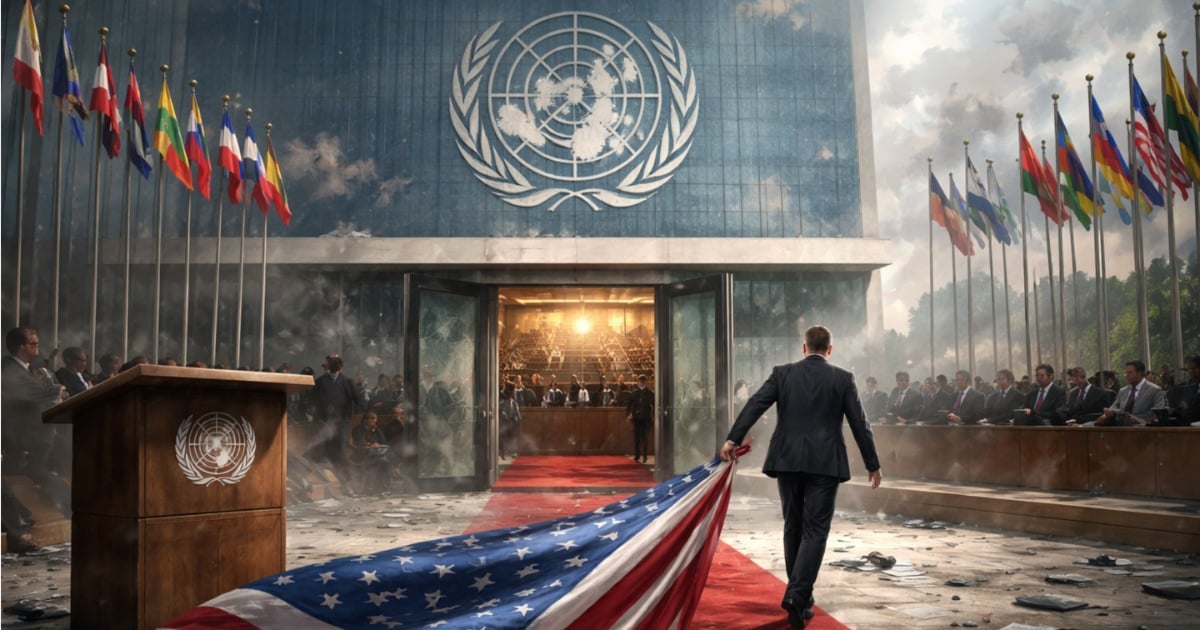
On Wednesday, President Donald J. Trump signed a presidential memorandum directing the United States to exit 66 international organizations, a move that has sent shockwaves globally.
The memorandum specifies that these organizations "no longer serve American interests." It urges federal agencies to take "immediate action" to facilitate the withdrawal "as soon as possible." This decision stems from a review previously ordered by the White House.
Among the 66 organizations, 35 are not affiliated with the United Nations, while 31 are entities within the UN system.
According to the document, "Many of these bodies advocate for radical climate policies, global governance, and ideological programs that conflict with U.S. sovereignty and economic strength." The memorandum continues, stating, "American taxpayers have poured billions into these organizations with minimal outcomes, often facing criticism of U.S. policies while these groups push agendas counter to our values or squander taxpayer money without achieving tangible results."
The directive stems from Executive Order 14199, issued on February 4, 2025, which tasked the Secretary of State, in consultation with the U.S. representative to the UN, to evaluate all intergovernmental international organizations and treaties in which the U.S. participates, identifying those "contrary" to national interests.
Trump has reviewed the Secretary of State's report and, after discussions with his cabinet, decided that continuing participation or support for the listed entities is against national interests.
For UN-affiliated entities, the withdrawal involves ceasing participation or funding "as permitted by law." The document notes that the review of "other conclusions" by the Secretary of State is "ongoing."
The memorandum lists 35 non-UN organizations, including the Intergovernmental Panel on Climate Change (IPCC), the International Renewable Energy Agency (IRENA), the International Solar Alliance, the International Union for Conservation of Nature (IUCN), the Global Forum on Migration and Development, the Global Counterterrorism Forum, the International Centre for the Study of the Preservation and Restoration of Cultural Property, and the Venice Commission of the Council of Europe, among other platforms and agreements enumerated in the document.
The list of 31 UN system entities from which the U.S. will withdraw includes components of the Department of Economic and Social Affairs, various regional commissions of ECOSOC, the International Law Commission, the International Trade Center, offices of the Secretary-General related to children and armed conflict and sexual violence in conflict. Also included are the Peacebuilding Commission and its fund, the Alliance of Civilizations, UNCTAD, the United Nations Democracy Fund, UN Women, the United Nations Framework Convention on Climate Change, UN-Habitat, the UN Population Fund, the Conventional Arms Register, UN-Water, and the United Nations University, among others detailed in the list.
For implementation, the memorandum instructs the Secretary of State to issue the necessary "additional guidance" to agencies and authorizes the Secretary to publish the memorandum in the Federal Register.
The text emphasizes that the actions will comply with existing laws and be subject to the availability of funds, noting that it does not create enforceable rights against the government.
This decision emerges amid high diplomatic tensions.
Just a day before, the United States appeared before the UN Security Council to refute accusations of "war" or "occupation" following the detention of Nicolás Maduro, in a session marked by clashes with Russia and China.
The U.S. ambassador to the UN, Mike Waltz, stated there was no "war" against Venezuela nor occupation, but rather a "police operation" targeting a figure Washington deems illegitimate and linked to narcotics trafficking.
Secretary of State Marco Rubio denied that the U.S. is "at war with Venezuela," describing the action as a "legal and limited" "law enforcement operation" related to drug trafficking and organized crime charges.
Understanding Trump's Withdrawal from International Organizations
Why did Trump decide to withdraw from these organizations?
President Trump believes these organizations no longer align with American interests and often promote policies that conflict with U.S. sovereignty and economic strength.
What is the impact of leaving UN-affiliated entities?
The withdrawal may result in the U.S. ceasing participation and funding, potentially affecting international cooperation on various issues such as climate change and human rights.
How does this decision relate to U.S. foreign policy?
This decision reflects a shift towards prioritizing national interests and reducing involvement in international bodies deemed counterproductive to U.S. goals.