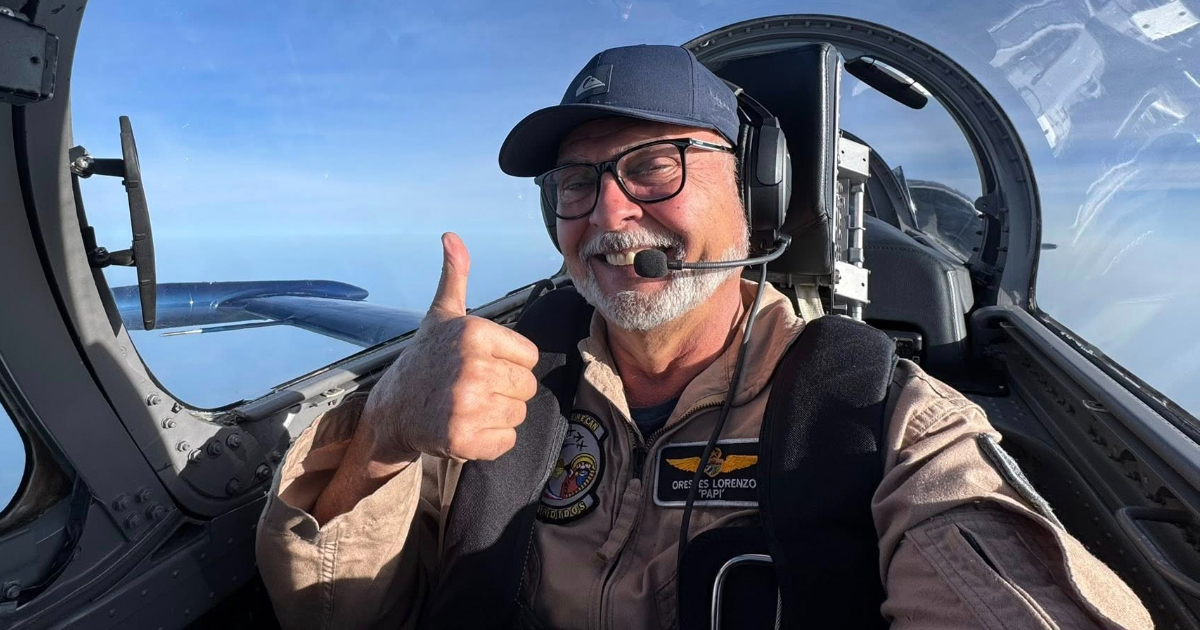
Orestes Lorenzo Pérez, a former Cuban pilot known for his daring escape from Cuba and his subsequent return to rescue his family in the 1990s, has issued a scathing critique concerning the 32 Cuban soldiers who perished in Venezuela during a U.S. operation that ended with Nicolás Maduro's capture.
Speaking from Miami, Lorenzo argued that the fallen soldiers were not trained for genuine combat situations but rather for suppressing and controlling unarmed civilians.
Although some analysts have suggested that the Cuban military was unprepared for a mission to remove Maduro, Lorenzo contends that this viewpoint is incomplete.
He emphasized that the U.S. military incursion was "a foreseen event" and did not catch the soldiers guarding the dictator off guard. "They were well aware that it could happen at any time. There was no strategic surprise," he highlighted on his Facebook page.
In Lorenzo's view, although the Cuban and Venezuelan soldiers anticipated the attack, they lacked the necessary training for such combat scenarios, which partially explains the heavy casualties.
The former officer elaborated that the Cuban army's training focuses on repressing defenseless and disorganized adversaries—such as protesters or dissenters—and intimidating with aggressive force demonstrations in public settings.
"But facing a well-armed and organized enemy? Nah, they never learned that. And they paid with their lives for it," he concluded.
Lorenzo's critique directly targets the Cuban forces' inability to conduct conventional military operations outside their borders, questioning the actual purpose of these soldiers sent to Venezuela: rather than being trained combat troops, they were forces intended to uphold allied regimes and maintain internal order.
The deaths of so many Cuban soldiers in a military operation expose the structural and doctrinal weaknesses of the Castro regime's military system.
Simultaneously, Lorenzo's stance resonates with the discontent of many regime critics who highlight how human resources—and even the lives of its soldiers—are used to support allied governments instead of addressing Cuba's internal needs.
His analysis gains gravity considering his personal experience with the dictatorship: Lorenzo defected from the Cuban Air Force in 1991 in a MiG-23BN and later secretly returned to Cuba to rescue his family, a high-risk operation that was ultimately successful.
The 32 deceased Cuban soldiers were officially acknowledged by Havana as members of the Revolutionary Armed Forces (FAR) and the Ministry of the Interior (MININT), who were "on missions at the request of Venezuelan counterparts" during the U.S. operation in Caracas on January 3rd.
The publication of their names and photos marked a significant shift in the official narrative, which for years had denied the presence of Cuban forces in overseas security operations.
The list included high-ranking officers, captains, lieutenants, and soldiers aged between 26 and 67, among them two colonels and three majors.
According to MININT, the Cubans "fell in direct combat or as a result of bombings" and were presented as "heroes."
Leader Miguel Díaz-Canel declared two days of national mourning, suspending festive activities and lowering flags to half-mast in tribute to the deceased.
Orestes Lorenzo's criticism highlights a deep contradiction: while the Cuban government glorifies the sacrifice of its soldiers in a foreign land, these forces lack the preparation for conventional armed conflicts. This reveals the priorities of a regime that sends its citizens to defend foreign dictators while its own population faces shortages and repression at home.
Understanding the Cuban Military's Role in Venezuela
What were the Cuban soldiers doing in Venezuela?
The Cuban soldiers were officially recognized as being on missions requested by Venezuelan counterparts, likely to support the Maduro regime.
Why does Orestes Lorenzo criticize the Cuban military's training?
Lorenzo criticizes the Cuban military's training for focusing on suppressing unarmed civilians rather than preparing for real combat situations, leading to unpreparedness in conventional military operations.
How did the Cuban government respond to the soldiers' deaths?
The Cuban government declared two days of national mourning, suspended festive activities, and lowered flags to half-mast in honor of the deceased soldiers.