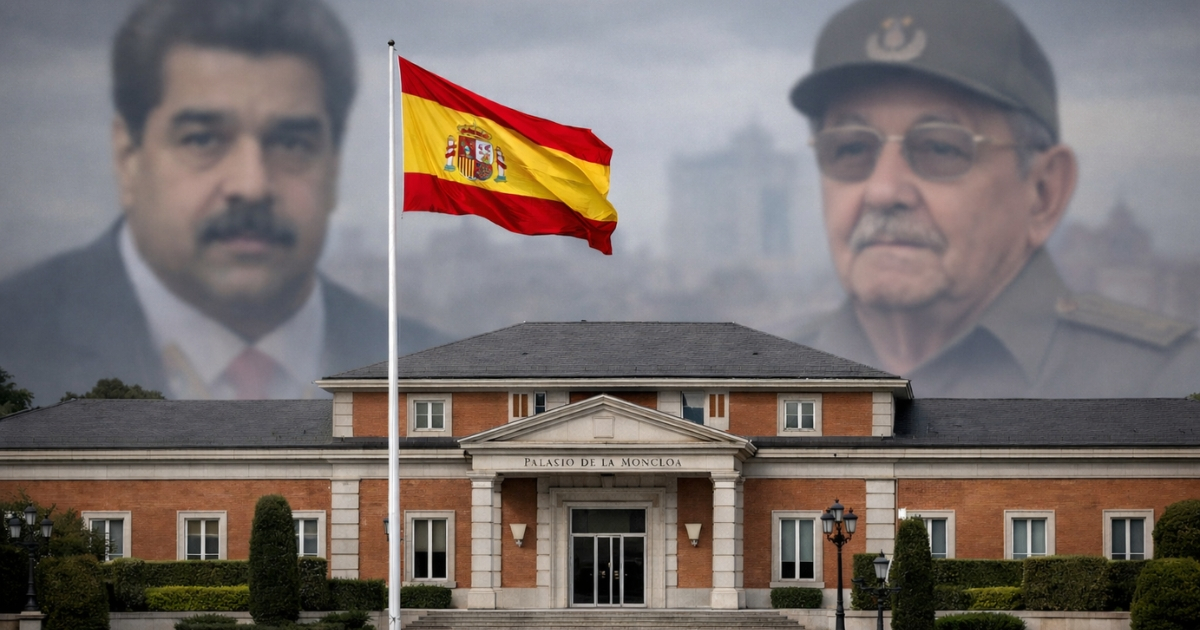
In January 2026, a momentous event unfolded: the apprehension of Nicolás Maduro by U.S. forces, ordered by President Donald Trump. This operation, named “Absolute Resolution,” marked the end of over two decades of Chavismo, heralding a new era for Latin America. Trump declared that “the Cuban dictatorship is ready to fall,” confident that Havana, deprived of Venezuelan oil, would collapse under its own weight.
While millions of Cubans and Venezuelans celebrated with hope, Spain’s official reaction was one of distant disapproval. Pedro Sánchez’s government condemned the U.S. operation for “violating international law” and warned of “regional instability risks.” Rather than welcoming the end of a dictatorship, Madrid chose to criticize Washington. This response reignited an uncomfortable question: what has Spain truly done for the freedom of Cuba and Venezuela over the past three decades?
Business First: Prioritizing Interests Over Freedom
The straightforward and painful answer is: very little, if anything. For two decades, Spain has prioritized business and diplomatic appeasement over the defense of democracy. Meanwhile, Cubans and Venezuelans have paid the price with repression, exile, and poverty.
Over the last thirty years, Spain has maintained an ambiguous relationship with the regimes in Havana and Caracas. In theory, it defends human rights and democracy; in practice, it safeguards investments, credits, and contracts. The policy has been clear: business first, freedom later.
In Cuba, Spanish companies dominate the tourism sector. Hotel chains manage dozens of state-owned establishments, sharing a portion of the revenue. This model benefits the companies but also financially sustains the regime. Despite accumulated losses and millions in unpaid debts, Spanish companies remain, trusting in promises rarely fulfilled. Not even the currency blockade imposed by the Cuban government has prompted a massive withdrawal. On the contrary, Spain continues sending business delegations and forgiving debts that ease the regime’s financial chokehold.
In Venezuela, the situation mirrors. Major Spanish corporations stayed for years, hoping to recover debts or investments. Repsol, banks, airlines, and public insurers endured the economic deterioration under Chavismo, hoping not to “lose position” in case of political change. This business interest shaped Spain’s foreign policy, opting for caution and silence to secure billions of euros.
The paradox is clear: while the United States tightened sanctions and exerted economic pressure on the Maduro and Castro regimes, Spain preserved the commercial status quo. In the name of “economic diplomacy,” it ended up, albeit indirectly, supporting two dictatorships. The result was the same: extending their artificial lifespan at the cost of their peoples’ suffering.
Diplomatic Whitewashing: The Art of Looking the Other Way
The second major constant in Spain’s policy toward Cuba and Venezuela has been diplomatic whitewashing. Instead of firmly denouncing human rights violations, Madrid favored a discourse of dialogue and mediation that in practice legitimized the regimes.
In the 1990s, Spain pushed for a European stance that conditioned relations with Cuba on democratic improvements. However, since the mid-2000s, that firmness waned. Socialist governments opted for unconditional engagement and courtesy visits, replacing political pressure with symbolic gestures. The release of Cuban political prisoners exiled to Spain was presented as a humanitarian advance, but it relieved Havana of its most visible opposition without relinquishing power.
In 2019, the Spanish Royals’ state visit to Havana sealed that normalization. There were no meetings with dissidents or support gestures for civil society. The Castro regime was treated as a legitimate partner, just as internal repression reached unprecedented levels. The same occurred with Venezuela: while the international community hardened its stance, Spain chose “political dialogue,” with José Luis Rodríguez Zapatero as an unofficial and controversial mediator.
Zapatero positioned himself as a facilitator of negotiations between Chavismo and the opposition, but his neutrality was questioned even by Venezuelan democrats. His closeness to the regime and frequent visits to Caracas earned him a reputation as a Maduro ally. Spain, by backing his figure and maintaining “cordial” relations with the Chavista circle, lost credibility among freedom defenders in the region.
PSOE and PP: A Shared Responsibility
It would be simplistic to blame a single party entirely. The responsibility for this ambiguous policy lies with both the socialist and popular governments, albeit with nuances.
The PSOE governments, first with Zapatero and then with Pedro Sánchez, favored diplomatic engagement and “good offices.” Zapatero advanced the idea that conversing with dictators was more useful than isolating them; Sánchez inherited this, adapting it to his pragmatic style. Both downplayed abuses in the name of dialogue and cooperation. Under their management, Spain became a predictable partner for Havana and Caracas, never discomforting, always willing to negotiate.
The Popular Party had moments of greater firmness, especially during José María Aznar’s government, when Spain led the so-called “common position” of the European Union towards Cuba. But that line faded over time. Mariano Rajoy maintained a low profile regarding Latin America: he neither pressured the Cuban regime nor pushed for an international coalition to support the Venezuelan opposition. Economic prudence and lack of strategic interest did the rest. Only from the opposition have PP leaders reclaimed a firm discourse in defense of freedom, but without translating it into state policy.
In summary, both PSOE and PP have been prisoners of business interests and conservative diplomacy that avoids conflicts. In practice, neither has promoted a sustained policy of supporting democracy in Cuba and Venezuela. Both shared an unspoken premise: it’s better not to disturb dictators if money is involved.
The Double Standard of the Spanish Left
Beyond governments, a significant part of the Spanish left has shown a double standard towards Latin American dictatorships. While it condemns human rights violations in conservative countries, it remains silent when the culprits are ideologically aligned regimes.
Radical left parties and movements have openly defended the governments of Havana and Caracas, justifying their abuses as “resistance to imperialism.” Some leaders even called for Maduro’s release after his capture, labeling the operation as “U.S. aggression.” This ideological blindness reveals a moral issue: confusing political loyalty with defending freedom.
Many progressive intellectuals and artists have also maintained an indulgent attitude towards Cuba and Venezuela, relying on supposed past social achievements or the embargo narrative. For decades, it was considered politically incorrect to criticize the Cuban Revolution, and even today, many prefer silence over admitting that the socialist model has failed. This romantic sympathy has served as cultural cover for political tepidity.
The result is a divided Spain: one part, especially the right and the Latin American diaspora, demands firmness against the Castro and Maduro regimes; another part, the ideological left, remains trapped in a 1970s discourse. This internal fracture has prevented a coherent and morally clear foreign policy.
The Contrast with U.S. Action
While Spain debated over diplomacy and legality, others acted. Washington, with Donald Trump back in the White House and Marco Rubio leading the State Department, chose a strategy of strength against the regimes in Caracas and Havana. Its intervention in Venezuela, beyond controversies, achieved what two decades of European dialogue could not: opening an unprecedented chapter that puts the Venezuelan dictatorship on a countdown.
Maduro's downfall exposed the fragility of the alliance system sustaining Castroism. Without Venezuelan oil or Chavismo's financial support, Cuba faces its worst economic crisis in half a century. Trump bluntly stated: “The Island is falling on its own.” That may be so. But if Cuba finally gains freedom, it will not be thanks to Spain.
The Spanish government, instead of supporting this process, has persisted in condemning the U.S. operation. Its priority seems to be defending formal legality, even if that means preserving the privileges of dictatorships. However, history doesn’t reward neutrality in the face of abuse.
A Lesson for the Future
After thirty years of omissions, Spain has an opportunity for redemption. Cuba is on the brink of collapse, and Venezuela is beginning an uncertain transition. It’s time for Spain to reclaim its moral voice in Latin America, not as a complacent partner of exhausted regimes but as an ally of peoples demanding freedom.
To achieve this, it must break with economic calculation diplomacy and adopt a foreign policy based on principles. This involves conditioning aid, credits, and cooperation on real democratic reforms; supporting Cuban and Venezuelan civil society; and abandoning the tepidity characterizing the last two decades.
History will judge Spain by its actions, not its words. When Cuba and Venezuela regain freedom—and that day will come—many will attempt to be “in the picture” of the new era. But the peoples will remember who stood by them when they needed it most. And, for now, Spain is on the list of the absent.
Spain’s Role in Cuba and Venezuela’s Quest for Freedom
What has been Spain's economic involvement with Cuba and Venezuela?
Spain has maintained significant business interests in both Cuba and Venezuela. In Cuba, Spanish companies have dominated the tourism sector, while in Venezuela, major Spanish corporations have persisted through economic turmoil to protect their investments.
How has Spain's diplomatic approach differed from that of the United States?
While the United States has opted for a strategy of sanctions and economic pressure, Spain has favored a diplomatic approach focused on dialogue and maintaining business relations, often at the cost of not taking a firm stance against human rights violations.
What are the criticisms of Spain's foreign policy towards Cuba and Venezuela?
Critics argue that Spain's foreign policy has prioritized economic interests over democratic principles, indirectly supporting dictatorial regimes through business ties and diplomatic whitewashing instead of condemning human rights abuses.