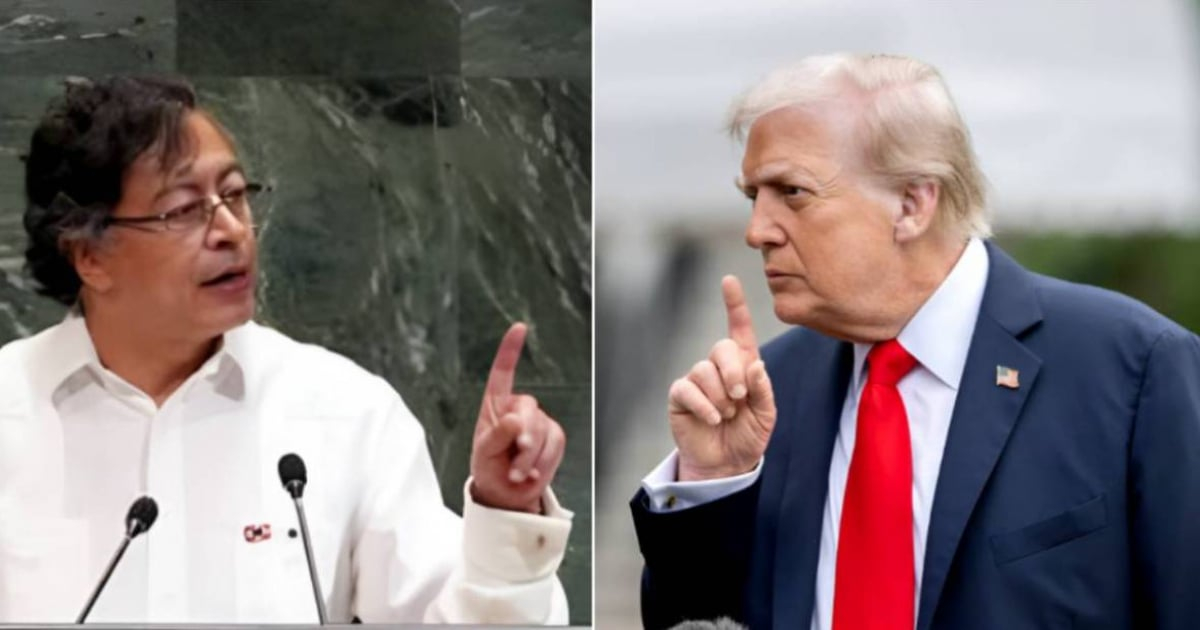
Colombian President Gustavo Petro has stirred controversy with his assertion that he might "take up arms" once more to protect the nation's sovereignty against what he described as the "illegitimate" threats from U.S. President Donald Trump. Petro's statement was part of an extensive post shared on the social media platform X early Monday morning.
In a bold declaration, Petro, a former guerilla member of the M-19 movement, stated, "I swore not to wield a weapon again since the 1989 peace pact, but for my country, I will take up arms I don't wish to hold." His message intertwined political warnings, historical references, and direct criticisms of Washington.
Context of Trump's Remarks and Petro's Response
The tension escalated following Trump's comments on Sunday, where he claimed that Colombia, much like Venezuela, is "very sick," and accused Petro of leading a nation primarily involved in cocaine production and trafficking to the United States. In response, Petro dismissed these remarks as an "illegitimate threat," defending the legitimacy of his presidency and the country's institutions.
Petro further rejected statements made by Secretary of State Marco Rubio, accusing him of relying on false information provided by Colombian sectors allegedly tied to the mafia through family or commercial connections.
Actions and Accusations Against Colombian Intelligence
Within this contentious environment, Petro announced the dismissal of several police intelligence colonels who were allegedly supplying incorrect information against the Colombian state. In his message, he reminded that under the 1991 Constitution — a product of the peace process involving M-19 — the president serves as the supreme commander of the Military Forces and Police. He claimed personal leadership in significant anti-narcotics operations.
Among these, he noted the largest cocaine seizure in history, efforts to halt the expansion of coca plantations, and a voluntary substitution plan that, according to him, has reached 30,000 hectares.
Military Operations and Humanitarian Concerns
Petro defended the bombings ordered during his administration, asserting they adhered to international humanitarian law, and cautioned that criminal groups recruit minors as shields to prevent attacks. "If they bomb without adequate intelligence, they will kill children; if they bomb farmers, they will turn into guerrillas," he warned.
In one of the most charged parts of his message, Petro issued a stark warning: "If they arrest the president whom a significant portion of my people want and respect, they will unleash the popular jaguar."
Defending Sovereignty and Counteracting Accusations
The president affirmed he has ordered the public forces to defend national sovereignty, cautioning that any commander who "prefers the flag of the United States over Colombia's" must resign. He urged the populace to "defend the president," suggesting that the way to do so is to "take power in all municipalities," instructing the public forces not to fire on the people "but against the invader."
Petro rebuffed accusations of drug trafficking, declaring himself neither illegitimate nor corrupt, and emphasized that his sole asset is his family home, still being paid for with his presidential salary. "I am not greedy," he wrote, noting that his bank statements have been made public.
The Colombian president's statements have intensified diplomatic tensions with the United States amid a regional backdrop already affected by recent U.S. actions in Venezuela to capture dictator Nicolás Maduro and Trump's stern warnings to several Latin American nations, including Mexico and Colombia.
Key Questions About Colombia-U.S. Relations
What prompted Gustavo Petro's comments about taking up arms?
Petro's remarks were in response to statements by Donald Trump, who accused Colombia of being heavily involved in cocaine production and trafficking, which Petro viewed as illegitimate threats against Colombia's sovereignty.
How has Petro justified the military operations during his presidency?
Petro has defended the military operations by stating they are conducted following international humanitarian law, and he highlighted significant successes in anti-narcotics operations as evidence of their effectiveness.