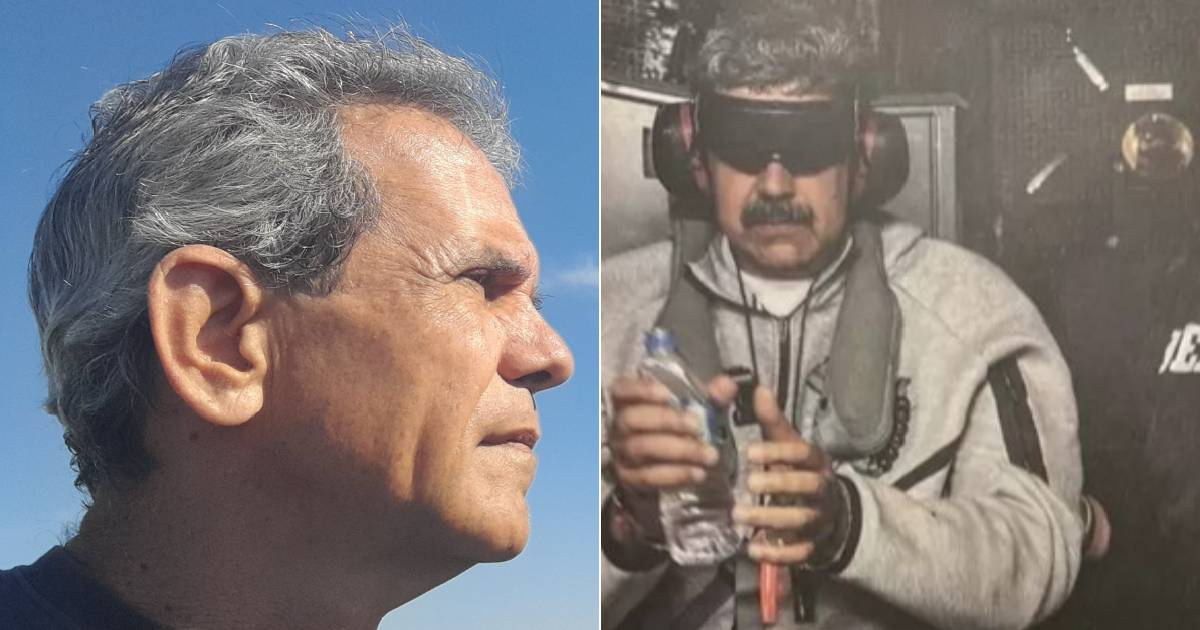
Cuban author Jorge Fernández Era ignited a heated discussion among Cubans with his recent commentary on the capture of Venezuelan President Nicolás Maduro by U.S. forces this past Saturday. He denounced the operation as a terrorist act and criticized the idea of a foreign power determining Venezuela's fate.
In a Facebook post titled "Quick Ink," Fernández Era condemned the U.S. military operation that led to Maduro's capture, describing it as a terrorist act by a government acting as the "master of the world."
The writer argued that regardless of Maduro's status as a dictator, it should be up to Venezuelans to decide their political future without foreign intervention.
Fernández Era pointed out that this is not a new precedent but rather a historical pattern of U.S. imperial power. He challenged the heroic narrative surrounding the operation.
He noted the lack of a visible military response from Venezuelan forces and the ease of the capture as evidence of an action that was both unpunished and deeply humiliating for the country's sovereignty.
His post also criticized what he termed as irresponsible propaganda about a "brave and unyielding people," warning against legitimizing external violence under the pretext of toppling dictatorships.
"You can't polish the boot that might one day crush you," he concluded.
Similarly, Cuban comedian Ulises Toirac criticized the armed action that resulted in Maduro's capture and transfer to New York.
The reactions were swift and varied. Many commentators disagreed sharply, arguing that expecting an unarmed and oppressed populace to overthrow a dictatorship on their own is an ethically abstract stance, disconnected from the realities of totalitarian regimes.
Several users reminded that in Venezuela, all internal avenues—elections, protests, institutions—had been closed, with the opposition being jailed, exiled, or silenced.
Others defended the intervention as the only viable option after years of repression, electoral fraud, and systematic human rights abuses, viewing Maduro's capture not as an invasion, but as liberation.
Some even took a pragmatically open stance: the alternative, they argued, was the indefinite continuation of the dictatorship.
There were also voices that, while not agreeing with Fernández Era, defended his right to express a dissenting opinion, emphasizing that a future democratic Cuba will need to learn to coexist with opposing views without moral lynching.
This exchange revealed a deep divide in the Cuban debate, between the principled rejection of any foreign intervention and the belief that some regimes can only be toppled by force.
Beyond Venezuela, this discussion inevitably brings up the uncomfortable question that many have also considered in the Cuban context itself.
Key Questions on Venezuela's Political Crisis
Why did Fernández Era describe the U.S. operation as a terrorist act?
Fernández Era labeled the operation as a terrorist act because he sees it as foreign interference in Venezuela's sovereignty, carried out by a government acting as if it controls global affairs.
What was the reaction to Fernández Era's statement among Cubans?
The statement sparked a heated debate, with some supporting the foreign intervention as necessary and others criticizing it as an ethical and practical overreach.
How do critics view the idea of foreign intervention in Venezuela?
Critics argue that expecting Venezuelans to overthrow a dictatorship without external help is unrealistic, and they see intervention as the only way to end the regime's oppressive rule.
What are the implications for Cuba in this debate?
The debate reflects broader questions about Cuba's future, suggesting that any move toward democracy will need to address how to handle opposing views and the role of foreign influence.