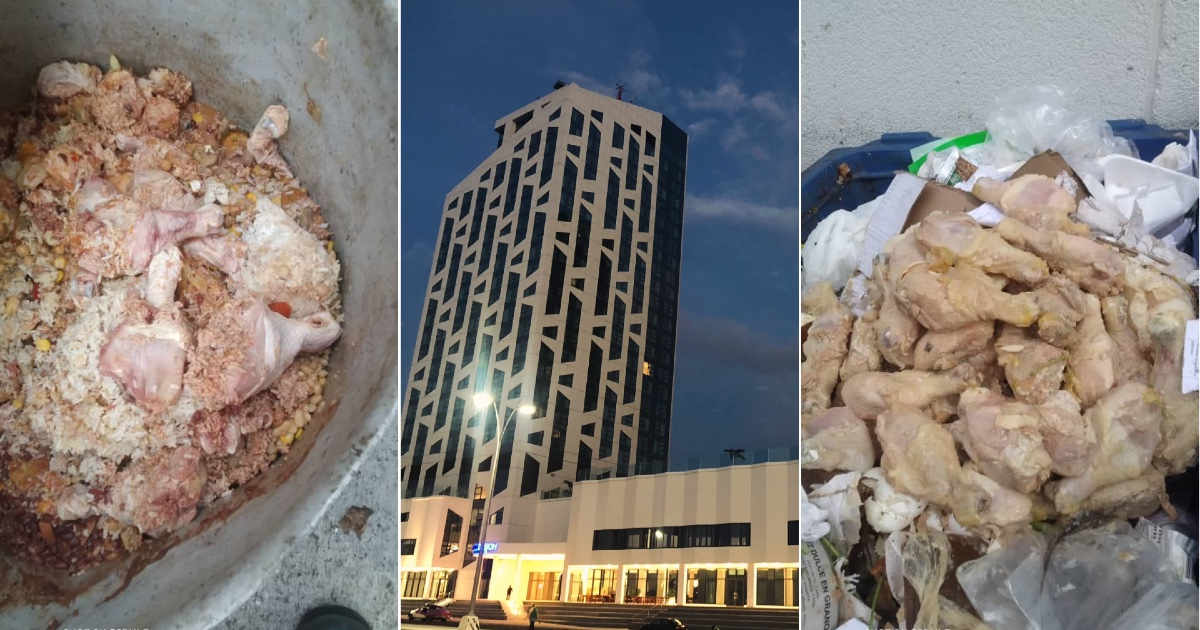
A former employee of the Grand Aston Havana hotel, which is under the military-controlled Grupo de Administración Empresarial S.A (GAESA), has taken to social media to expose the large-scale food waste occurring at this tourist facility. This revelation comes at a time when millions of Cubans are grappling with an unprecedented food crisis.
The images shared are a direct response to a recent controversy on social media, ignited by a government official's comments about Cubans consuming foods "not native to the country," such as rice and potatoes. The former worker responded, "After hearing what that doctor said about rice and potatoes and listening to the so-called professor from Maxlenin, I present this. It's shameful what's happening in a hotel where I used to work here in Havana."
Posted in the CubaAlerts group, the images depict trays and containers filled with fried chicken, rice, eggs, and other seemingly edible foods discarded in the trash. The whistleblower claimed such scenes are common, highlighting that "they prefer to throw away the food rather than allow workers to take it home."
Public Outcry Over Hotel Food Waste
"This happens at the Grand Aston Havana hotel, where I worked. Look at how they waste food while an entire nation suffers from hunger. I am at a loss for words; I am outraged," wrote the ex-employee in a post that quickly went viral, accumulating hundreds of comments filled with anger and sorrow.
Social media users reacted with fury to the images. "This cries out to the heavens while the people starve," one user commented. Others pointed out that such practices aren't limited to one hotel but are widespread across the country, as echoed in numerous comments.
"In many hotels, they check the workers' bags before they leave to ensure they don't take any food. It's disgraceful," another user lamented. Some claimed to have witnessed similar scenarios in tourist facilities in Holguín and Varadero, where "tons of food that could feed entire families are discarded."
Cuba's Stark Inequality Highlighted
"So many children barely have anything to eat, and elderly people cannot start their day with a proper meal, yet this is happening in the hotels," another person stated. "It's a sin," added a woman, expressing her indignation.
In a nation where shortages, inflation, and power outages plague the populace, images of food waste in a hotel that serves the ruling class stir deep resentment. The comments capture a widespread sentiment of injustice and inequity: hotels operate in abundance for foreign tourists while the majority of Cubans struggle to obtain basic staples like rice or a pound of chicken.
"They would rather discard the food than give it to those in need," lamented one user. "At the very least, they should donate it to the zoo, where the animals are also starving," suggested another.
The worker's testimony and the public's reactions once again spotlight the disconnect between the tourist sector in Cuba and the everyday life of ordinary citizens. In hotel kitchens, food is wasted; in homes, the daily bread is scarce.
The Impact of Food Waste on Cuban Society
Why is food waste at hotels a significant issue in Cuba?
Food waste at hotels is significant because it highlights the disparity between the resources available to the tourism sector and the scarcity faced by ordinary Cubans. While tourists enjoy abundant meals, locals struggle to find basic food items, exacerbating feelings of inequality and injustice.
How do the authorities in Cuba typically respond to such revelations?
Authorities in Cuba often remain silent or deflect responsibility when faced with such revelations. There is little to no public acknowledgment or action taken to address the underlying issues of resource allocation or to rectify the glaring inequalities highlighted by these incidents.