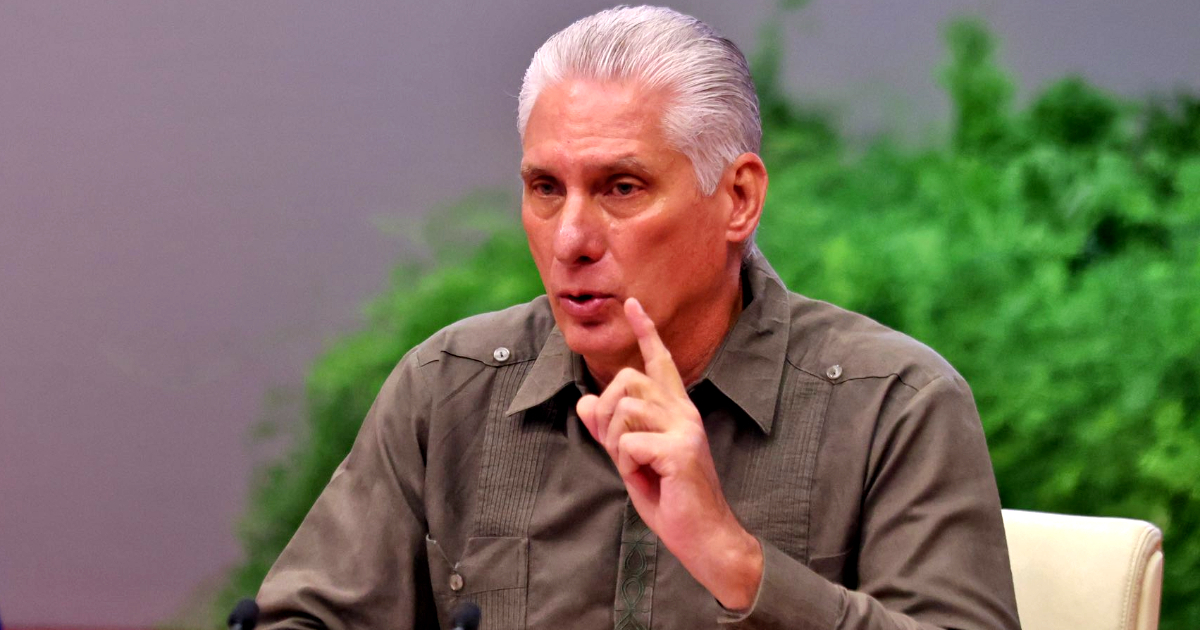
On Friday, Miguel Díaz-Canel Bermúdez took to social media platform X to assert that the Cuban government's strategies are proving effective in curbing the arbovirus epidemic ravaging the nation.
"During a meeting with experts and scientists, mathematical models were presented indicating that the arbovirus outbreak in the country is being contained. The measures are yielding results, and we will not let our guard down. We will continue with the current work system," the president stated.
The post sparked critical responses, including one from a user who remarked, "It's necessary for these experts and scientists to create a model predicting how much longer this life imposed on Cubans will last. When will this endless hardship end? I need that mathematical-scientific model or perhaps a fortune teller or Nostradamus."
Díaz-Canel's comments followed a meeting on December 24 with health system experts and scientists at the Palace of the Revolution, where he was informed that dengue and chikungunya cases are on a downward trend.
Current Epidemic Trends and Predictions
MINSAP experts report that Cuba has experienced eight consecutive weeks of declining arbovirus diagnoses. However, most provinces, except for Matanzas, Granma, and the Isle of Youth, remain within the endemic epidemic corridor.
Raúl Guinovart Díaz, a mathematician, stated that the forecast models "indicate an improving trend" and estimated that the situation could be brought under control between January and February, provided that environmental conditions remain stable.
Ongoing Challenges and Public Health Concerns
Despite the optimism, data from the meeting confirm that over 2,800 chikungunya cases persist across 134 municipalities, with incidence rates exceeding the national average in provinces such as Guantánamo, Las Tunas, Santiago de Cuba, Pinar del Río, and Artemisa.
Meanwhile, many Cubans continue to endure chronic joint pain, fatigue, and other persistent symptoms as a result of the virus.
Health authorities acknowledged that in Matanzas, more than 60% of patients seek rehabilitation or traditional medicine treatments three months post-infection.
Understanding the Arbovirus Situation in Cuba
What measures has the Cuban government implemented to combat the arbovirus outbreak?
The Cuban government has implemented containment strategies based on mathematical modeling and expert advice to manage the arbovirus outbreak, showing signs of effectiveness in reducing cases.
How are Cuban citizens affected by the arbovirus epidemic?
Many Cubans are suffering from chronic symptoms such as joint pain and fatigue, and a significant number are seeking rehabilitation or traditional medicine treatments months after infection.
What are the predictions for controlling the arbovirus situation in Cuba?
Experts predict that the arbovirus situation in Cuba might be under control by January or February, assuming environmental conditions do not change significantly.