Cuban economist Pedro Monreal has delivered a sharp critique of the Cuban government's newly implemented exchange rate framework.
In his Substack article titled “The Christmas Choir of Exchange Rates in Cuba: Planning New Distortions,” Monreal argues that the recently introduced multiple exchange rate system doesn't address the imbalances plaguing the Cuban economy. Instead, it merely reshuffles them under an even more opaque and stringent control.
Monreal highlighted that the policy enacted by the Central Bank of Cuba (BCC) on December 18 represents an attempt to reconfigure state economic management beyond mere currency exchange. Rather than enacting a structural reform, the government has merely initiated a new phase of the same centralized model, which he claims is inept at fostering efficiency or trust.
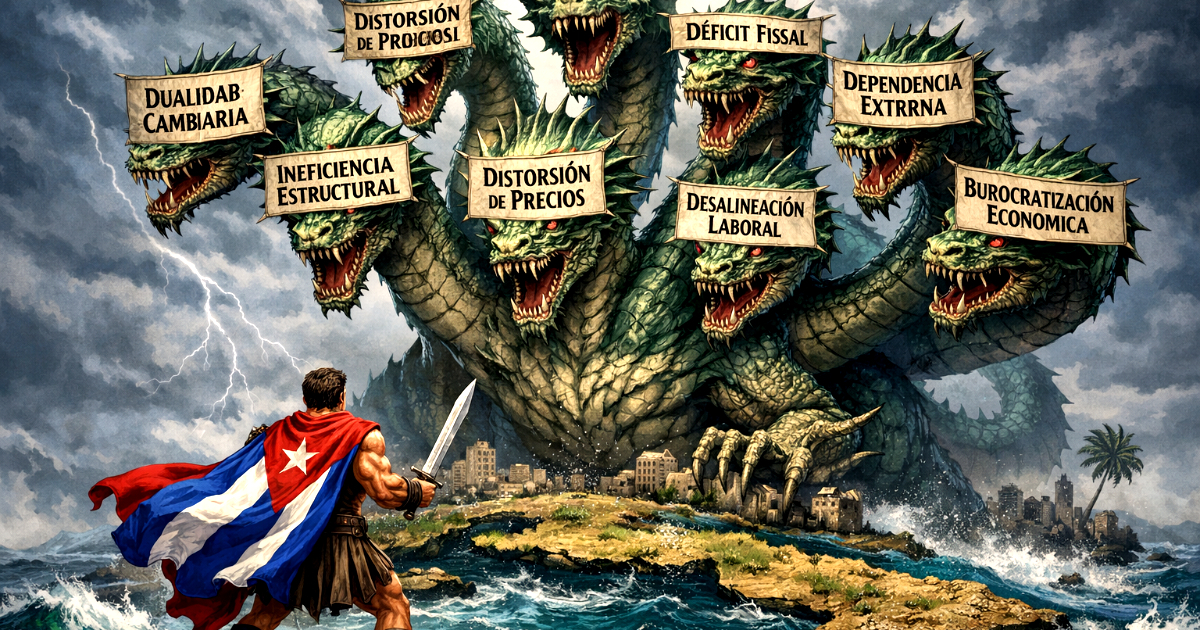
The economist described the outcome as an “economic Hydra,” where each attempted solution only spawns larger problems, akin to the mythical creature that grows two heads for every one severed.
From "Monetary Reordering" to Exchange Labyrinth
Monreal's critique stems from a shared observation among economists: the Cuban government has backtracked on its promise to unify exchange rates, a cornerstone of the 2021 “monetary reordering.” This unification was intended to integrate the economic system and bring coherence to internal pricing. Four years later, under President Miguel Díaz-Canel, the government has done the opposite, dividing the economy into exchange compartments, each with its own rate, logic, and level of privilege.
“Integration is abandoned in favor of segmentation, with the vague and unverifiable promise that this will eventually lead to future integration,” Monreal remarked with irony. He suggests this shift is driven not by economic logic but by a political need to control the flow of foreign currency amid a production collapse and dwindling reserves.
A Reform That Fails to Reform
Monreal emphasized that the newly established three-tier exchange structure should not be considered a genuine market but rather an accounting reorganization of scarcity. The official rates, even the so-called “floating” one, do not reflect market conditions but instead represent the political role the state assigns to each trading space. “Economic calculations are not based on market prices but on premeditated bureaucratic decisions,” he explained.
In this context, the economist sees the new scheme as a cosmetic adjustment to the centralized model, an attempt to project modernization without relinquishing control. This, he warns, will lead to greater disorganization, reduced transparency, and a growing divide between state and private sectors, each operating under different rules and without a coherent system of relative prices.
Hidden Subsidies and Accumulated Distortions
One of the most pointed aspects of Monreal's analysis concerns the use of an overvalued Cuban peso (1 USD = 24 CUP) in state operations, functioning as a hidden subsidy for unproductive sectors. Monreal argues that this practice distorts the economy and encourages imports while discouraging national production. “Subsidizing through exchange rate overvaluation is less effective than through fiscal means,” he explained.
Conversely, the devaluation applied to certain exporters does not ensure real income growth or competitiveness. In a rigid production apparatus with little room for maneuver, a weaker exchange rate does not boost exports but rather inflates internal prices.
Regarding the “floating” segment intended for citizens and small businesses, Monreal describes it as a symbolic fiction: a showcase of flexibility where only control exists.
Unveiling the Silent Hydra
Beyond technicalities, Monreal's text maintains a tone of caution. The new system, he asserts, entrenches a fragmented and dysfunctional economy where each segment operates as a separate compartment. “The government has replaced economic calculation with a simulation of planning,” he wrote. “Exchange rates are no longer policy tools but bureaucratic anchors.”
He concluded with a compelling image: “Behind the initial gibberish of exchange segmentation stands an economic Hydra, where cutting off one head—a dysfunction—will generate more heads—more distortions.”
A Repeated Model
In practice, the new exchange system does not signify the start of reform but the continuation of an exhausted model. As the Cuban peso continues to lose value, the informal market remains the real reference point for citizens and businesses. The state retains formal control of the currency, but it has lost effective control over the economy.
The “Hydra” Monreal describes is essentially a metaphor for a country where every attempt to correct an imbalance opens three more. And, as in Greek mythology, as long as the government continues to fight symptoms rather than causes, the heads will keep multiplying.
Understanding Cuba's Currency Challenges
What is the new currency exchange framework in Cuba?
The new framework introduces a multiple exchange rate system aimed at managing currency flows under stricter control, but it does not solve the existing economic imbalances.
How does Pedro Monreal view the new exchange rate policy?
Pedro Monreal views the new policy as a reshuffling of existing problems rather than a solution, describing it as an economic Hydra that exacerbates issues rather than resolves them.
Why is the Cuban peso's overvaluation considered a problem?
The overvaluation acts as a hidden subsidy for unproductive sectors, distorts the economy, encourages imports, and reduces incentives for domestic production.