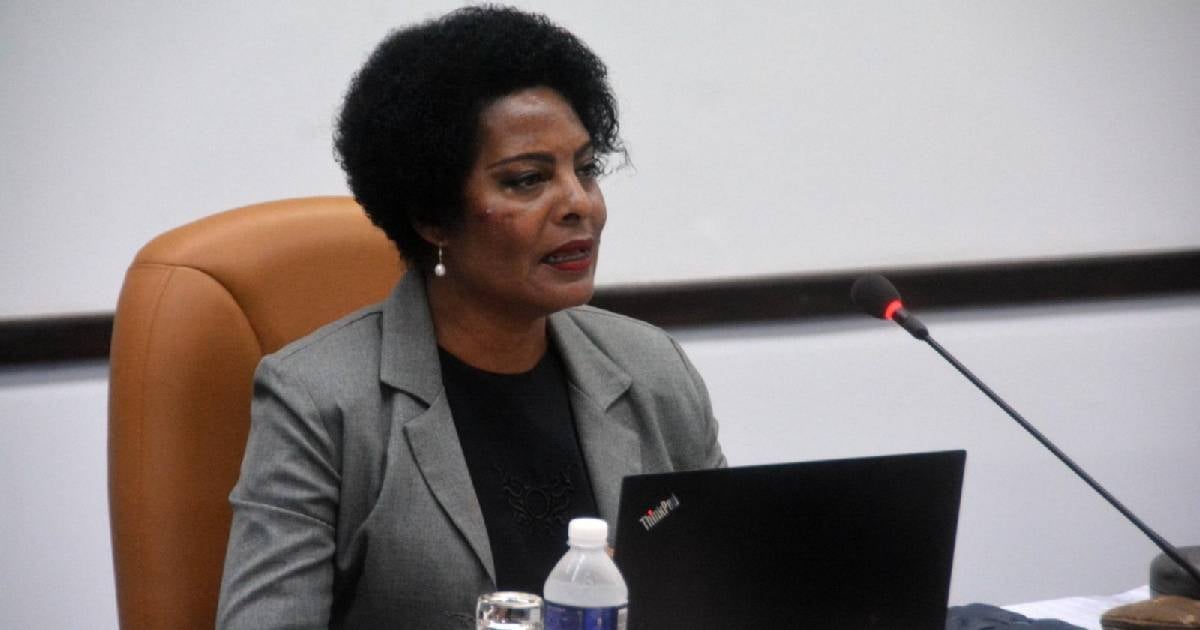
The Cuban government has announced that Juana Lilia Delgado Portal, President of the Central Bank of Cuba (BCC), will address the nation with a special broadcast following tonight's airing of the Emisión Estelar of the Cuban National Television News. This announcement comes as analysts anticipate an attempt to defend the contentious partial dollarization of the economy, which took effect on Wednesday.
The broadcast will be available on Cubavisión, Cubavisión Internacional, and Caribe, as well as on Radio Rebelde and Radio Habana Cuba, according to the official portal Cubadebate.
This announcement comes just six days after the enactment of Decree-Law 113/2025, which for the first time in over two decades, allows the internal use of the dollar and other foreign currencies within Cuba, under the leadership of Miguel Díaz-Canel.
The newly introduced system, described as a "currency management and control mechanism," disrupts the 2021 Monetary Ordering model that had designated the Cuban peso (CUP) as the sole valid currency for all domestic transactions.
Under this new framework, the Central Bank and the Ministry of Economy and Planning (MEP) are granted the authority to approve transactions, payments, and bank accounts in dollars and euros. This applies to state enterprises as well as non-state actors, including micro, small, and medium enterprises (MSMEs), cooperatives, self-employed workers, artists, producers, and individuals with foreign accounts, as announced by the government.
While the government claims the measure is "temporary," economists caution it signifies a "structural reconfiguration" of the monetary system, introducing a dual currency framework with centralized control over currency via the new "Foreign Currency Access Capacity Allocation" (ACAD) mechanism.
"This decree-law facilitates foreign currency transactions in our country," stated Minister Joaquín Alonso Vázquez.
"We are not building capitalism with this partial dollarization, but rather socialism with characteristics unique to our country," he added.
The ACAD will enable authorized businesses and individuals to purchase foreign currency directly from the state using Cuban pesos, provided there are available funds.
This system replaces the previous liquidity capacity accounts (CL) and places the access to dollars under administrative control by the ministry.
Additionally, private entities will be permitted to retain only up to 80% of their foreign currency earnings; the remaining portion must be surrendered to the state, which will convert it to pesos at the official exchange rate of 1 USD = 120 CUP.
In effect, the government ensures a share of all foreign currency circulating within the economy, thereby enhancing its control over hard currency flow, even within the private sector.
Furthermore, the Decree-Law "authorizes payments in foreign currency within the country," particularly in the Mariel Special Development Zone (ZEDM) and in retail and wholesale trade operations involving Freely Convertible Currency (MLC).
This measure institutionalizes what was previously a tolerated practice, solidifying a "legalized dual economy."
The forthcoming broadcast has sparked anticipation among economists and citizens alike, who are demanding explanations on how the measure will truly affect prices, wages, and the value of the Cuban peso.
On social media, Cubans have voiced concerns over a potential increase in "social inequality" between those with access to foreign currency and those who rely solely on the CUP, which continues to depreciate in the informal market.
Understanding Cuba's Economic Shift
What is the purpose of the partial dollarization in Cuba?
The partial dollarization aims to introduce a "currency management and control mechanism" that allows the use of foreign currencies like the dollar within Cuba, disrupting the previous model where the Cuban peso was the only currency for domestic transactions.
How will the new currency system affect private entities in Cuba?
Private entities will be able to retain up to 80% of their foreign currency earnings, with the rest being converted to pesos by the state at the official exchange rate. This system centralizes control over foreign currency through administrative decisions.
Why are economists concerned about the Cuban government's new economic measures?
Economists are concerned because the measures represent a "structural reconfiguration" of the economy, potentially leading to increased social inequality and a dual currency framework that may destabilize the value of the Cuban peso.