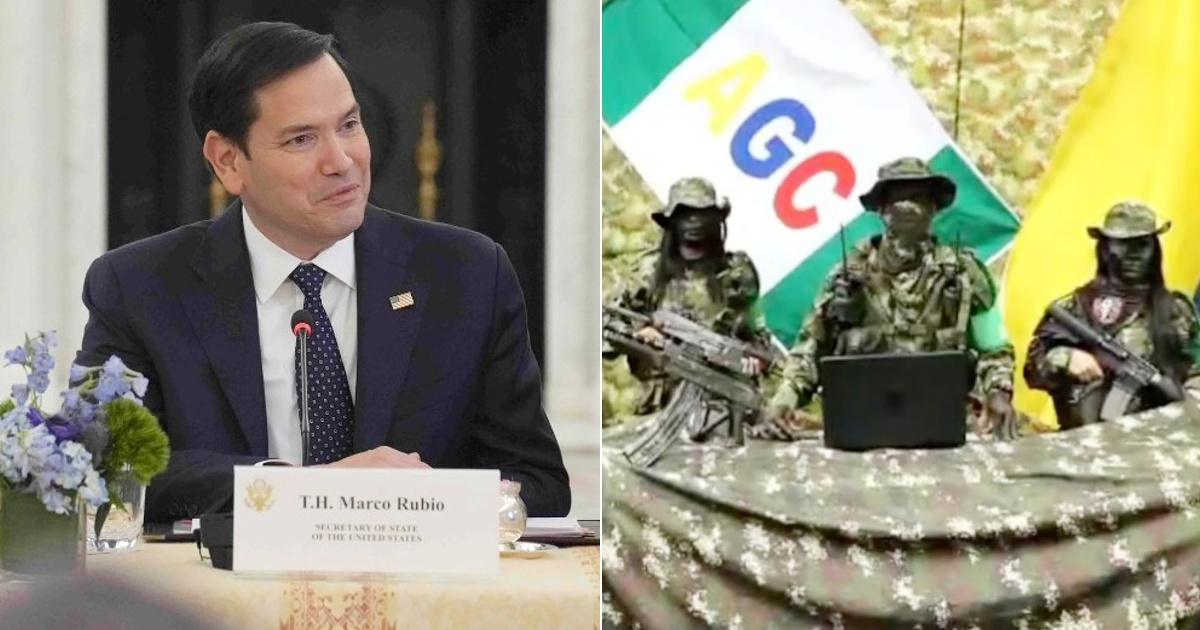
The United States has taken a significant step in its fight against transnational organized crime by officially designating the Colombian group Clan del Golfo as a Foreign Terrorist Organization (FTO) and Specially Designated Global Terrorist (SDGT).
Legal Framework and Reasons Behind the DesignationThis move, announced on December 16 by Secretary of State Marco Rubio, is grounded in the provisions of Section 219 of the Immigration and Nationality Act and Executive Order 13224.
"The Clan del Golfo is a violent and powerful criminal organization with thousands of members," Rubio stated in the official Department of State release. Known also as the Gaitanista Self-Defense Forces of Colombia (AGC), this group is considered Colombia's largest criminal network, boasting an estimated 9,000 members.
Funding Violence through NarcoticsTheir primary source of income is cocaine trafficking, which finances a sustained campaign of violence. "They use cocaine trafficking to fund their violent activities," emphasized Rubio. Washington holds the group accountable for terrorist attacks against public officials, law enforcement, military personnel, and civilians in Colombia.
Global Influence and Criminal AlliancesThe decision underscores the U.S. commitment to using "all available tools to protect our nation and stop the campaigns of violence and terror committed by international cartels and transnational criminal organizations," the statement reads. This designation amplifies international pressure on a criminal network with a global reach.
According to Colombian police data, cited by Euronews, the Clan del Golfo operated in at least 28 countries, forming alliances with Mexican cartels like Sinaloa and Jalisco New Generation, as well as European mafias, including those in Italy and the Balkans.
Legal Consequences and Asset FreezingInclusion on the list of foreign terrorist organizations carries significant legal ramifications in the United States. Authorities can freeze assets, prohibit financial transactions, and prosecute any collaboration, direct or indirect, with the organization.
These measures also enable Washington to strengthen international cooperation, limiting the Clan del Golfo's access to financial resources, weapons, and support networks.
Context: Peace Talks and Diplomatic StrainsThis designation arrives at a particularly delicate time for Colombia. Since last September, President Gustavo Petro's government and the Clan del Golfo have been engaged in peace talks in Doha, Qatar, with mediation from countries like Spain, Norway, Switzerland, and Qatar.
In December, the creation of three special zones in northern and western Colombia was announced, where group members will be temporarily positioned starting March 2026. The U.S. move could impact these negotiations by labeling the Clan not just as a criminal threat but as a terrorist entity.
Escalating U.S.-Colombia TensionsThis comes amid bilateral tensions between Washington and Bogotá, marked by verbal exchanges between Petro and Donald Trump, and the U.S. military presence in the Caribbean as part of its anti-drug campaign.
Since Trump's return to power in January 2025, his administration has intensified its offensive against drug trafficking. Beyond the Clan del Golfo, six major Mexican cartels—Sinaloa, CJNG, Northeast, Gulf Cartel, United Cartels, and New Mexican Family—have also been designated as terrorist organizations. Additional groups include Tren de Aragua, MS-13, Barrio 18, and Ecuadorian groups Los Lobos and Los Choneros.
Persistence Despite Leadership LossDespite the 2021 capture of their historic leader, Dairo Antonio Úsuga, alias 'Otoniel', the Clan del Golfo hasn't disbanded. Colombian authorities report that the group has fragmented into regional cells, maintaining their capacity for violence and international presence.
Before Otoniel's arrest, the criminal network moved around 20 tons of cocaine monthly, part of which was smuggled into Europe via agricultural product containers. Key distribution hubs included ports like Rotterdam, Antwerp, and southern Spain.
Trump's Harsh Rhetoric: "Colombia Will Be Next"In a recent White House press briefing, President Donald Trump launched a scathing critique of Colombian President Gustavo Petro, accusing him of being a "drug trafficker" and allowing Colombia to become a "drug production hub."
"Colombia will be next," Trump warned. "They have cocaine factories sending the product directly to the United States," he asserted.
The Republican leader stressed that Petro "will face significant issues if he doesn't realize" and highlighted his belief that the Colombian president is "quite hostile towards the United States."
These statements further escalate measures by Trump's administration: decertifying Colombia in anti-drug efforts, revoking Petro's visa, and halting all U.S. subsidies and payments to the South American country.
The tension escalated with the recent bombing of a submarine in the Caribbean by U.S. forces as part of the "war on cartels." Washington claimed it was transporting drugs from Venezuela, while Petro insisted the attack occurred in Colombian territorial waters, leaving a Colombian and an Ecuadorian among the survivors.
This latest verbal confrontation between Trump and Petro highlights the rapid deterioration of bilateral relations, as Colombia seeks to advance peace processes with armed groups while the United States bolsters its military and legal strategy against transnational drug trafficking.
A Clear Political and Legal MessageThe U.S. decision to label Clan del Golfo a terrorist organization sends a strong signal that it is no longer seen merely as a narcotics group but as a destabilizing actor affecting governments, societies, and borders, both in America and beyond.
This action deepens the doctrine of equating cartels with terrorist groups, solidifying a strategy that broadens legal tools for combating transnational organized crime.
Meanwhile, the peace process between Colombia and the Clan del Golfo faces a new hurdle: one imposing severe limits on any future concessions, given that it is now considered a terrorist entity by one of the world's leading powers.
Key Insights on U.S. Designation of Clan del Golfo
What led the U.S. to designate Clan del Golfo as a terrorist organization?
The U.S. designated Clan del Golfo as a terrorist organization due to their involvement in cocaine trafficking to fund violent activities, and their accountability for terrorist attacks against public officials and civilians in Colombia.
How does this designation impact Clan del Golfo legally?
This designation allows U.S. authorities to freeze assets, prohibit financial transactions, and prosecute collaboration with the Clan del Golfo, while also strengthening international cooperation to limit their access to resources.
What are the implications for Colombia-U.S. relations?
The designation has heightened tensions between Colombia and the U.S., as it could affect ongoing peace talks and has been accompanied by critical statements from President Trump towards Colombia's leadership and anti-drug efforts.
How does the Clan del Golfo's network operate internationally?
The Clan del Golfo has alliances with Mexican and European criminal organizations, allowing operations in at least 28 countries, demonstrating their extensive international reach.