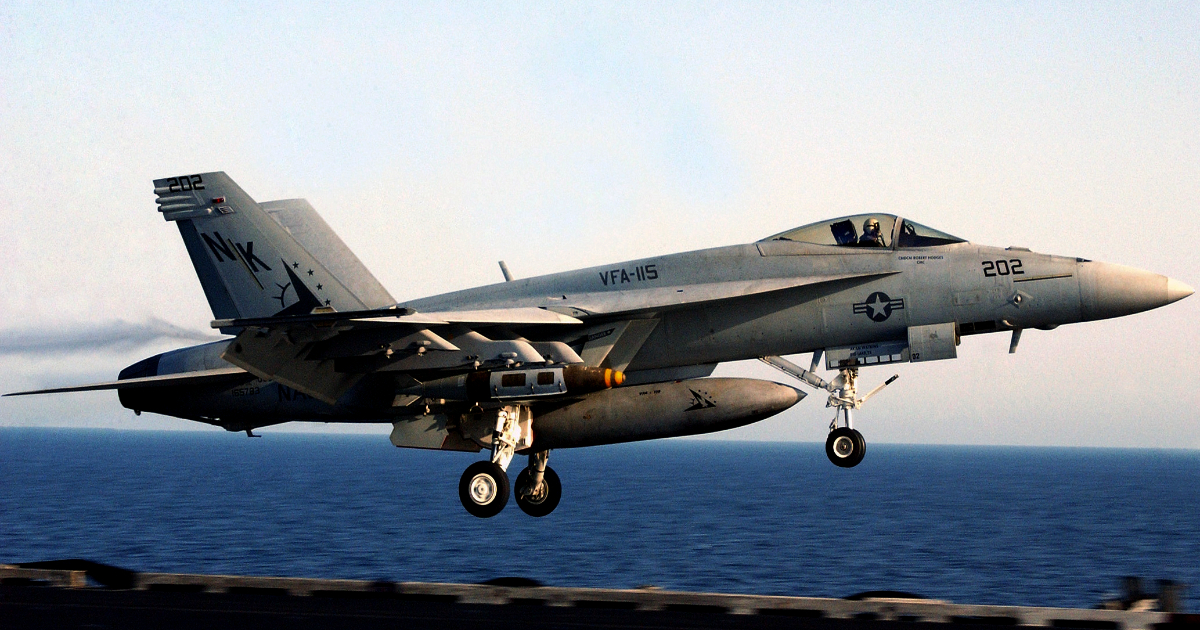
The United States Navy's fighter jets and intelligence platforms ramped up aerial patrols near Aruba, Bonaire, and Curaçao on Friday, escalating military tensions in the Caribbean amidst the ongoing confrontation between Washington and Nicolás Maduro's regime.
According to air tracking data, two F/A-18E Super Hornet fighter jets, including one identified with tail number 166904, flew over international airspace north of Curaçao. The Pentagon described these maneuvers as part of an “enhanced security operation” targeting drug trafficking networks, as reported by El Nuevo Herald.
These missions are part of Operation Southern Spear, ordered by President Donald Trump as an extension of the naval campaign launched in September to combat drug cartels and trafficking routes in the Caribbean and Pacific regions. Washington maintains that the offensive aims to neutralize transnational threats and dismantle the so-called Cartel of the Suns, which the U.S. alleges is led by Maduro and senior Venezuelan military officials.
Venezuela Accuses U.S. of Provocation
Venezuela's Defense Minister, Vladimir Padrino López, condemned the U.S. flights as a “deliberate provocation” and an “attempt to impose war in Latin America and the Caribbean.” During a televised ceremony, he declared that surrender is a “historical impossibility” for Venezuela and warned that U.S. military actions could endanger American lives.
“They intend to send young Americans back home in body bags and caskets,” the general accused, claiming Washington is using the fight against drug trafficking as a pretext to enforce regime change.
The Venezuelan government also protested the recent seizure of the oil tanker Skipper, intercepted by the U.S. Coast Guard carrying 1.9 million barrels of Venezuelan crude oil. Caracas labeled the interception as “blatant theft,” while U.S. officials argued the operation complied with existing sanctions and maritime law.
Trump's Ground Strategy
From Washington, Trump defended the increased military presence and announced that the next phase of the campaign “will be on land.” “We've stopped 96% of the drugs coming by sea. Now we start on land, and on land, it’s much easier,” he stated, without providing further details.
The president insisted that the offensive is not aimed at any specific country but at “terrible people who bring drugs and kill our people,” though Venezuela remains the primary focus of U.S. pressure. With the USS Gerald R. Ford aircraft carrier and several destroyers operating in the area, the crisis has entered a new phase: the U.S. has moved from a naval blockade to the threat of ground incursions, while Caracas continues to denounce that Washington's ultimate goal is to overthrow Maduro.
Understanding the U.S.–Venezuela Tensions
What is the purpose of the U.S. aerial patrols near Venezuela?
The U.S. aerial patrols are part of an enhanced security operation aimed at targeting drug trafficking networks in the Caribbean region.
Why did Venezuela condemn the U.S. military actions?
Venezuela condemned the U.S. military actions as deliberate provocations and attempts to impose war in Latin America and the Caribbean.
What was Trump's announced strategy regarding the drug trafficking campaign?
President Trump announced that the next phase of the campaign against drug trafficking will shift from the sea to land operations, targeting those responsible for drug smuggling.