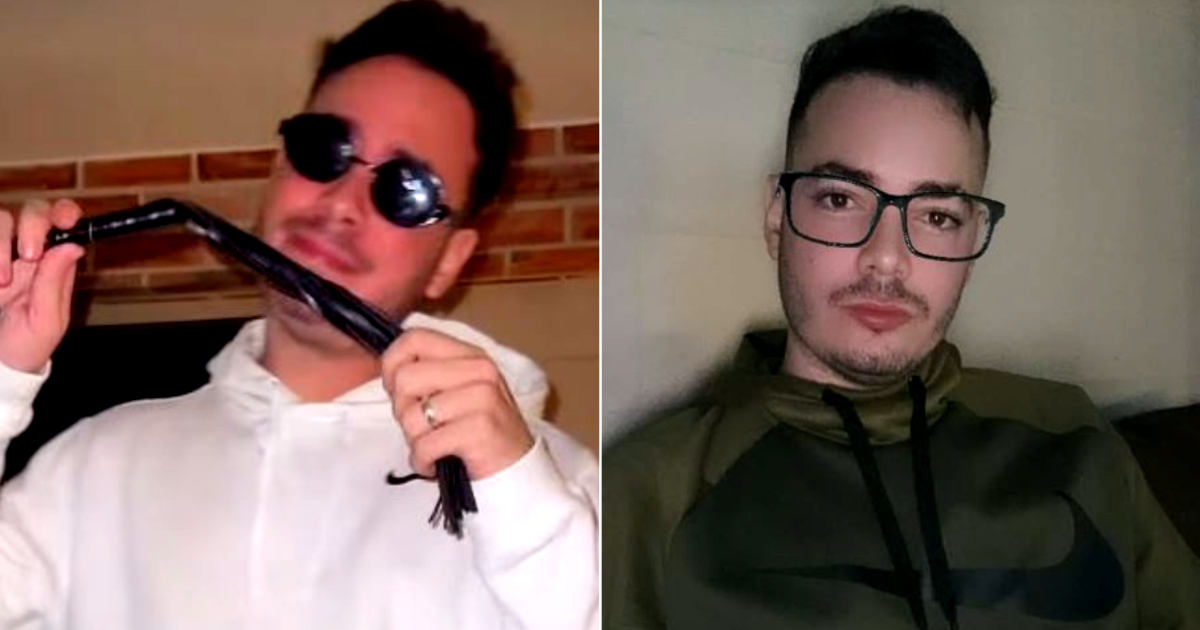
Sandro Castro, the grandson of dictator Fidel Castro, has once again stirred up social media with a statement that, under the guise of empathy, highlights the disconnect, hypocrisy, and cynicism of a ruling class that enjoys abundance while the regime inherited from his grandfather crumbles.
"The greatest thing is my homeland, it is humanity, where I grew up. It's a shame it's going through such hard and difficult times. The worst part is, we don't see the light at the end of the tunnel," Sandro wrote on his Instagram, responding to a user who asked what Cuba means to him.
Accompanied by the Cuban flag and sad emojis, the phrase was meant to express compassion but sounded hollow coming from the heir of a family that has ruled the island with an iron fist for over six decades.
Sandro, accustomed to luxury and opulence, is unable to perceive the irony of speaking about "hardship" from the comfort of his life in Havana, surrounded by sports cars, exclusive parties, and businesses sheltered by the very system that stifles the people.
His comment, which could be interpreted as an implicit critique of Miguel Díaz-Canel's "continuity" government, in reality, reveals an act of arrogance: the awareness of impunity from someone who knows he can say whatever he wants without consequences, even playing with incendiary words at a time when the darkness of power outages sparks protests among the population.
In a country where thousands of young people are imprisoned for expressing their opinions, Sandro plays the role of the regime's "harmless rebel." His tone of false sadness does not aim to question the root of the national disaster but rather to reaffirm his supposed moral superiority over the leaders of the so-called "continuity," those bureaucrats who worship his grandfather's memory as he ridicules them with every word.
His delusions of grandeur became evident just a few weeks ago when he responded to a follower asking if he would like to be president of Cuba. With a mix of naivety and arrogance, he claimed he "might" do it "when the US blockade ends," as if the country's leadership were a pending inheritance or a game reserved for his lineage.
That response, absurd in content but revealing in tone, was read by many as a direct provocation to Díaz-Canel himself, whom Sandro seems to regard as merely a caretaker of the family estate. This verbal whim, disguised as humor, hints at a symbolic challenge to the "continuity" power: the grandson of the supreme leader reminding the disciple that his throne is borrowed.
Behind the supposed patriotism lies a hollow populism, a rhetoric of "humanity" that serves to mask his inflated ego. In each of his social media replies, Sandro presents himself as a narcissistic and sociopathic character, incapable of genuinely empathizing with ordinary Cubans.
His constant need for attention—whether to deny being a communist, claim he "has no privileges," or feign pain over the crisis—is part of a personal spectacle sustained by provocation and disdain.
In this latest performance, Sandro not only mocked the Cuban people but also the very guardians of power.
His message, wrapped in false compassion, acted as a slap in the face to the "revolutionary continuity" that insists on portraying a Cuba in resistance, while the "grandson" publicly admits there is no light at the end of the tunnel. With one sentence, Sandrito exposed the moral defeat of the official narrative.
This contradiction—between the discourse of sacrifice and the privileged life of the power heirs—is the cruelest mirror of current Cuba.
Sandro Castro does not speak for the people: he speaks about them, from a distance only maintained by someone who has never gone hungry, stood in line for bread, or endured an eight-hour blackout. His "patriotism" is as cheap as his empathy, yet his words, paradoxically, accurately describe the state of a country without a future and without hope.
The "light at the end of the tunnel" that Sandro does not see is not a confession; it is a provocation. A way to remind Cubans—and the continuity's leaders—that the notorious Castro surname still has the license to say what others cannot, and laugh afterward at the gag it causes.
Understanding Sandro Castro's Statements
What did Sandro Castro say about Cuba?
Sandro Castro expressed that while Cuba is going through hard times, the worst part is that there is no light at the end of the tunnel.
How has Sandro Castro's lifestyle been perceived in relation to his statements?
Sandro's lifestyle, marked by luxury and privilege, contrasts sharply with the hardships faced by ordinary Cubans, making his statements appear hypocritical and disconnected.
Why is Sandro Castro's comment seen as a provocation?
His comment is seen as a provocation because it highlights his awareness of impunity and the privilege to speak freely, contrasting with the restrictions faced by ordinary Cubans.