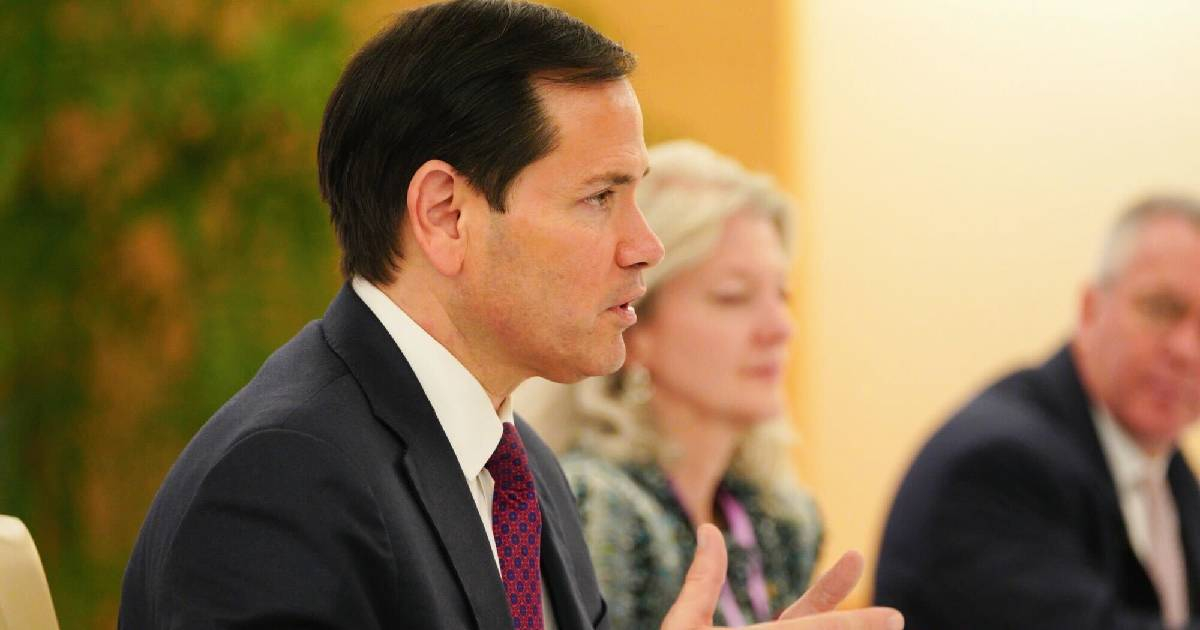
U.S. Secretary of State Marco Rubio believes that weakening the government of Nicolás Maduro in Venezuela could deliver a decisive blow to Cuba's communist regime, as detailed in an extensive report by The New York Times.
Rubio, whose parents immigrated from Cuba to Florida prior to the 1959 revolution, has made the Caracas-Havana relationship a central focus of his policy towards Latin America.
His theory, shared both publicly and privately, posits that cutting off Venezuela's economic and intelligence support to Cuba would lead to political collapse on the island.
The Strategic Vision
The New York Times portrays Rubio as a key strategist for President Donald Trump in the administration's military and economic pressure campaign against Maduro's regime.
While the stated goal is to "restore Venezuelan democracy," government sources acknowledge that the Republican politician is also intent on weakening the Castro regime.
"His theory of change involves cutting off all support to Cuba. Once Venezuela falls, Cuba will follow," stated Juan González, a former advisor to President Joe Biden for Latin America, to the newspaper.
Public and Private Advocacy
In previous interviews, Rubio has been unequivocal: "Anything detrimental to a communist dictatorship is something I support."
According to former advisors cited by the newspaper, the Florida senator, who has built his career on growing support from the Cuban exile community, consistently advocated in the Senate and with diplomats about the need to isolate the Havana regime and sever its alliance with Caracas.
The failed 2019 military uprising in Venezuela only reinforced his suspicions. U.S. intelligence reports indicated that Cuban agents warned Nicolás Maduro of the attempted uprising, allowing the Venezuelan leader to quickly quash it.
"The only coup is the one carried out by Cuba in support of dictator Maduro," Rubio wrote on social media at the time.
Current Actions and Future Goals
In recent months, Washington has ramped up military operations in the Caribbean and increased sanctions on officials from both countries.
President Trump personally demanded over the phone that Maduro step down, while the White House ordered the seizure of a Venezuelan oil tanker bound for Cuba.
For Rubio and his Republican allies, including Senator Lindsey Graham, these measures are part of a long-term strategy: "If Maduro falls, we can focus on Cuba, one of the most oppressive regimes in our backyard," Graham wrote on Friday on X.
However, experts caution that the Cuban regime has weathered decades of sanctions and isolation.
Supported by Russia and China, the government of Miguel Díaz-Canel and Raúl Castro continues to endure, albeit with dwindling resources and growing social unrest on the island.
As the Trump administration doubles down on its efforts in Venezuela, Rubio remains steadfast in his objective: economically strangle Havana to trigger the downfall of the Castro regime.
His message is clear and direct: without Maduro, Cuba loses its lifeline, he indicates.
Understanding Marco Rubio's Strategy on Cuba and Venezuela
What is Marco Rubio's strategy regarding Cuba and Venezuela?
Marco Rubio aims to weaken Nicolás Maduro's government in Venezuela as a means to destabilize and ultimately collapse Cuba's communist regime by cutting off its economic and intelligence support.
How does Rubio view the relationship between Venezuela and Cuba?
Rubio sees the Caracas-Havana connection as pivotal, believing that severing this link would lead to a political collapse in Cuba.
What actions has the U.S. taken recently against Venezuela and Cuba?
The U.S. has increased military operations in the Caribbean, imposed further sanctions, and seized a Venezuelan oil shipment intended for Cuba.