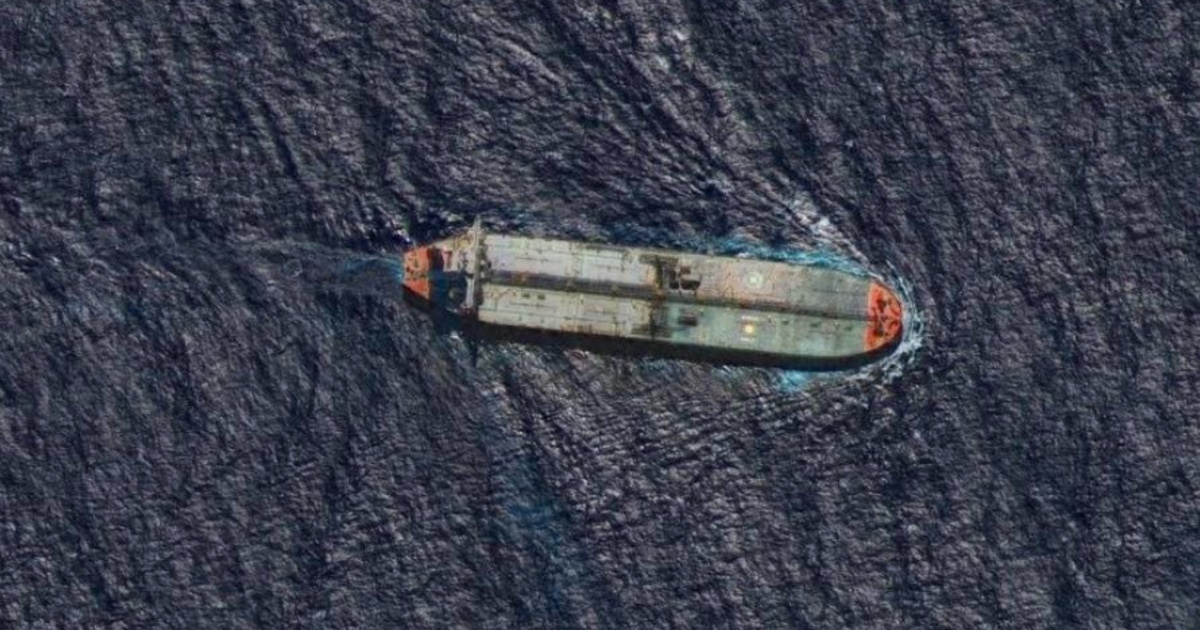
A U.S. military operation recently concluded with the seizure of the Venezuelan oil tanker "Skipper" near Venezuela's coastline.
This action, as reported by investigations from The New York Times and The Economist, highlights Cuba's involvement in a network facilitating energy and financial cooperation between the regimes of Nicolás Maduro and Havana. This network reportedly revolves around the transportation and resale of crude oil through channels designed to bypass sanctions and traditional market routes.
According to the report, the "Skipper" departed on December 4 with nearly two million barrels of heavy crude from Venezuela. Internal documents from PDVSA and testimonies from industry officials cited by The New York Times identified the declared destination as the Cuban port of Matanzas. This operation was under a joint contract between Cubametales, Cuba's state-run trading company, and an entity linked to Panamanian merchant Ramón Carretero, who has been sanctioned by the U.S. Treasury Department.
The report claims that Carretero's affiliated companies have managed "up to a quarter" of the crude exported by PDVSA. Cubametales reportedly secured contracts for approximately 65,000 barrels per day this year, a volume that has risen by 29% compared to 2024, according to the data cited.
However, the document adds that part of the cargo supposedly bound for the island is actually resold in Asia, particularly in China, to acquire foreign currency deemed essential for alleviating Cuba's economic woes.
During its voyage, the "Skipper" transferred 50,000 barrels to the vessel Neptune 6, which then set course for Cuba, according to maritime data firm Kpler mentioned in the report.
The seizure took place on December 10, when U.S. elite troops boarded the ship from Black Hawk helicopters, encountering no resistance from the mostly Russian crew, as reported by The Economist.
Washington justified this move as part of its sanctions policy against Maduro and his allies. Attorney General Pam Bondi asserted that the cargo included Venezuelan and Iranian oil being moved to evade sanctions. President Donald Trump remarked that the confiscation was “for a very good reason,” estimating the oil's value at around $80 million.
Following the operation, Cuban authorities denounced the incident as an “act of piracy and maritime terrorism,” accusing the U.S. of seeking to disrupt energy exchanges between Venezuela and Cuba.
In response, Caracas labeled the action as “piracy” and “kidnapping” in international waters, according to the same report.
The text further notes that the White House and U.S. officials have indicated to The Economist that the action against the "Skipper" is not an isolated incident, and plans exist to target other vessels linked to the Venezuelan oil export network.
While the official narrative for the naval deployment in the Caribbean is an anti-drug campaign, sources suggest it also serves to apply political pressure on Maduro.
In this context, the document describes operations involving a “ghost fleet” associated with Venezuela, Iran, and Russia: ships with changing names and flags, disabled transponders, and ownership hidden behind shell companies to complicate tracking and evade sanctions.
Additionally, it warns that these operations raise costs (freight, commissions, and risk premiums) and can diminish PDVSA's profit margins, which has reportedly begun demanding advance payments before setting sail.
Although Venezuelan oil shipments are insufficient to resolve Cuba's power outages and supply issues, they remain a “crucial” factor for the political and financial survival of the regime, according to documentation from The New York Times.
Cuba's Role in Venezuelan Oil Smuggling: Key Insights
What was the significance of the U.S. operation against the "Skipper"?
The U.S. operation exposed Cuba's involvement in bypassing sanctions through a network that supports energy and financial ties between Venezuela and Cuba, highlighting the geopolitical stakes in the region.
How does Cuba benefit from the Venezuelan oil shipments?
Cuba benefits by reselling part of the oil in Asia, particularly in China, to earn foreign currency that is vital for addressing the country's economic challenges.
What is the "ghost fleet" and how does it operate?
The "ghost fleet" refers to vessels associated with Venezuela, Iran, and Russia, which use tactics like changing names and flags, disabling transponders, and hiding ownership to evade detection and sanctions.