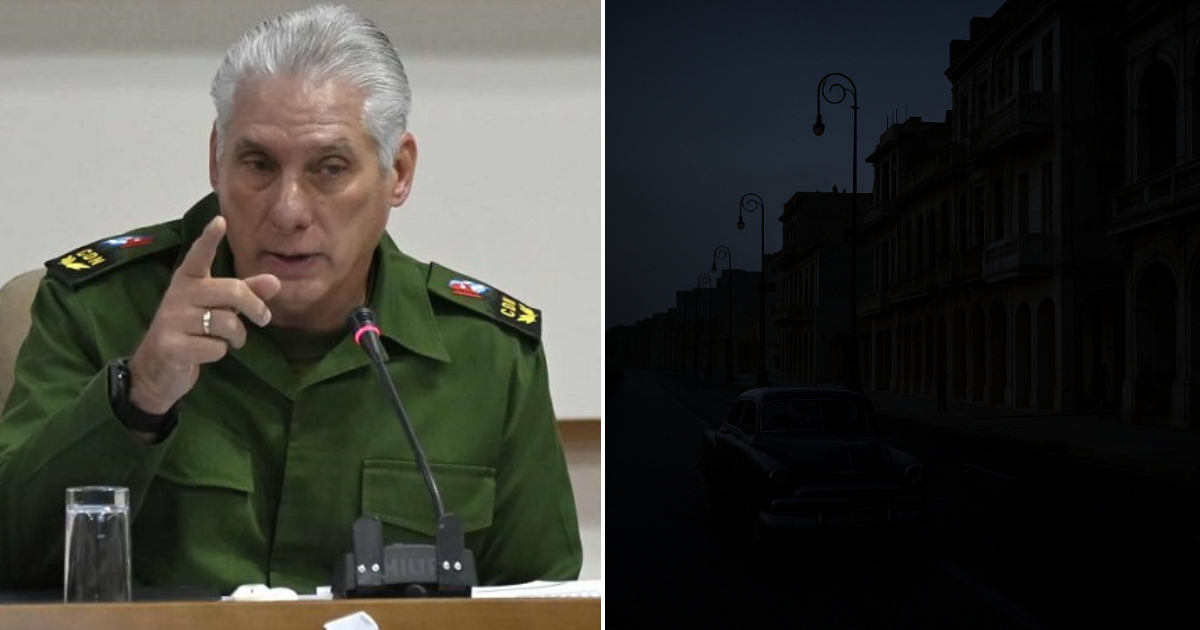
On Wednesday, Miguel Díaz-Canel addressed the widespread power outage that left Havana and several western provinces without electricity. In his statement, he cited the "disconnection of the National Electric System (SEN)" while also blaming the country's struggles on the U.S. "embargo" and the recovery efforts from Hurricane Melissa. His comments on social media sparked a wave of criticism and ridicule from Cubans exhausted by the ongoing energy crisis.
Using his profiles on X and Facebook, Díaz-Canel claimed that "workers from the Ministry of Energy and Mines, who tirelessly work amidst the daily complexities imposed by the embargo and the hurricane's aftermath, are already resolving the issue." He further stated, "Once again, we place our trust in them."
His remarks ignited a storm of criticism and frustration online, with hundreds of users responding with reproach, sarcasm, and demands for improved living conditions amid prolonged blackouts, shortages, and declining basic services.
Public Discontent and Criticism
The use of the term "embargo" as a justification for the electrical failures was widely rejected. Many internet users pointed out that the real issues lie in the inefficiency of the system and the lack of maintenance for the thermoelectric plants. Others expressed anger over the repetitive official narrative, mocking phrases like "the embargo and the touch" or "Cuba has been disconnected since 1959."
Many found it insulting that the leader would once again blame the external embargo while the population endures outages lasting up to 30 hours. Comments summed up the frustration with statements like "you are the ones disconnected from the reality of this people."
Outage Details and Government Response
The power disconnection occurred in the early hours of Wednesday in Cuba's western region, affecting provinces from Cienfuegos to Pinar del Río, including the capital. According to official reports, a failure in a transmission line between Santa Cruz del Norte and the Antonio Guiteras thermoelectric plant in Matanzas led to an overload in the grid, causing several generating plants, including Mariel, Santa Cruz, Cienfuegos, and Felton, to go offline.
Later, Havana's Electric Company announced the beginning of service restoration, prioritizing hospitals and water supply systems following the partial disconnection in the western system.
Social Media Reaction
The blackout triggered a tidal wave of indignation on social media, where Cubans voiced their exasperation with the repeated failures and the deteriorating energy system. The phrase "this is not just a blackout, it's a country turned off" circulated widely in posts and comments, capturing the cumulative discontent over the electrical crisis.
Reports indicated that the event left millions without power from the early hours, causing Havana to wake up in complete darkness. According to the Electric Union, the cuts resulted from an overload in the western region, exacerbating a national generation deficit that already exceeds 2,000 megawatts.
The Broader Crisis
The outage adds to a long list of failures exposing the deep fragility of the National Electroenergetic System, plagued by breakdowns, fuel shortages, and a lack of investment. In recent months, Cuba has faced at least five national collapses and numerous regional blackouts that have paralyzed entire provinces.
While authorities continue to refer to "technical failures" and "complexities stemming from the embargo," citizens are demanding transparency and solutions. For many, Wednesday's darkness was just another episode in a country that, as one social media user put it, "has been disconnected for far too long."
Understanding the Cuban Energy Crisis
What caused the recent power outage in western Cuba?
A failure in a transmission line between Santa Cruz del Norte and the Antonio Guiteras thermoelectric plant led to an overload, causing several generating plants to go offline.
How did Díaz-Canel respond to the power outage?
Díaz-Canel blamed the U.S. embargo and praised the workers of the Ministry of Energy and Mines for addressing the issue, sparking criticism and ridicule on social media.
Why are Cubans frustrated with the government's response?
Cubans are frustrated due to the repeated blackouts, deteriorating energy infrastructure, and perceived inefficiency and lack of transparency in addressing these issues.
What has been the impact of the power outages on daily life in Cuba?
The power outages have resulted in prolonged blackouts affecting millions, disrupting daily life, and exacerbating existing shortages and service declines.