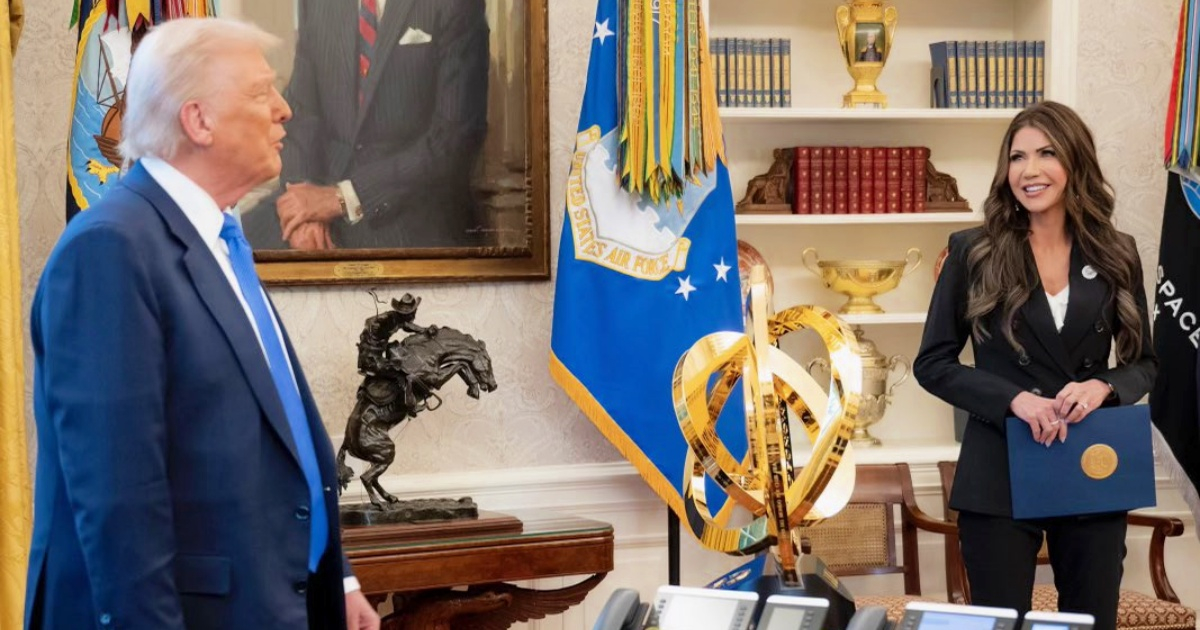
The U.S. Secretary of Homeland Security, Kristi Noem, urged President Donald Trump on Monday to enforce a comprehensive travel ban targeting citizens from countries she claims have "flooded" the United States with "foreign invaders."
Noem's statement, filled with incendiary rhetoric, was shared on her social media account, X, sparking widespread discussion.
"I've just met with the President. I recommend a total travel ban on all nations that have been inundating our country with murderers, parasites, and welfare addicts," Noem declared, marking another controversial chapter in the intensification of the U.S.'s immigration policy.
Without specifying the countries she referred to, Noem used alarmist language to justify her proposal: portraying immigration as an existential threat compromising the nation's security, economy, and foundational values.
"Our ancestors built this nation with blood, sweat, and an unyielding love for freedom, not for foreign invaders to slaughter our heroes, drain our hard-earned taxes, or seize benefits owed to Americans. We don't want them. Not a single one," she concluded.
Political Backlash Following Violent Incident
Noem's comments were made in the aftermath of a tragic event in Washington, where an Afghan immigrant shot two National Guard members, resulting in the death of one.
The Trump administration quickly leveraged this case to justify a new set of harsh immigration measures.
In direct response, President Trump halted asylum applications and suspended immigration processes for Afghan nationals, including those who had collaborated with U.S. forces abroad.
This incident has become a catalyst for a broader narrative depicting immigration, especially from impoverished or conflict-ridden countries, as a "destructive invasion."
Trump's Intensified Rhetoric: Targeting "Third World" Nations
Last week, Trump reinforced his stance with a message posted during the Thanksgiving holiday on Truth Social.
He revealed plans to "permanently" suspend immigration from all Third World countries, though he did not provide a definitive list, framing these actions as part of a "national recovery."
"I will permanently suspend migration from all Third World countries to allow the American system to fully recover," he asserted.
"I will eliminate Biden's millions of illegal admissions, including those signed by Sleepy Joe Biden's Autopen, and deport anyone who is not a net asset to the United States or incapable of loving our country," he added.
The viral post signifies one of the most significant hardenings in recent U.S. immigration policy history.
Trump has announced a "reverse migration" policy, explicitly promising mass expulsions, benefit revocations, and immigrant denaturalizations.
"I will strip all federal benefits and subsidies from non-citizens; denaturalize migrants who undermine national tranquility, and deport any foreigner who is a public burden, a security risk, or incompatible with Western civilization," he proclaimed.
Expanding List of Banned Nations
This is not the Trump administration's first attempt in recent months to block entry from certain countries.
Last June, the government enacted a complete travel ban on citizens from Afghanistan, Burma, Chad, the Republic of Congo, Equatorial Guinea, Eritrea, Haiti, Iran, Libya, Somalia, Sudan, and Yemen.
Additionally, partial visa restrictions were imposed on individuals from Burundi, Cuba, Laos, Sierra Leone, Togo, Turkmenistan, and Venezuela.
Civil rights organizations and legal experts have questioned the legality and effectiveness of these policies, arguing that collectively criminalizing entire communities based on their country of origin violates fundamental principles of international law and the U.S. Constitution.
Nevertheless, Trump and his officials, including Kristi Noem, continue to promote a narrative rooted in fear, economic resentment, and national identity.
Understanding U.S. Immigration Policy Changes
What prompted Kristi Noem's call for a travel ban?
Kristi Noem's call for a travel ban was prompted by a violent incident involving an Afghan immigrant and a broader desire to address what she perceives as a threat from certain nations.
What countries are affected by the proposed travel ban?
While Noem did not specify countries, the Trump administration had previously banned or restricted travel from nations like Afghanistan, Burma, and several others.
How has the Trump administration previously addressed immigration from certain countries?
The Trump administration has implemented travel bans and visa restrictions on various countries, citing security and economic concerns as reasons for these measures.
What has been the response to these immigration policies?
Civil rights groups and legal experts have challenged the legality and effectiveness of these policies, arguing they violate international law and constitutional principles.