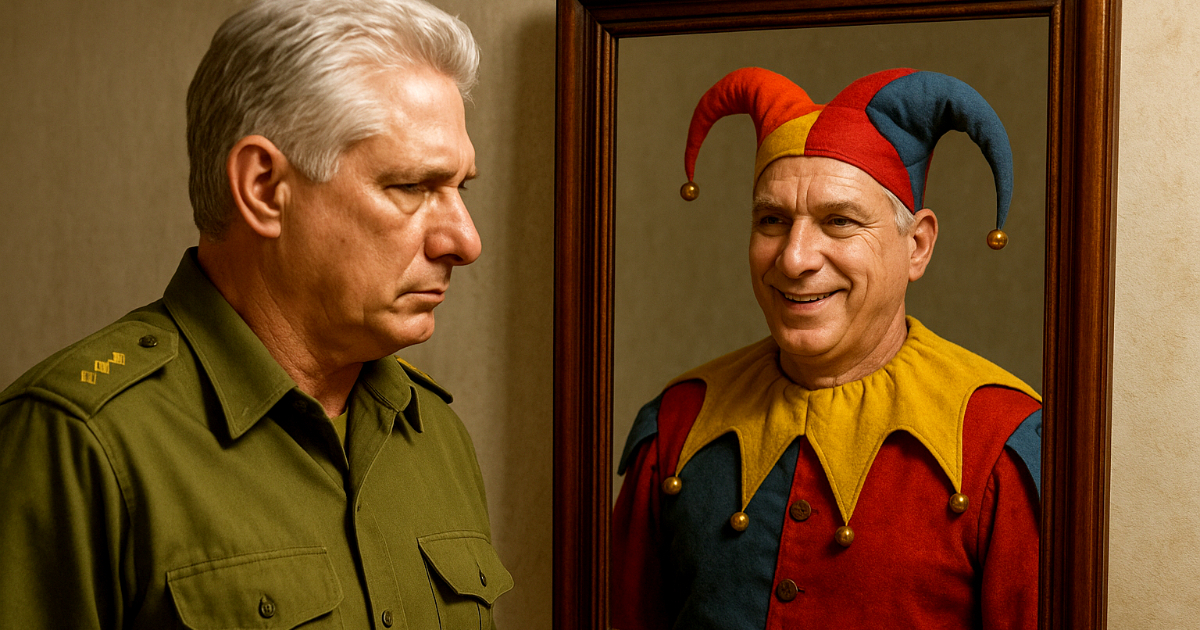
The sight of Miguel Díaz-Canel donning a green military uniform continues to stir controversy in Cuba. CiberCuba’s article titled “Why is Díaz-Canel Wearing a Military Uniform in His Recent Public Appearances?” sparked a whirlwind of ridicule, criticism, and outrage, amassing over 1,500 comments within hours.
What began as a debate on CiberCuba Noticias’ Facebook page quickly turned into a pulse check on the public’s mood—highlighting both humor and exasperation. Amid the jokes, insults, and political reflections, Cubans painted a scathing picture of the leader: a puppet trying to command respect in soldier’s garb, succeeding only in becoming a laughingstock.
When Humor Becomes Resistance: “The Battle of Palo Cagao”
The most celebrated thread of comments was born from irony. One user humorously claimed that the appointed leader "earned that uniform at the Battle of Palo Cagao, on the Hill of Peo alongside his friend Pendejón González."
This quip unleashed waves of laughter and numerous responses in the same vein: “He fought on the Hill of Esperón”; “Corporal Pendejón and the Russian advisor Kagalovich”; “He got the uniform for distinguished service in the war against mosquitoes.”
In a matter of minutes, the thread evolved into a festival of popular humor where sarcasm replaced indignation. For many, mocking the appointed leader serves as a symbolic form of resistance. “I laughed until I cried,” confessed one woman. Another added, “Only humor saves us from this reality.”
Fear and Mockery: “The Combat Order Has Been Given”
Some interpreted the uniform as a gesture of threat. “Because the combat order has been given,” one person wrote, to which another replied, “Combat against whom, against his own people?”
Such sentiments echoed repeatedly: "He's at war with his conscience," "Preparing for the next crackdown like on July 11," "Wears green to intimidate, yet even in military attire, he scares no one, not even mosquitoes."
This blend of mockery and fear reflects prevailing distrust. “I’m not sure what they’re planning, but it’s clear they’re scheming,” commented one user. “They seem to want to keep the country in a perpetual ‘defense mode.’”
Criticism of “Improper” Uniform Use
A group of commentators took a more technical stance, noting that the attire worn by Díaz-Canel “doesn’t match” his background.
“It’s disrespectful; that uniform is ceremonial and should only be worn by trained military personnel,” one stated. Another added, “He never went to the Sierra nor did military service. It’s a usurpation of duties.”
Although some regime supporters argued that as head of the National Defense Council, the president “has the right to wear it,” the majority rejected this justification. “The uniform doesn’t make him a commander, just as a guayabera didn’t make him civilized,” one woman quipped. “The habit doesn’t make the monk, and green doesn’t grant authority.”
Language of Discontent: “Puppet,” “Clown,” “Costumed”
On the surface, these comments could be seen as just a barrage of jokes. However, a deeper analysis reveals a more complex emotional pattern: disdain, distrust, and political fatigue.
The most recurring words are “clown,” “puppet,” “ridiculous,” “costumed.” For many, the uniform symbolizes an empty theater of power: “That’s how buffoons are, they need the attire to feel important,” wrote one user.
Another summarized it in improvised verse: “Such are and simulate the buffoons / lacking courage and valor; / they appear in military garb / to feign respect and lost authority.”
A third commentator noted, “That outfit doesn’t command respect, it commands pity. It only shows his fear.”
Everyday Humor: “To Hide the Belly” or “Because He Has No Clean Clothes”
Popular wit also transformed the debate into a parade of domestic occurrences. “He wears it because there’s no water to wash clothes”; “The Machi doesn’t do his laundry”; “With the blackouts, he doesn’t have time to iron the guayaberas”; “It’s too small, but it hides the belly”; “Green withstands the dust.”
Among the most shared comments, one joked: “He’s at war with mosquitoes, blackouts, and inflation. In that, he does have experience.” Another added, “It’s the campaign against Aedes aegypti.”
This stream of everyday humor, far from being trivial, illustrates how Cubans channel their daily frustrations: by turning scarcity and disenchantment into absurd jokes.
Supporters' Justifications
Amid thousands of critical comments, there were also voices defending the presidential decision.
“The National Defense Council is activated,” several explained. “As head of the CDN, he must wear that uniform during the hurricane recovery phase.” Others appealed to hierarchical arguments: “The president is the Commander in Chief and can dress as he wishes.”
However, these defenders were in the minority and often found themselves caught in ironic replies. “Yes, but the emergency is in his credibility,” someone responded. “He’s not at war with a cyclone but with the people.”
The Shadow of the Past: “He Thinks He’s Fidel”
One of the most recurring lines in the reactions is the comparison to Fidel Castro. “He thinks he’s Fidel but isn’t even close”; “He imitates the deceased to seem alive”; “He’s filming his own version of the revolution.”
Several users saw the gesture as a desperate attempt to appropriate historical symbols of power: “It’s psychological manipulation, a way to project himself as Fidel’s heir among his followers,” one wrote. Another added, “He does it so the ‘clarias’ associate him with the Commander and continue to obey.”
A Reflection of the Nation
Beyond jokes and indignation, the torrent of comments reflects the emotional and political exhaustion with the official discourse.
Díaz-Canel’s figure, far from commanding respect, inspires sarcasm; his appeal to military authority is seen as weakness; his attempt to project strength, as fear.
One reader summarized it succinctly: “That man is at war, yes, but not with the United States nor with mosquitoes. He’s at war with his conscience.”
This phrase, echoed numerous times, became the popular synthesis of a shared perception: the olive green uniform no longer evokes epic or authority, but rather a costume of power in an exhausted country.
The Cuban social media landscape, once again, served as a space for catharsis. Where official media remain silent, popular humor speaks. The reactions to Díaz-Canel’s military attire are more than just a collective meme: they mirror the national mood.
In this mirror, olive green no longer shines as a symbol of “revolution,” but fades into gray, the color of weariness.
Understanding the Public Reaction to Díaz-Canel's Military Attire
Why did Díaz-Canel wear a military uniform in public appearances?
Díaz-Canel wore a military uniform, allegedly to symbolize authority during a recovery phase, although it has sparked ridicule and criticism from the public.
How did the public react to Díaz-Canel's military attire?
The public reacted with ridicule, sarcasm, and criticism, viewing the attire as an empty display of authority and a source of humor.
What are some of the criticisms about Díaz-Canel wearing the uniform?
Criticisms include the perception that he is using the uniform improperly, as it does not align with his non-military background, and that it is seen as an attempt to intimidate without genuine authority.
What does the military uniform represent for many Cubans?
For many Cubans, the military uniform represents an empty display of power, a reminder of historical figures, and is often mocked as a symbol of Díaz-Canel's lack of genuine authority.