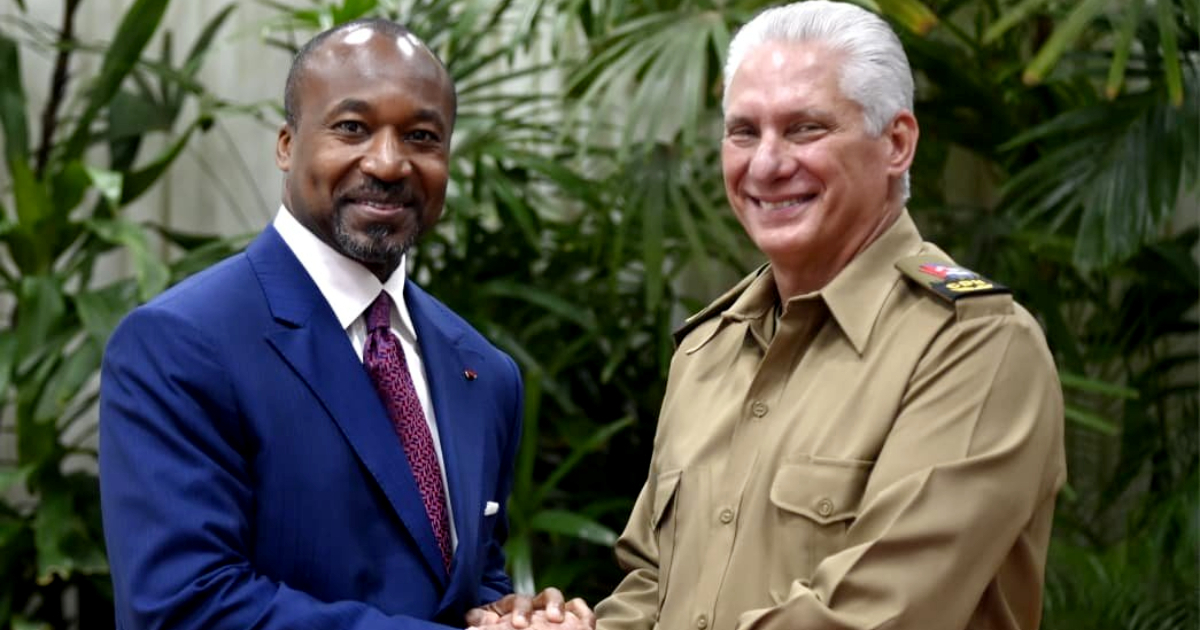
Since October 28, when Miguel Díaz-Canel addressed the nation on state television about Hurricane Melissa, the Cuban leader has consistently appeared in military fatigues. Even a month later, with the storm threat long past, Díaz-Canel, who also serves as the first secretary of the Communist Party, continues to don the olive green uniform, a symbol of the National Defense Council, at both domestic and international events.
During his meeting on November 28 with Denis Christel Sassou, the Minister of International Cooperation from the Congo, Díaz-Canel was once again seen in military attire, standing in stark contrast to Sassou’s formal blue suit. This attire choice highlights a striking discrepancy: the Cuban head of state appears more as a military commander than a civilian leader.
More Than Just a Symbol: The Weight of the Uniform
In Cuba, the olive green uniform is not just a color choice; it is a historic emblem of revolutionary and military power. Since 1959, it has been the attire of Fidel and Raúl Castro, the historic commanders, and the defense apparatus that upholds the regime. Díaz-Canel’s continuous use of this uniform, even after Hurricane Melissa, is unusual and politically charged.
Official sources report that the country is no longer on high alert. Special measures from the Civil Defense were lifted in eastern provinces in early November. There is no technical or institutional rationale for the president to maintain the uniform, yet political reasons might exist.
The Return of Raúl Castro
One explanation could be the visible return of Raúl Castro to the center of power. On October 16, just two weeks before the hurricane, the 94-year-old military general presided over a session of the National Defense Council at the Ministry of the Revolutionary Armed Forces (MINFAR). In official reports, Raúl was described as the “leader of the Revolution,” with Díaz-Canel seated to his right. This arrangement reaffirms that real power remains with the veteran military leader, despite his supposed retirement in 2021.
That meeting marked a turning point in Díaz-Canel's public image. Since October 28, he has not been seen in civilian clothes during public events. This shift seems to be a symbolic response to Raúl's display of authority: dressing like Raúl to project command that he doesn’t truly hold.
The Undeclared Health Crisis
Another factor might be the health crisis the regime refuses to acknowledge. As of December 1, the Ministry of Public Health confirmed 33 deaths from dengue and chikungunya, mostly in children. Deputy Minister Carilda Peña admitted that nearly the entire country is in an “epidemic zone,” yet the government insists the situation is “under control.”
In reality, the island is experiencing a health collapse: overwhelmed hospitals, medicine shortages, and halted fumigations due to a lack of insecticides. In this context, Díaz-Canel’s military attire acts as a display of authority and discipline, a way to show the country that the State “maintains control” over an emergency it cannot publicly admit.
Geopolitical Storm Fears
The internal crisis is compounded by external threats, notably the increasing U.S. military presence in the Caribbean. Washington is conducting naval exercises aimed at neutralizing the Cártel de los Soles, but in Havana and Caracas, these are seen as precursors to direct action against Venezuela.
The Cuban regime fears that the fall of Nicolás Maduro could trigger a domino effect on the island. Experts cited by EFE note that Havana currently receives about 32,000 barrels of Venezuelan oil daily, covering roughly 25% of its energy needs. Losing this supply would mean longer blackouts, soaring inflation, and a direct hit to the military conglomerate GAESA’s economic structure.
This concern was echoed in recent statements by Foreign Minister Bruno Rodríguez Parrilla, who called the U.S. maneuvers a “war-crazy” act. In reality, the tension has put Cuba in a state of defensive readiness. Díaz-Canel’s persistence in wearing military attire could be seen as an attempt to project strength amid a perceived external threat.
International Isolation and Vulnerability
Havana’s position is more precarious than ever. A recent analysis suggests that Cuba has lost its “global shield”: Russia, Iran, China, and the European Union are not as willing to support the regime as they were in the past. Moscow is focused on its war in Ukraine; Beijing favors economic pragmatism; Tehran is retreating after U.S. and Israeli strikes; and Brussels distances itself due to human rights violations on the island.
Without solid allies and with an economy on the brink of collapse, the Castro regime faces a precarious future. The potential fall of the Venezuelan chavismo could be the final blow. In this scenario, Díaz-Canel’s anti-imperialist rhetoric sounds like an echo from a bygone era, and the olive green uniform attempts to sustain a military narrative without international backing.
The Real Power Behind the Throne: Raúl Castro
Raúl Castro’s public return to MINFAR, his presentation as the “leader of the Revolution,” and the visible presence of his grandson, Colonel Raúl Guillermo Rodríguez “El Cangrejo,” reveal that military control remains intact. Raúl has not relinquished command of the army or GAESA, the country’s most powerful economic conglomerate.
In this context, Díaz-Canel appears more as a delegated figure of the military power than as an autonomous head of state. His prolonged use of the uniform can also be seen as an act of subordination: an attempt to visually align with the military elite that truly governs the country.
A Presidency in Defensive Mode
Meanwhile, on the streets, the Cuban people face blackouts, hunger, epidemics, and unprecedented mass emigration. The population perceives that the regime responds to crises not with transparency or solutions, but with displays of authority and propaganda.
Díaz-Canel’s uniform encapsulates this paradox: it aims to convey security but projects fear; it seeks to show leadership but confirms dependency. In a country without officially declared emergencies, the leader dresses as if at war. Perhaps he is, not against a cyclone or an invasion, but against the internal decay and political collapse of a system struggling to sustain its narrative.
Ultimately, his olive green uniform is not a fashion choice but a political symptom: a visible reflection of an entrenched regime that refuses to acknowledge its fragility while silently preparing to weather the coming storm.
Understanding Díaz-Canel's Military Attire
Why is Díaz-Canel wearing military uniforms in public?
Díaz-Canel's choice to wear military attire may be a political move to project authority and align with the military power structure in Cuba, especially in the current climate of internal and external pressures.
What does the olive green uniform symbolize in Cuba?
The olive green uniform is a historic emblem of revolutionary and military power in Cuba, associated with leaders like Fidel and Raúl Castro, and the defense apparatus supporting the regime.
How is the current health crisis impacting Cuba?
Cuba is facing a health crisis with a surge in dengue and chikungunya cases, overwhelmed hospitals, and medical shortages, which the regime is reluctant to fully acknowledge.
What external threats does Cuba perceive currently?
Cuba perceives a threat from increasing U.S. military activities in the Caribbean and fears that a collapse of the Venezuelan government could destabilize the island.