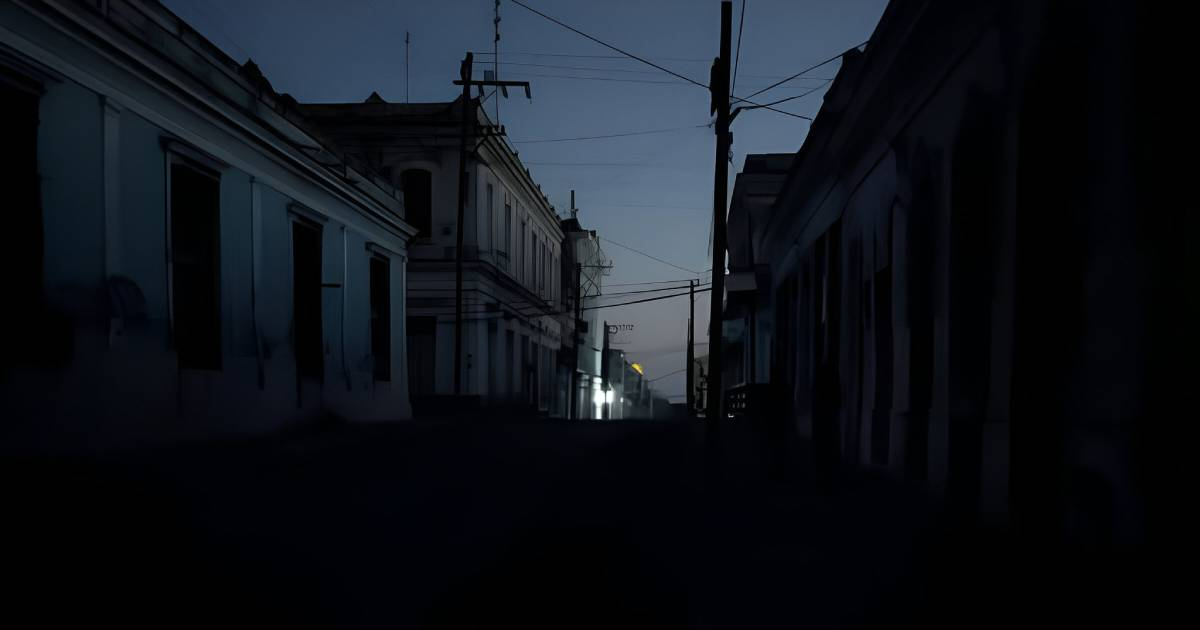
The state-run Electric Union, under the Cuban Ministry of Energy and Mines, announced on December 1, 2025, that the National Electric System (SEN) had a morning availability of 1,300 megawatts (MW), compared to a demand of 2,450 MW. This resulted in a shortfall of over 1,100 MW from the start of the day.
The situation is expected to worsen during peak hours. The government anticipates a peak demand of 3,250 MW with only 1,325 MW available, potentially leaving nearly two-thirds of the country without power at the same time, facing a deficit of 1,925 MW. "If conditions remain as forecasted, an impact of 1,995 MW is expected during these hours," stated the official report.
The UNE acknowledged that there were power outages throughout the previous day, and it was impossible to adhere to the supply schedule in provinces like Havana, where a maximum impact of 281 MW was reported, and entire blocks remained disconnected due to "emergency" throughout the early hours.
Causes of the Energy Collapse
The primary reasons for the energy crisis include malfunctions in units 2 of the Felton Thermal Power Plant and 3 of the Renté Thermal Power Plant, along with maintenance in five other thermoelectric plants, including Mariel, Santa Cruz del Norte, Cienfuegos, and Nuevitas.
Additionally, 96 distributed generation plants are out of service due to fuel shortages, and a further 68 MW cannot operate due to a lack of lubricants.
Impact on Havana and Beyond
Havana experienced blackouts starting at 1:00 p.m., with a peak impact of 281 MW at 7:00 p.m. Restoration of service was not possible due to low availability. Moreover, emergency conditions affected 118 MW, and during the night, cuts persisted due to deficits, keeping blocks 3, 4, 5, and 6 with 158 MW out of service.
Structural Failures and Economic Challenges
While the regime attempts to blame the crisis on foreign currency shortages and the aging infrastructure, the core issue is structural, stemming from decades of neglect in energy investments, corruption, and reliance on state control. This has left the nation with an outdated and inefficient electrical system.
Experts estimate that it would take between 8,000 and 10,000 million dollars to minimally restore the system, a sum unattainable under the current economic policies of the Communist Party.
Meanwhile, Cubans brace for another long night without electricity, enduring heat, mosquitoes, and exhaustion without fans or refrigeration.
The government promises "medium-term" solutions, yet the daily reality shows that Cuba remains trapped in a darkness that extends far beyond electricity.
Understanding Cuba's Energy Crisis
What are the main causes of Cuba's current energy crisis?
The crisis is mainly due to malfunctions in key thermal power plants, maintenance issues, and lack of fuel and lubricants, compounded by structural problems from decades of underinvestment and state control.
How is Havana affected by the blackouts?
Havana has experienced significant power outages, with maximum impacts reported and entire blocks disconnected due to emergencies, leaving residents without electricity during crucial hours.
What financial investment is needed to restore Cuba's electrical system?
Experts estimate that restoring the system would require an investment of between 8,000 and 10,000 million dollars, a challenging figure given the current economic policies.