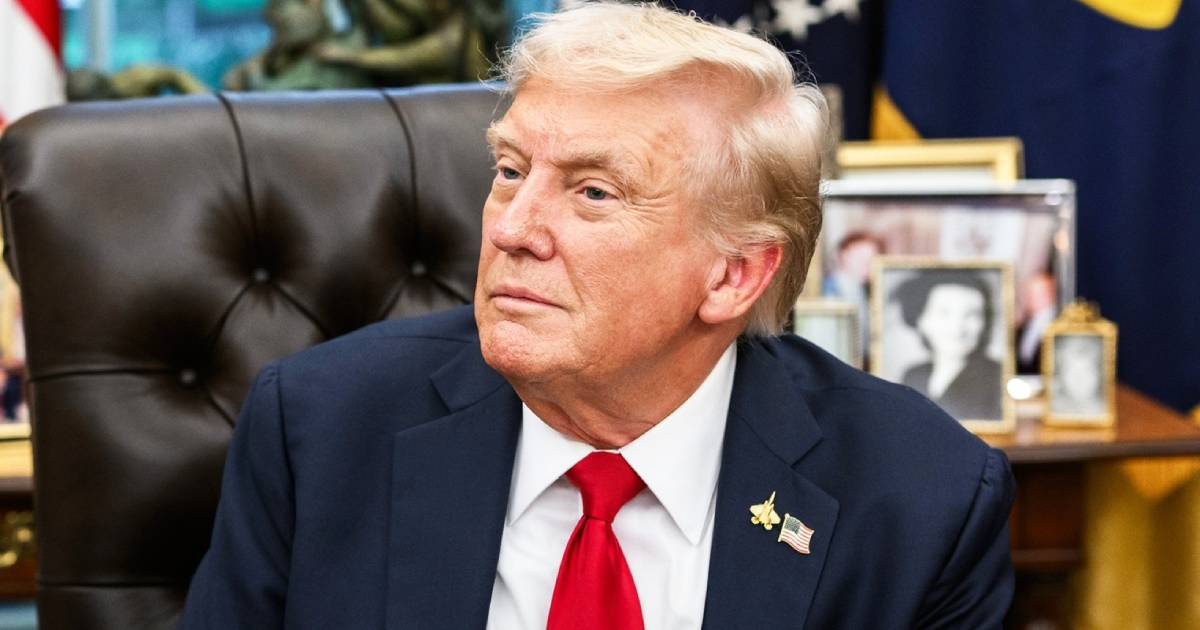
President Donald Trump of the United States confirmed on Sunday that he had a phone conversation with Nicolás Maduro, amidst escalating tensions between Washington and Caracas not seen in years. This revelation was made aboard Air Force One during an informal chat with journalists.
When directly questioned about the conversation, as reported by The New York Times, Trump simply replied, "The answer is yes." However, when pressed for more details, he refrained from characterizing the exchange: “I wouldn't say it was a good or bad call; it was just a call.”
Despite withholding specifics about the discussion, Trump maintained his strong message of pressure against Caracas. When asked why the White House deemed Venezuelan airspace off-limits, Trump was blunt: "Because we consider Venezuela not a very friendly country."
He claimed, without evidence, that "millions" of Venezuelans have arrived in the United States from "prisons, gangs, and drug trafficking networks," asserting that many of them "should not be in our country."
The Secret Call and Heightened Tensions
The public confirmation of the contact comes after investigations by The New York Times and Infobae revealed that Trump and Maduro had spoken over the past weekend. While initial reports suggested they discussed the possibility of meeting on U.S. soil, Infobae's expanded report stated the White House firmly denied any intention of such a meeting.
According to Infobae, Trump issued an ultimatum demanding that Maduro and his close circle leave Caracas, a demand including figures like Diosdado Cabello, Vladimir Padrino López, and siblings Delcy and Jorge Rodríguez.
Hours following the call, Washington designated the so-called "Cartel of the Suns" as a Foreign Terrorist Organization (FTO), enabling expanded military and financial operations against the Chavista leadership.
"Don't Read Too Much," Yet Military Pressure Mounts
During his exchange with reporters, Trump urged that people "don't read too much" into whether there might be an imminent attack on Venezuela. However, this statement contrasts with the regional tension.
Since September, the United States has carried out numerous bombings on vessels in the Caribbean, with Trump himself suggesting that operations could soon extend to land targets. “The terrain is easier,” he remarked recently, emphasizing that no option is off the table.
Sources cited by Reuters additionally report that the CIA has ramped up covert operations to prepare "political transition options," while the Pentagon maintains a naval blockade off Venezuela's coast.
Maduro Accuses the U.S. of Oil Appropriation Attempts
Also on Sunday, the Venezuelan government heightened its rhetoric. According to a letter from Maduro to the secretary-general of the Organization of the Petroleum Exporting Countries (OPEC), the United States is allegedly attempting to seize Venezuela's "vast oil reserves" through "the use of lethal military force."
The document, published by El País, warns of a threat to global energy stability at a time when the Caribbean is witnessing an unprecedented increase in U.S. military operations.
Maduro accuses Washington of conducting a "campaign of harassment" since August, which, according to him, includes more than 14 warships, 15,000 troops, and at least 20 bombings on small vessels, resulting in over 80 "extrajudicial killings."
In the letter, Maduro calls on OPEC and OPEC+ countries for support to halt what he describes as an aggression threatening the "balances of the international energy market."
Key Questions on U.S.-Venezuela Relations
What did Trump discuss with Maduro during their call?
Trump confirmed the call but refrained from providing specific details, only stating it was not particularly good or bad.
Why does the U.S. consider Venezuela unfriendly?
The U.S. considers Venezuela unfriendly due to its political stance and alleged threats to regional stability and U.S. interests.
How has Washington responded to the situation in Venezuela?
Washington has increased military and financial pressure, designating the "Cartel of the Suns" as a terrorist organization and considering broader operations.