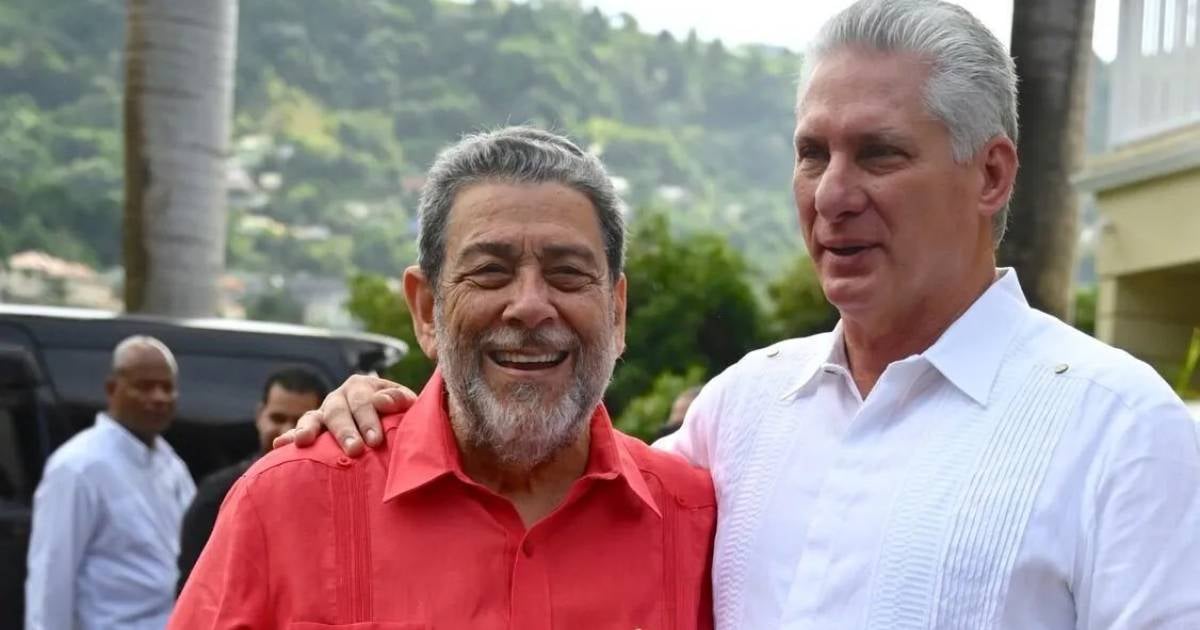
As of last Friday, Havana finds itself without one of its most steadfast allies on the political map of the Caribbean. The electoral defeat of Ralph Gonsalves, who held power in Saint Vincent and the Grenadines for 24 years, leaves the Cuban regime without one of its strongest regional voices. While the official public response was diplomatic, the emotional undertones in messages from Miguel Díaz-Canel and other officials underscore the symbolic significance of this loss.
The initial reaction came from Díaz-Canel's social media, where he congratulated the new Prime Minister, Godwin Friday, a 66-year-old historian and political scientist educated in Canada and leader of the New Democratic Party.
However, the more telling message was directed toward the man who, for two decades, supported Cuba at the United Nations, defended its medical missions, and became a regional champion of Castroism. “Dear brother Ralph, your loyal friendship will forever remain a symbol of brotherhood and solidarity,” Díaz-Canel wrote, in a nearly fraternal farewell to the leader who opened diplomatic doors in forums where Havana is often isolated.
The official stance was echoed by other top officials. Foreign Minister Bruno Rodríguez emphasized the "friendship" and "solidarity" between the two nations, while Manuel Marrero sent a message of continuity to the new government, but reserved a "grateful embrace" for Gonsalves.
State-controlled media merely reported the election results, avoiding any political analysis of the defeat of one of Castroism’s most solid supporters.
Venezuela, another regime that lost a key ally, issued a more detailed statement highlighting Gonsalves' role in regional integration, defending common interests, and initiatives that directly benefited the governments of Caracas and Havana. Meanwhile, the Venezuelan embassy in Cuba congratulated Friday but also acknowledged the "notable career" of the outgoing prime minister.
In the case of Nicaragua, independent media recalled that Gonsalves was the only head of state present at the Sandinista anniversary in 2023 and a frequent ally of Ortega and Murillo, who honored him with their highest political decoration.
The defeat of "Comrade Ralph," as he is known in leftist circles, reshapes the regional landscape. For Cuba, his departure means losing a reliable vote in international bodies and a vocal defender of its medical missions, even as these have been criticized as forms of labor exploitation.
For Caracas and Managua, it represents the loss of a diplomatic bridge that served as a buffer during times of isolation.
While Godwin Friday promises "transformative changes" and a new direction for his country, the Castro regime faces an awkward scenario. It remains uncertain how the new government will proceed, as Saint Vincent and the Grenadines could distance itself from the political axis led by Havana, Caracas, and Managua for the first time in two decades.
Implications of Ralph Gonsalves' Electoral Defeat
What impact does Ralph Gonsalves' defeat have on Cuba?
The electoral defeat of Ralph Gonsalves means Cuba loses a consistent ally and advocate in the Caribbean, affecting its influence in regional politics and international forums.
How might the new government in Saint Vincent and the Grenadines change its alliance with Cuba?
With Godwin Friday in power, Saint Vincent and the Grenadines may shift its political alignment, potentially moving away from Havana's influence, though the exact changes remain to be seen.