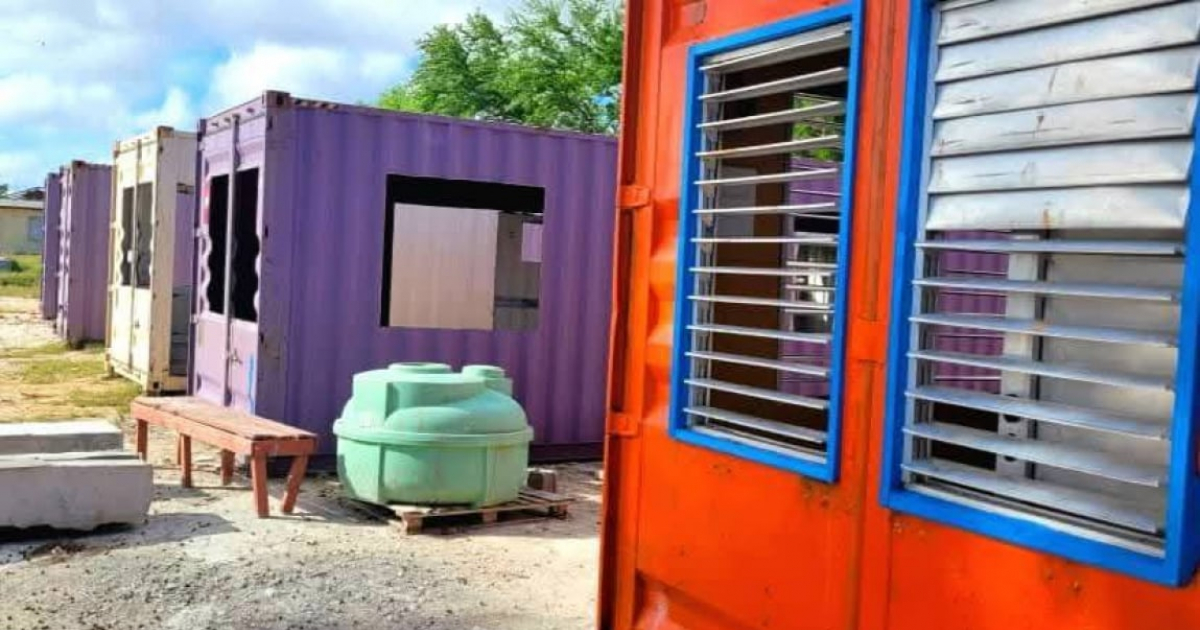
One month after the catastrophic impact of Hurricane Melissa, with countless families in Holguín still struggling to piece their lives back together amidst the wreckage, the provincial government has introduced a controversial housing solution: homes made from repurposed shipping containers.
While the official newspaper Ahora painted a picture of enthusiasm and progress, describing these container homes as "creative and technologically advanced" solutions, the local population has largely voiced strong opposition. Many see these metal structures as further proof of the government's historical failure to provide decent housing for its citizens.
The state-run publication praised the container homes as "safe, resilient, and dignified," portraying the province as buzzing with solidarity and effort. The narrative of industrious activity—factories, military companies, and local businesses working "without improvisation"—was promoted, yet it starkly contrasts with the everyday reality for many residents.
Public Outcry Over "Solar Ovens"
Social media erupted with criticism of Ahora's portrayal of the container homes. Engineers, parents, artists, and residents from various provinces agreed on one thing: living inside a metal box in Cuba's climate is a sign of extreme poverty, not modernity.
"That's like cooking someone alive with the intense sun we have here," warned a local mother. An engineer echoed the sentiment, noting, "They're solar ovens, and if not secured properly, any flood or hurricane will sweep them away."
Critics pointed out that while container homes exist in other countries, they are typically well-insulated, climate-controlled, and designed to meet housing standards that are not even considered in Cuba. "Calling a repurposed container a 'dignified home' is disrespectful, unethical, and inhumane. If they're so dignified, let the officials live in them and give their homes to the people," suggested a resident from Camagüey.
Recycled "Solution" Already Deemed a Failure
The popular sarcasm is well-founded: just last week, the government admitted the failure of its national program for container housing, launched with much fanfare only a year prior as an "economic and ecological" solution to the country's severe housing shortage.
According to an official government account, over 1,700 containers have been released, but the project is virtually stagnant due to delays in extraction and adaptation. A recent assessment meeting, led by Manuel Marrero, highlighted failures in other basic sectors—from garbage collection to funeral services—serving as a reminder of the nation’s structural crisis affecting all aspects of daily life.
Marrero acknowledged the lack of oversight and inefficiency in adhering to regulations, attempting to justify the shortcomings by calling for "sensitivity and immediacy" in addressing citizens' needs. Meanwhile, families continue to wait.
Hurricane Melissa Exacerbates an Already Unbearable Housing Crisis
Hurricane Melissa only deepened an already dire situation. Thousands of homes were destroyed or severely damaged, leaving families not only without shelter but also stripped of furniture, appliances, and essential goods that are virtually irreplaceable given the country's inadequate salaries.
Instead of providing free materials to those affected, the government persists in charging for and regulating resources, even for those who have lost everything. Presenting metal structures without thermal insulation, proper design, or real safety guarantees as an "alternative" further highlights the disconnect between official triumphalism and the actual despair of affected families.
In the official narrative, they speak of "reinventing the way to create homes," yet in the hardest-hit neighborhoods, the question remains: how can a government that failed to construct container homes over a year now expect to do so for thousands who lost everything in mere hours?
A Province "Rising" at the People's Expense
The Ahora publication emphasized the presence of the first secretary of the Party in Holguín, Joel Queipo Ruiz, overseeing the efforts "from the first dawn after the hurricane." However, the real issue for the population is not the lack of televised official visits but the absence of genuine, sustainable, and humane solutions.
Providing containers as homes, in a country suffering from decades of decay and underinvestment, appears to be just another makeshift patch for a long-neglected housing collapse. There's nothing innovative about it—only the starkest evidence of a government that, amid an emergency, once again arrives late, inadequately, and with answers the population openly rejects.
In Holguín, as throughout Cuba, those affected by Melissa continue to wait for what should be basic: a secure home, not a sweltering, uninsulated container disguised as progress.
FAQs on Container Housing in Holguín
Why are container homes controversial in Holguín?
Container homes are controversial in Holguín because they are seen as inadequate and unsafe solutions to the housing crisis, lacking proper insulation and design for Cuba's climate.
What challenges has the container housing project faced in Cuba?
The container housing project in Cuba has faced challenges such as delays in extraction and adaptation of containers, and inefficiency in implementation, leading to stagnant progress.
What impact did Hurricane Melissa have on Holguín's housing situation?
Hurricane Melissa exacerbated Holguín's housing crisis by destroying or severely damaging thousands of homes, leaving many families without basic necessities and shelter.