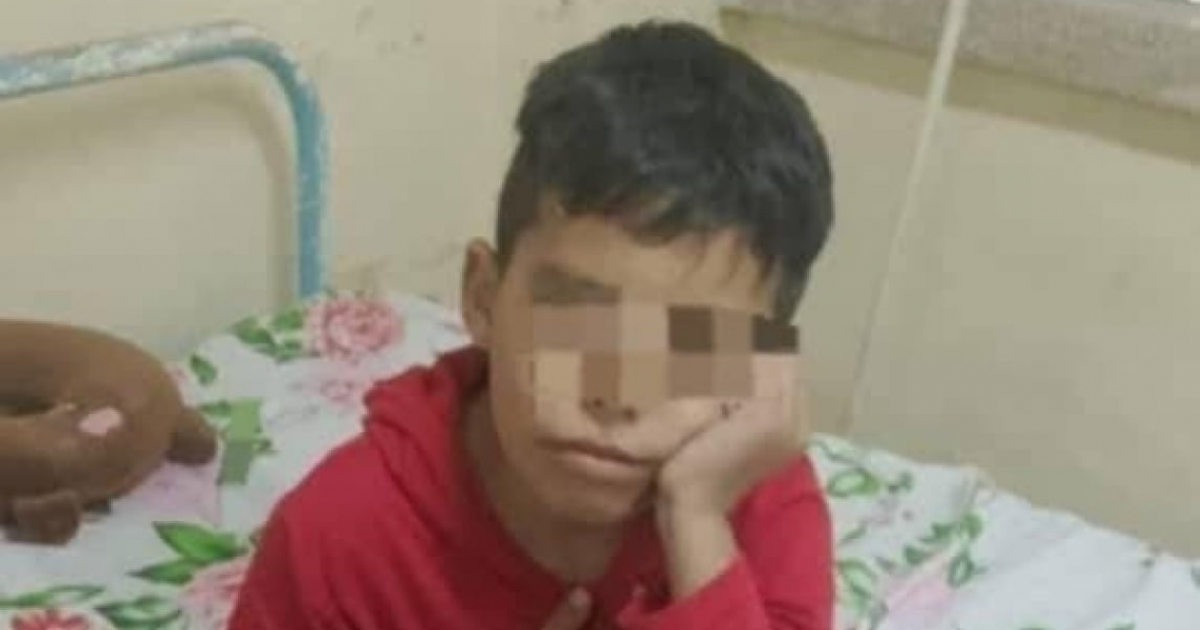
Social media once again became a lifeline as activist Idelisa Diasniurka Salcedo Verdecia urgently appealed for blood donors for a Cuban child in dire need of A+ blood to stabilize his condition.
According to her Facebook post, the child suffers from hemolytic anemia and has a severely swollen spleen, a combination that led him to Morón Hospital with zero platelets just two days ago.
He is currently in critical condition, with his family racing against time to secure the blood that the healthcare system has failed to provide.
The child's mother, whose phone number is (50841393), and grandmother (55478157), have reached out for help to anyone capable of donating.
"Please help and share," concluded the brief message, which, like many others in recent months, replaces the role that institutions should play.
The Growing Trend of Social Media Appeals for Help
This situation is not an isolated incident. About ten days ago, actress and singer Iyaima Martínez Navarro also relied on the generosity of citizens to undergo surgery at Hermanos Ameijeiras Hospital, requiring B+ blood but also accepting O+ and B- donations.
Her colleague Mariela López Galano had to broadcast the plea online, including phone numbers for coordination, because the surgery couldn't proceed without donors.
Just days before, in Bayamo, another woman publicly voiced her distress: she was seeking B- and O- donors to save her 53-year-old mother. She urgently offered to pay if necessary, as the hospital had no reserves. Every minute was critical, and assistance from strangers was the only option.
These cases starkly highlight how many Cuban families rely solely on social media to try and save a loved one, in a country where healthcare institutions can no longer provide basic solutions.
Official Statements vs. Reality on the Ground
In contrast to this grim reality, around the same time, health authorities in Granma claimed that the Bayamo blood bank was fully equipped to operate normally as Hurricane Melissa approached.
The provincial health director publicly assured that staff and resources were secured. However, cases like Marilin’s that surfaced shortly after revealed a hospital situation far removed from those statements.
The necessity of turning to social media for blood donations shows that, in practice, families continue to face a situation where essential resources are lacking, and the institutional response falls short.
A Chain of Emergencies No Longer Shocking
Blood donation requests have become emblematic of the system's decline: families searching for platelets for young children, adult patients recording themselves from beds pleading for help, hospitals unable to ensure basic supplies.
In Holguín, relatives of a two-year-old girl with leukemia had to request two daily platelet donations online. In Ciego de Ávila, a 38-year-old man with the same diagnosis publicly pleaded for blood from the very hospital that should have been able to treat him.
Each of these cases underscores the severity of the healthcare crisis: shortage of reagents, lack of basic supplies, resource-depleted laboratories, and blood banks unable to meet demand.
Amid this void, families bear the responsibility of securing what any functional system should guarantee.
When Social Media Becomes the Sole Resource
Diasniurka’s plea about the child from Morón underscores a painful truth: in Cuba, survival hinges more on the solidarity of people than on the healthcare system's capabilities.
It's the citizens who circulate requests, donate, coordinate, share, and informally sustain what should be a state obligation.
As the family waits for A+ donors to stabilize the child, his case adds to a country where every medical emergency seems solvable only if it goes viral.
This is yet another example of how the right to healthcare, far from being assured, has become a daily struggle against scarcity, precariousness, and an increasingly unsustainable official silence.
Understanding Cuba’s Healthcare Challenges
Why are Cuban families turning to social media for blood donations?
Cuban families are resorting to social media because the healthcare system is unable to provide essential resources like blood, forcing them to seek help from the public.
What types of blood are currently in demand in Cuban hospitals?
Cuban hospitals are experiencing a shortage of various blood types, including A+, B+, O+, and B-, which are critical for surgeries and medical emergencies.
How has the healthcare system in Cuba failed its citizens?
The healthcare system in Cuba has failed its citizens by not being able to supply basic medical resources and support, leading families to handle life-threatening situations on their own.