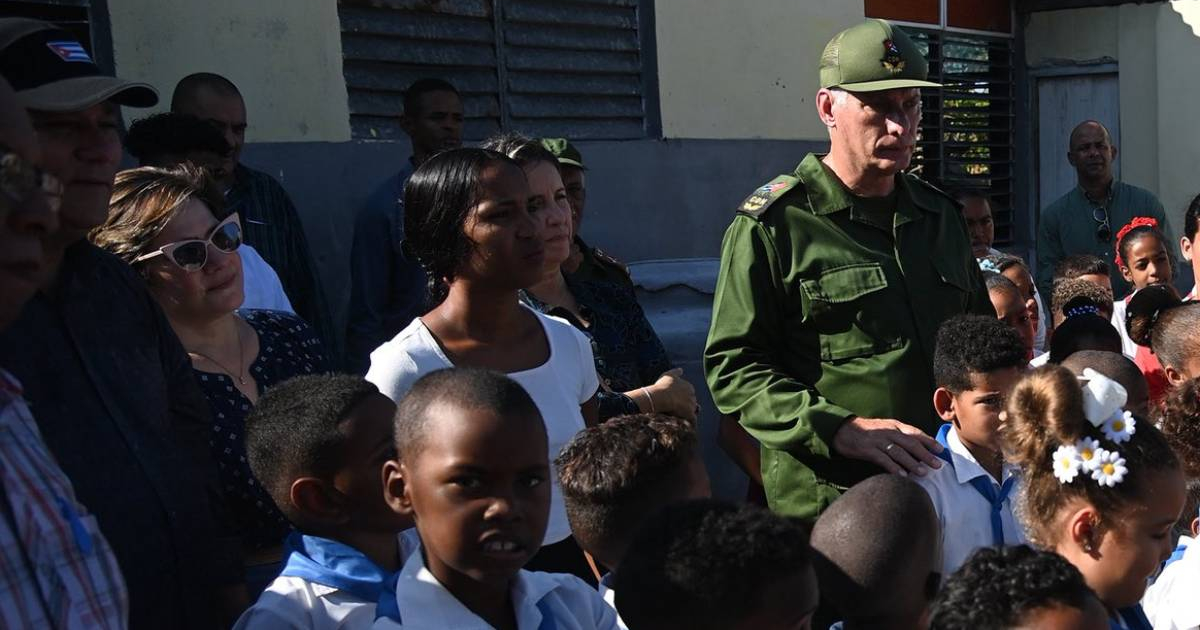
Lis Cuesta, wife of Cuban leader Miguel Díaz-Canel, appeared in Santiago de Cuba on Thursday. During her visit, she toured a school and interacted with residents who were impacted by a cyclone that caused widespread damage across eastern provinces over a month ago.
Social media has been buzzing with criticism over Lis's delayed appearance in the disaster-stricken areas, as she had not visited since the cyclone hit.
In her social media posts, the "non-first lady" has emphasized her role in these official visits as a government official, focusing on "Education and Culture," to oversee post-cyclone recovery efforts.
Images of the visit were shared by Cuba's Presidency, quoting Díaz-Canel who remarked on the "delight" of being there, noted a "hopeful atmosphere," and pledged to return to see the children at the educational center.
In Cayo Granma, one of the hardest-hit areas, the regime itself admitted that out of 256 surveyed homes, 170 were affected, with 15 completely destroyed and 20 partially collapsed.
Additionally, 31 roofs were reported as entirely destroyed, and 84 suffered partial damage. Although authorities claim to have distributed "150 mattresses," these are being sold to the public, despite the ongoing scarcity, unsanitary conditions, and neglect faced by the communities.
Electricity remains unrestored in some parts of Santiago and surrounding municipalities. The water supply is still disrupted, forcing many families to cook with wood and rely on makeshift cisterns for survival.
The humanitarian crisis is compounded by a chikungunya outbreak, predominantly affecting children and the elderly, exacerbated by accumulated garbage and stagnant water in areas where the sanitation system collapsed post-cyclone.
Meanwhile, Díaz-Canel and Lis Cuesta continue their promotional tour in the east, reiterating messages of "resilience" and "victory" at public events, yet failing to offer tangible solutions to the thousands left homeless and without aid.
The Cuban leader assured that "resources will continue to arrive" and urged people "not to fear," although despair grows among those who hear him repeat unfulfilled promises week after week.
Lis took the opportunity during her Santiago visit to pay her respects at the grave of Fidel Castro, sharing a photo of her tribute on her X profile with the caption: "FIDEL, when the road gets steep, I turn to you. Your legacy continues to guide us. Homeland or Death. We shall overcome!"
The cyclone struck eastern Cuba a month ago, leaving behind a trail of destroyed homes, agricultural losses, and a collapsed electrical system. Despite official declarations, recovery efforts are proceeding sluggishly, as the regime prioritizes political control and propaganda over aiding victims.
Impact of Cyclone and Government Response
What areas in Santiago de Cuba were most affected by the cyclone?
Cayo Granma was identified as one of the most severely impacted areas, with significant damage to homes and infrastructure.
How has the Cuban government responded to the cyclone's aftermath?
The government has focused on official visits and propaganda, promising resources and assistance, though recovery efforts are slow and insufficient.
What challenges are residents facing post-cyclone?
Residents are dealing with a lack of electricity, disrupted water supply, unsanitary conditions, and a chikungunya outbreak, amid minimal government aid.