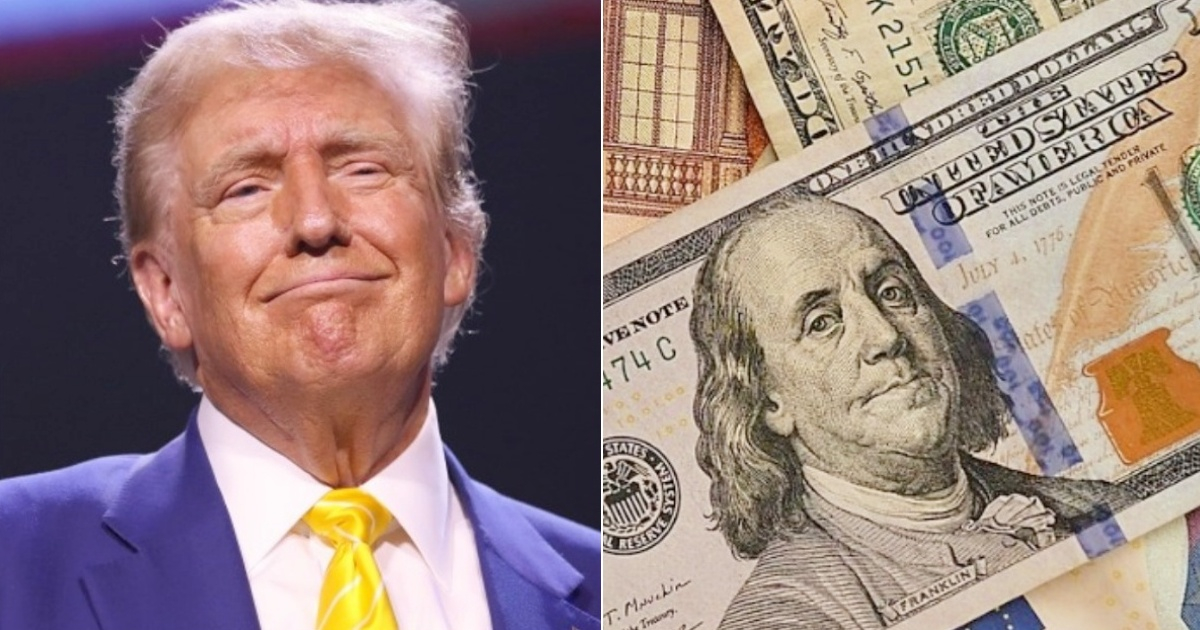
President Donald Trump has renewed his plan to distribute direct payments of at least $2,000 to middle and low-income Americans, financed by revenue from tariffs on imported goods.
This initiative has sparked enthusiasm in some circles and strong criticism in others, as it navigates a politically and economically challenging landscape that prevents immediate implementation.
From the White House, Trump announced on Monday that these payments are scheduled for release "between mid and late 2026," backed by the government's earnings from increased tariffs on foreign imports.
"We've accumulated hundreds of millions of dollars from tariffs. We're planning to issue dividends later, likely by mid-next year or a little later," Trump told reporters.
According to Trump, using these funds would not only ease the economic burden on millions of families but also help reduce the national debt, which currently exceeds $37 trillion.
"Those opposing tariffs are FOOLS! We're collecting billions and will soon begin tackling our MASSIVE DEBT," he emphasized on Truth Social.
The Economic Team's Perspective
Kevin Hassett, director of the National Economic Council, reinforced Trump's stance by stating that many Americans have already benefited from policies similar to the proposed check, thanks to the administration's fiscal strategies.
"In a time when we're thankful for so much, let's not forget... we've already sent checks of around $2,000 to everyone earning extra hours or tips," Hassett mentioned during a Fox News interview.
Hassett defended the tariff policy as a tool that has generated fiscal surpluses in recent months, promising that Trump will intensify efforts to mitigate inflationary pressures, which he attributes to Joe Biden's administration.
"A typical family has had to spend $20,000 or $25,000 more annually just to cover Biden's inflation," Hassett claimed.
Republican Resistance
Despite the optimistic declarations from the White House, the proposal faces a tough political path.
Some Republican lawmakers have expressed disagreement, arguing that the country is not in a fiscal position to undertake such a commitment.
Senator Ron Johnson was clear: "I wish we were in a position to return money to the American public, but we're not."
Johnson reminded that the projected deficit for this year is two trillion dollars, far exceeding levels seen during the Obama and Trump administrations.
Representative Andy Biggs also voiced his opposition: "I'd prefer we lower the overall tax rate and make it permanent."
Meanwhile, Senator Rick Scott suggested using tariff revenues directly to pay down the national debt.
Eligibility for the Checks
Although Trump has indicated that the payments would target "middle and low-income Americans," several questions remain unanswered.
It's unclear whether minors will be included or what the specific income threshold will be to qualify.
Treasury Secretary Scott Bessent has expressed skepticism, warning that the proposal will require congressional approval, posing a significant hurdle given internal divisions within the Republican Party.
Funding Source and Challenges
According to the Tax Foundation, tariffs could generate $158.4 billion in 2025 and $207.5 billion in 2026.
However, the estimated total may not suffice to cover the cost of distributing $2,000 payments to tens of millions of people.
JPMorgan has also estimated that American consumers are bearing about 20% of the real cost of tariffs, contradicting government claims that importing companies absorb the impact.
Legislative Alternatives
Prior to Trump's announcement, Senator Josh Hawley introduced the American Workers' Rebate Act, proposing to use tariff revenues to send checks of at least $600 per adult and dependent child.
According to this plan, a family of four could receive up to $2,400.
However, the bill has not progressed in Congress since its introduction in July.
The Feasibility of Trump's Proposal
Trump's proposal combines immediate economic relief with a narrative of nationalist economic success but faces legislative barriers and internal objections.
In a context of persistent inflation and fiscal pressures, many question whether this is an electoral strategy or an achievable policy.
Meanwhile, the White House insists that the president is committed to the idea.
"President Donald Trump is committed to sending $2,000 rebate checks using tariff revenues on imported goods," stated Press Secretary Karoline Leavitt.
Details regarding logistical implementation, distribution mechanisms, and political viability remain unclear, but Trump has once again put forward a proposal with a direct impact on millions of Americans' wallets.
FAQs on Trump's $2,000 Tariff-Funded Checks
When will the $2,000 checks be distributed?
President Trump announced that the checks are expected to be distributed between mid and late 2026.
Who is eligible to receive the $2,000 checks?
The payments are intended for middle and low-income Americans, though specific eligibility criteria have not been finalized.
What is the source of funding for these checks?
The checks will be funded by revenue generated from tariffs on imported goods.
What are the challenges facing the proposal?
The proposal faces political challenges, including internal Republican divisions and the need for congressional approval.