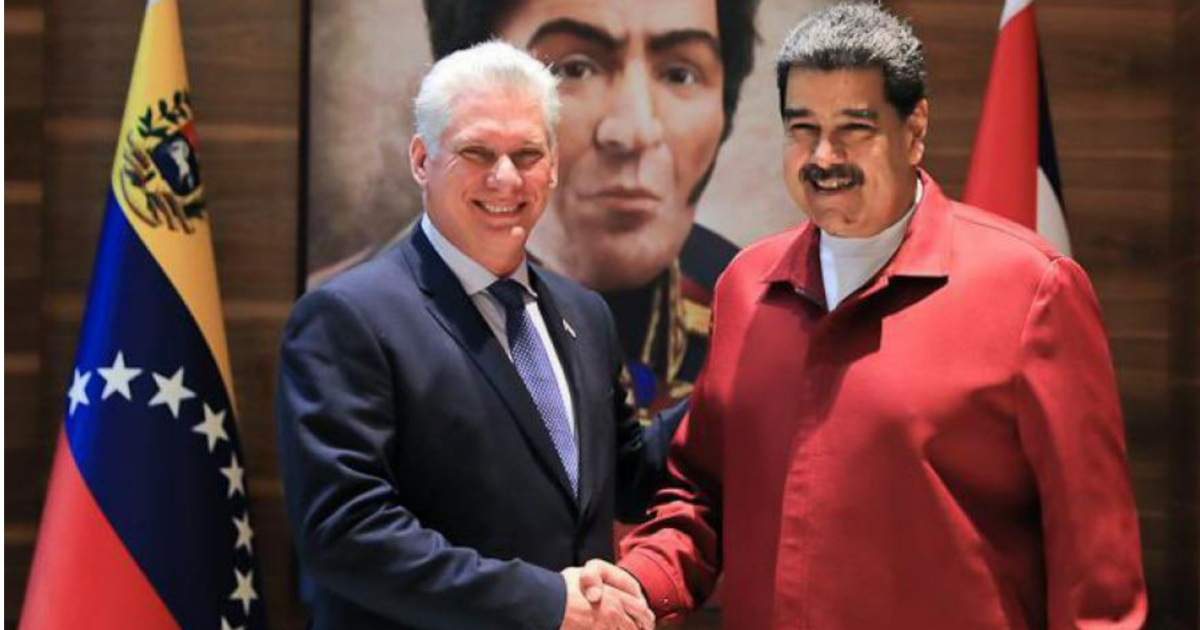
On Sunday, Cuban leader Miguel Díaz-Canel extended his congratulations to his ally, Nicolás Maduro, on his birthday, amidst escalating tensions between the Venezuelan regime and the United States.
"Dear brother Nicolás Maduro, receive our heartfelt congratulations on your birthday on behalf of the Party, the government, and the Cuban people. No Yankee pretense can undermine your steadfastness, courage, and unwavering commitment to the Bolivarian and Chavista homeland," Díaz-Canel expressed on the platform X.
Many Cubans responded to this exchange of greetings between dictators, hinting at the potential end of their regimes. Comments such as "I don't think there's much time left" or "Tick tock, tick tock" were among the responses.
"Dictators and criminals congratulate each other"; "As a gift, he will move to a maximum-security box in NY"; "The last birthday as a dictator" were other remarks made by Cubans and Venezuelans trolling those who oppress them.
Heightened Tensions with the U.S.
Maduro's birthday coincided with a weekend of heightened tensions with the United States. On Saturday, Reuters reported that the U.S. government is contemplating a new phase of operations concerning Venezuela in the coming days.
The news was shared with Reuters by four officials from the Trump Administration, one of whom mentioned that options under consideration included attempts to unseat Maduro. The news agency could not confirm the precise timing or scope of these potential operations, nor if President Donald Trump had made a final decision.
However, two anonymous officials, cited by Reuters, suggested that covert operations might be the next move against the Maduro regime. Both the CIA and the White House refrained from commenting.
One official remarked, "President Trump is willing to use all resources of American power to prevent drugs from reaching our country and to bring those responsible to justice."
Venezuelan Response to U.S. Threats
Venezuela's response came through the regime's Defense Minister, Vladimir Padrino López, who declared that the Maduro government would respond "with their heads held high" to the U.S. threat.
Despite his defiant tone, the regime's military leader acknowledged the U.S. deployment as a "threat" during a Saturday appearance on state television. He labeled the U.S. as "one of the most genocidal empires in history," recognizing its power from "every perspective: technological, economic, financial, military, always to cause harm and preserve its interests."
"The North American imperialism decided to threaten us even more with bomber aircraft, missile ships, nuclear-powered submarines in the Caribbean, and what did we do? We responded with greater national unity," he asserted.
Padrino emphasized that "no threat, no military deployment, no matter how powerful or intimidating it may seem," will deter them from their path of "freedom and independence."
Airlines Cease Flights to Venezuela
On Saturday, it was also reported that six international airlines have temporarily suspended operations in Venezuela following a security warning issued by the United States.
The Spanish airline Iberia, Portugal's TAP, Colombia's Avianca, Trinidad's Caribbean Airlines, Brazil's GOL, and Chile's LATAM suspended their flights to and from Venezuela due to an alert from the United States Federal Aviation Administration (FAA) about an "increase in military activity" and deteriorating security conditions in the airspace over the Caribbean nation.
Marisela de Loaiza, president of Venezuela's Airline Association (ALAV), confirmed to EFE that the six airlines chose to cancel operations in response to the warning, which particularly affects the Maiquetía flight information region, a hub for international arrivals and departures.
According to the Spanish newspaper El País, while the FAA has not banned flights over Venezuela, it has advised airlines to "exercise extreme caution" due to "a potential risk situation" linked to increased military maneuvers in or around Venezuelan territory.
The advisory remains in effect until February 19 and requires airlines to provide 72-hour advance notice if they plan to enter Venezuelan airspace.
Regional context further heightens concerns. El País notes that the USS Gerald Ford, the world's largest and most modern aircraft carrier, has recently joined Washington's naval deployment in the Caribbean as part of Operation Southern Lance, a campaign the United States presents as a fight against drug trafficking but which has sparked political tensions and speculation about possible actions against Nicolás Maduro's government.
Maduro's Defiant Stance
On Friday, Nicolás Maduro made a spectacle of himself by dancing to a song featuring his unique attempt at speaking English.
"No war, no crazy war, no, no, no, how do you say it in English? Peace, peace, yes peace," Maduro was heard repeating and singing along to the music during a student day celebration in Caracas.
"It's Friday, and what happens on Friday? And what are we going to do today? Peaceful Venezuela, Friday night is declared a total party, party, party, party! It's Friday, and I'm going to party! And nothing stops me!" he declared to the gathering of students.
Amid the U.S. tensions, the Venezuelan dictator insisted that American "snares" would not stop him. "Stop the war, no to war, Venezuela wants peace," he added.
Frequently Asked Questions about U.S. and Venezuela Tensions
What actions is the U.S. considering against Venezuela?
The U.S. is considering a new phase of operations, which may include attempts to unseat Nicolás Maduro through covert operations, although details remain undisclosed.
Why have airlines suspended flights to Venezuela?
Six international airlines have suspended flights due to a security alert from the U.S. FAA, citing increased military activity and deteriorating conditions in Venezuelan airspace.
How has Venezuela responded to U.S. threats?
Venezuela, through Defense Minister Vladimir Padrino López, has vowed to respond with unity and defiance, despite acknowledging the U.S. threat as significant.