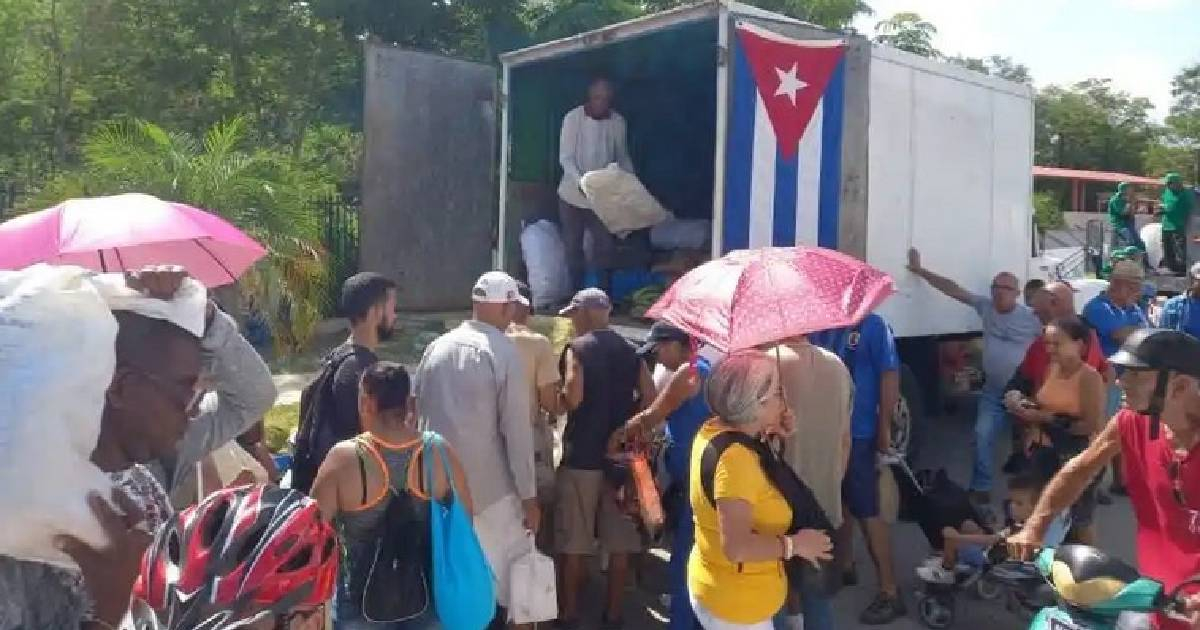
The government in Villa Clara province has unveiled plans for special year-end fairs featuring food, beverages, and agricultural products, alongside packages aimed at vulnerable groups.
Officials are striving to provide "different" celebrations despite the ongoing economic challenges.
During a meeting with various production entities, led by the Vice President of the Defense Council, Milaxy Yanet Sánchez Armas, authorities detailed the organization of culinary, recreational, and cultural events, as well as the sale of food and drinks, reported the provincial radio station CMHW.
René Bacallao Figueroa, the provincial government's program coordinator, assured that despite economic hardships, there is a "willingness" to orchestrate a unique year-end for the community.
Highlighted measures include special packages for vulnerable families, pregnant women, children, and the elderly.
Yanelis Saborido Pérez, director of the Emilio Córdoba Agroindustrial Grain Company, stated that two extra pounds of rice per household are currently being distributed, with another two to follow soon.
She also promised that rice would be available at the December fairs at a cost lower than 155 pesos per pound.
Milagros Heredia Moffs, head of the Villa Clara Beverage and Soft Drink Company, announced that each family unit would receive a bottle of Decano Nacional rum, and arrangements are underway for the sale of soft drinks and syrup for children, which will also be available at the fairs.
Additionally, Ihosvani Martín Peña, the delegate of Agriculture in the central region, disclosed that "giant" agricultural fairs with extensive supplies of root vegetables and greens will take place in all 13 municipalities.
The economic crisis has turned these agricultural fairs into chaotic environments, with prices so high they are out of reach for most Cuban families.
Often, these venues are exploited to sell bones to the public, capitalizing on the severe food shortage and the reality that many Cubans have no choice but to buy them despite their exorbitant prices.
Recently, the Communist Party secretary in Matanzas, Mario Sabines Lorenzo, acknowledged issues in the province's agricultural fairs, such as frequent price violations, unmet production targets, hoarding by resellers, and minimal impact from digital sales.
While acknowledging these problems, he did not offer specific solutions or timelines to address them, highlighting a disconnect between political rhetoric and the Cuban people's reality.
Regarding the lack of government control in organizing these commercial activities, official journalist Yuni Moliner commented in June 2024 that "the deceit is so blatant that sometimes you can't tell if you're at a fair or in the Wild West."
In Havana, the government enforced Resolution 148/2025, setting price caps for farm products and conducting control operations involving fines and confiscations.
These operations have resulted in penalties, seizures, and restrictions on private vendors, who often struggle to comply with official regulations.
This situation has drawn public criticism, as many relied on informal sales to survive amidst the scarcity and rising costs of basic goods.
Understanding Villa Clara's Year-End Government Initiatives
What are the special year-end fairs in Villa Clara?
The special year-end fairs in Villa Clara are events organized by the government offering food, beverages, and agricultural products, alongside cultural and recreational activities.
Who will benefit from the aid packages?
The aid packages are intended for vulnerable groups, including families in need, pregnant women, children, and the elderly.
What challenges do agricultural fairs face in Cuba?
Agricultural fairs in Cuba face challenges such as high prices, price violations, unmet production targets, and hoarding by resellers, making them inaccessible to many.