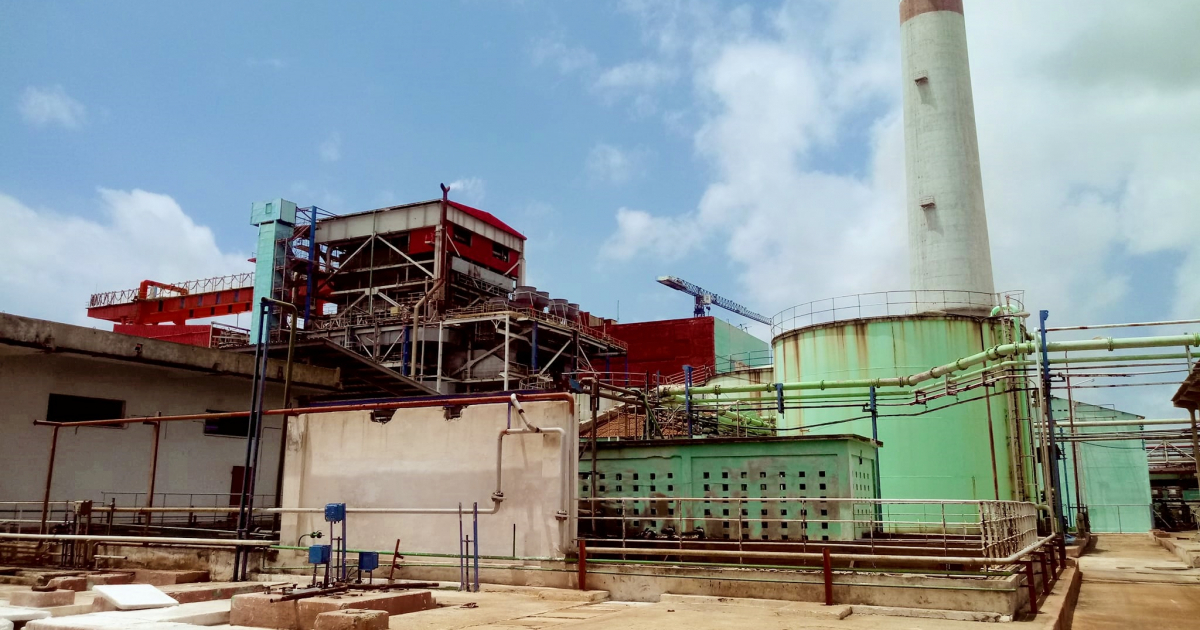
The Lidio Ramón Pérez thermoelectric plant, commonly referred to as Felton, has once again ceased operations this Saturday, highlighting the Cuban government's ongoing failure to maintain even a minimally stable energy infrastructure.
The Electric Union of Cuba (UNE) announced via Facebook that at 9:00 a.m., Unit 1 was taken offline due to "high temperature in the bearing," a technical issue that halts one of the critical components of the national electrical system.
While the official report was brief, it was the users who provided a clearer picture of the damage's extent. One user explained that bearings are crucial as they support the turbine shaft and allow it to spin at high speeds, meaning a failure necessitates disassembly, adjustment, cleaning, and maintenance.
Another user was more direct: "These repairs take at least 20 days..."
The UNE did not mention it, but the public has already accepted delays as part of the usual script of power outages and breakdowns.
A third commenter highlighted what many see as the root of the disaster: decades of improvisation and propaganda instead of state planning.
"We are far, very far from having a stable national electro-energy system, not now, not in 10 years, not in 50," they wrote.
The commenter also criticized the official insistence on solar energy as a miraculous solution, asserting that consulted experts predict it could worsen the situation if the government continues to rely on it as the sole way out.
Felton: A Symbol of Collapse
Felton is not just any plant; with over 500 megawatts of installed capacity, it is one of the pillars of electric generation in Cuba, especially for the eastern provinces. However, it has become a symbol of collapse.
In September, it was announced that the same Unit 1 would remain out of service for at least 20 days due to a transformer failure, which also required cleaning work on the boiler and condenser.
Then, at the end of October, the plant suffered partial damage after Hurricane Melissa passed through.
Authorities downplayed the impact, claiming that damage to roofs and metal structures "did not prevent the technical start-up," but still, it took several days because even accessing the water pumping area, essential for equipment cooling, was impossible.
Experts warned that it would take at least five days just to reach the site, following landslides and blocked roads.
The Crisis of Governance, Not the Weather
The constant deterioration of Cuban thermoelectric plants has become a vicious cycle where hurricanes, technical failures, obsolescence, lack of maintenance, and poor state planning accumulate without an exit strategy.
The government limits itself to publishing fragmented notes on social media, while citizens are the ones explaining the technology, estimating timelines, and recognizing the obvious: there is no short or long-term solution with the current course.
While the official discourse speaks of investments, alternative energies, and "resistance," machines collapse, cities return to darkness, and Cubans learn to live at the mercy of an electrical system that no one trusts to see working stably again.
What happened today in Felton was not an unforeseen accident: it was another symbol of an energy model exhausted by decades of governmental inefficiency. And it is also another sign that the blackout is more in the country's management than in the cables.
Understanding Cuba's Energy Challenges
What caused the shutdown of Felton's Unit 1?
Unit 1 was shut down due to high temperatures in the bearing, a critical technical issue that halts operations.
How long are repairs expected to take?
Repairs are expected to take at least 20 days, as reported by users familiar with the technical requirements.
Why is Felton considered crucial for Cuba?
With over 500 megawatts of installed capacity, Felton is vital for electricity generation, especially in eastern provinces.
What are the broader implications of Felton's failures?
Felton's repeated failures symbolize the broader energy crisis in Cuba, marked by inefficiency and lack of strategic planning.