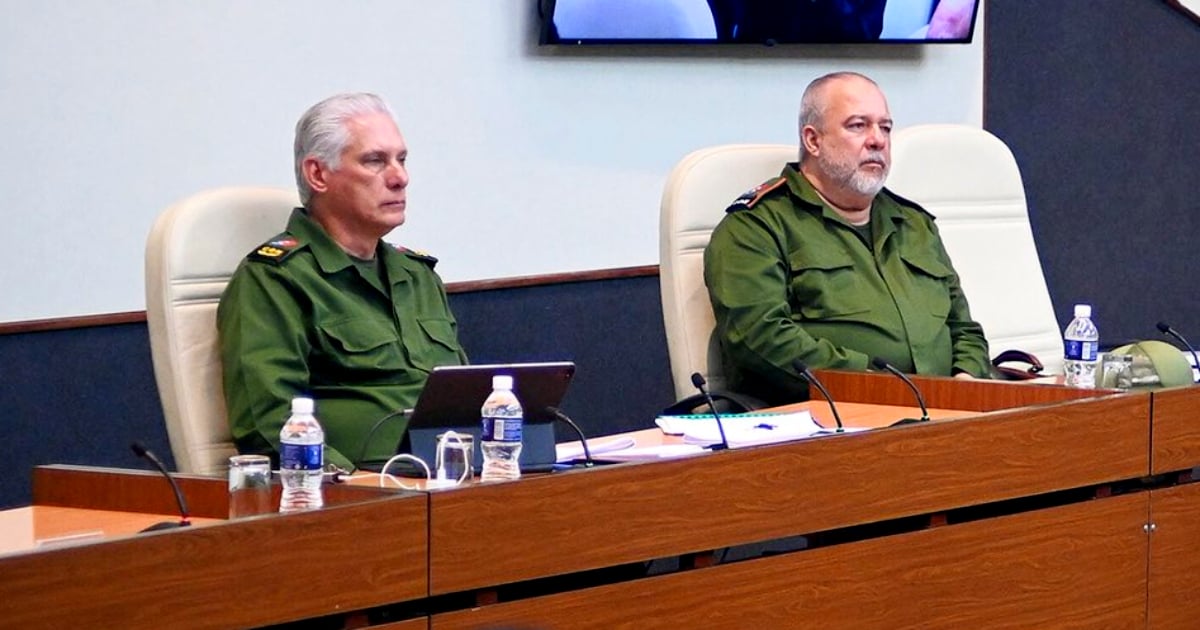
On Thursday, Miguel Díaz-Canel once again convened a "meeting with experts" to discuss the severe health crisis gripping the nation. Although the Cuban Presidency promoted the gathering as a demonstration of leadership and effective management, it failed to produce any concrete measures, new policies, or verifiable commitments.
Facing a healthcare collapse, with hospitals overwhelmed and more than 47,000 people hospitalized due to arboviral infections, according to official figures, the Cuban leader resorted to his usual playbook: assembling scientists to discuss "protocols" and "follow-up actions," offering no real solutions to a populace weary from illness, misinformation, and state neglect.
The official report, penned by journalist Yaima Puig Meneses, described a meeting filled with empty phrases like "strengthening prevention," "perfecting protocols," and "continuing to advance," yet no operational announcements were made.
There was no discussion of budgets, resource allocation, or urgent measures to ensure the availability of medications, insecticides, or medical transport. Updated figures on infections or fatalities were also absent.
One of the most notable interventions came from Dr. Lorena Vázquez Bello of the Pedro Kourí Institute, who presented a study on 32 patients with chikungunya. However, according to the report, the work remains preliminary, with already known clinical data offering no immediate practical implications.
Similarly, the mention of the Cuban medication Jusvinza lacked published evidence of its antiviral efficacy, coupled with promises of "ongoing trials" that are announced annually without transparency.
The result is a narrative crafted to project scientific control and presidential management while the country sinks deeper into its most severe epidemiological crisis in decades. Buzzwords like "study," "innovation," and "science" are repeated as political mantras, devoid of transparency, accountability, or verifiable data.
The report also failed to address the responsibility of the Ministry of Public Health (MINSAP) or the inefficiency in controlling the Aedes aegypti mosquito. Instead, it highlighted the "presence of Prime Minister Manuel Marrero Cruz," as if a photo of a cabinet meeting equates to effective public health management.
The true message of the meeting was not scientific but propagandistic: showcasing activity without resolving issues. Once more, Díaz-Canel appears, listens, and directs, yet fails to govern.
Meanwhile, Cubans continue to face fevers, endure long lines at clinics and hospitals lacking medications, as the regime clings to its oldest strategy: substituting action with propaganda.
Understanding Cuba's Health Crisis and Leadership Response
What was the purpose of Díaz-Canel's meeting with experts?
The meeting was intended to address the worsening health crisis in Cuba by discussing protocols and follow-up actions with experts. However, it resulted in no concrete solutions or new policies.
What are the main criticism points of the meeting?
Criticisms include the lack of actionable outcomes, absence of discussion on budgets or resources, and the meeting's focus on empty phrases instead of real solutions. It was seen more as a propagandistic effort rather than a problem-solving session.
Why is the mention of Jusvinza significant?
Jusvinza is a Cuban medication mentioned in the meeting, but it lacks published evidence of its efficacy. The reference to ongoing trials without results reflects issues of transparency and accountability.