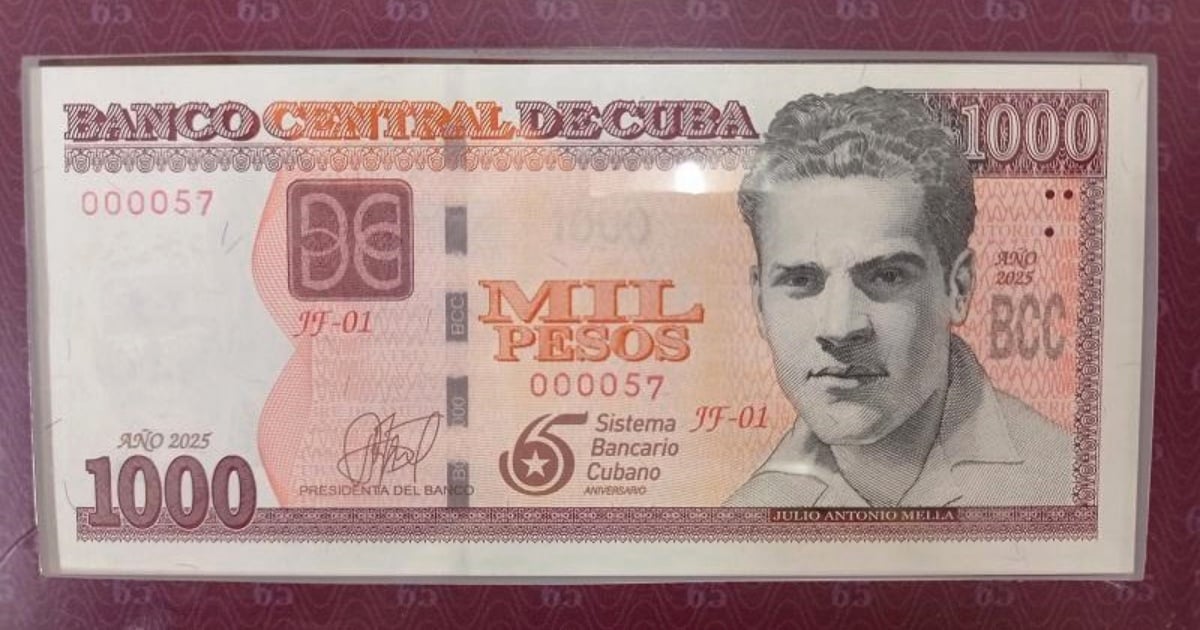
Marking the 65th anniversary of Cuba's banking nationalization, the Central Bank of Cuba (BCC) has introduced a special edition of the 1,000 Cuban peso (CUP) bill. This move is part of the celebrations for this significant date, which peaked on October 13, recognized as "Bank Workers' Day."
The BCC stated that the new bill retains the color and security features of the original, ensuring its authenticity. The major change is on the reverse side, where the traditional image of the University of Havana has been replaced by the Che Guevara Sculptural Complex in Santa Clara. Additionally, both sides of the bill display the identifier "65th Anniversary."
The institution assured that this edition circulates alongside the original bill, maintaining "equal validity and legitimacy."
Public Reaction: From Irony to Frustration
Despite the solemn tone of the announcement, public reception has been overwhelmingly critical and mocking. On the Central Bank's Facebook page, dozens of users responded with sarcasm, frustration, or outright indignation, questioning not only the appropriateness of the commemorative issue but also the economic implications of printing more money without backing.
Concerns frequently mentioned include inflation, the devaluation of the Cuban peso, and the contradiction of celebrating an event—the banking nationalization—that many associate with the country's economic collapse. As one user summarized, "They issue a special edition bill to celebrate the economic disaster that hasn't been corrected in 65 years."
Critiques of Inflation and Monetary Policy
Many comments warned that issuing more unsupported bills would only worsen the rampant inflation already plaguing the island. Phrases like "printing paper," "more toilet paper on the street," and "keep printing and inflation will keep rising" were common.
The confusion also targeted the lack of functionality in the banking system. Some criticized the absence of working ATMs, the lack of actual circulating money, and the peso's lack of tangible backing.
Nostalgic references were made to the value the Cuban currency once held before nationalization: "The Cuban peso was once equal to or more valuable than the dollar. After nationalizations... look where we are."
The Sarcasm and Desperation
Humor—often sharp—has been the common reaction for many. Some mocked the symbolic value of the bill, comparing it to the high cost of basic goods in the informal market: "With this, I can buy a package of chicken." "That’s 3 pounds of chicken mince, or 2 pounds of pork." "One pound of pork, and you still need to find 100 more."
Others were more pointed in their criticism of social and economic deterioration, listing unfulfilled official promises, such as improvements to the electrical system, the glass of milk, the dollar at 25 pesos, and the end of blackouts.
Additional comments summarize the crisis and economic dissatisfaction among Cubans:
- "A great way for the Revolution to move forward. Print more paper."
- "They love to produce inflation; in that, they are the best."
- "It will retain the essence of the bill because its value remains almost nonexistent."
- "After almost three months in circulation, now they announce it."
- "That bill has no value with the current inflation. 1,000 pesos is nothing."
- "How are they going to ensure that printing this 1,000-peso bill doesn't generate more inflation?"
- "Keep issuing more bills... so inflation rises like foam."
- "As long as they keep printing paper with any excuse, they will never stop hyperinflation."
- "Celebrate that those 1,000 pesos soon will be worth 2 USD."
- "The only industry that hasn't collapsed in Cuba is printing worthless bills."
- "Congratulations, and here's to more... misery."
Beyond technical or economic criticism, the comments express a widespread feeling of disconnect between institutional decisions and the reality experienced by citizens. For many, this special issue symbolizes a directionless monetary policy, an empty commemoration, or even a mockery in the face of collective impoverishment.
The new commemorative bill, far from uniting the population around a historical date, has served as a catalyst for discontent. Another testament to the disconnect between the symbols of power and the priorities of the people living under its weight.
Impact of New Cuban Currency on Inflation and Public Opinion
Why did the Central Bank of Cuba issue a special 1,000 peso bill?
The Central Bank of Cuba issued a special 1,000 peso bill to commemorate the 65th anniversary of the nationalization of Cuban banking. It is part of the celebrations marking this historic event.
What has been the public reaction to the new 1,000 peso bill in Cuba?
The public reaction has been overwhelmingly critical and mocking. Many have expressed frustration and sarcasm, questioning the economic implications and appropriateness of printing more money without sufficient backing.
How does the new bill differ from the original 1,000 peso bill?
The new bill retains the original's color and security features but replaces the University of Havana image with the Che Guevara Sculptural Complex in Santa Clara and includes the "65th Anniversary" identifier.
What are the concerns regarding the issuance of the special 1,000 peso bill?
Concerns include exacerbating inflation, the devaluation of the Cuban peso, and the perception that it celebrates an event associated with Cuba's economic decline.