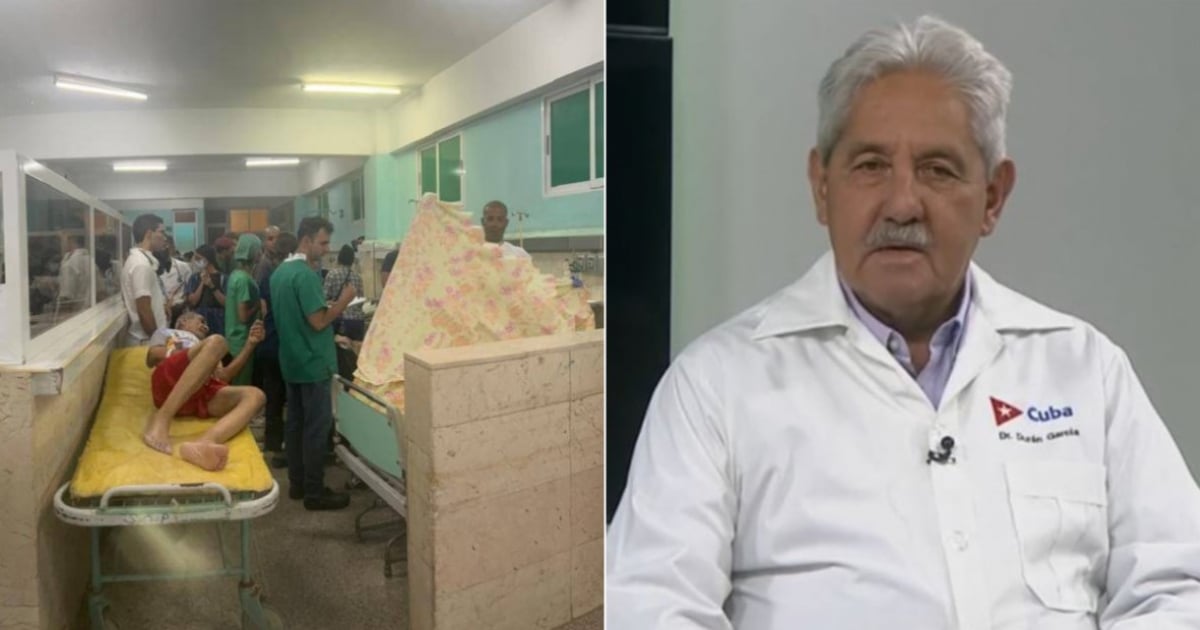
Dr. Francisco Durán, the National Director of Epidemiology at Cuba's Ministry of Public Health, recently made statements about the ongoing arboviral crisis and the public's access to medical care. These remarks have sparked significant backlash from citizens on social media.
On Facebook, where our newsroom shared Dr. Durán's latest report, many Cubans expressed that they avoid seeking medical care due to the absence of medications, essential supplies, and basic healthcare conditions.
During his address, Dr. Durán admitted that official statistics do not portray the true scope of the issue, as a substantial portion of those affected do not seek medical services.
He clarified that the data only accounts for those who visit healthcare facilities. He cited an example from the previous day, where 1,706 patients with unspecified febrile syndrome were identified, and 3,226 were admitted. Of these, 84.1% were monitored at home by family doctors and nurses, while only 16.9% remained in health institutions, totaling 47,125 patients nationwide admitted due to febrile illnesses.
Dr. Durán reminded the public that dengue has been an endemic disease in Cuba, with years of circulation and several outbreaks that have resulted in considerable fatalities both in the past and during the current crisis.
He confirmed the virus's presence throughout the country, although reports are concentrated in "14 provinces and 43 municipalities." The Granma province, particularly Bayamo and Río Cauto municipalities, recently reported active transmission. On the last day, more than 344 cases were diagnosed in various provinces.
The epidemiologist expressed concern over chikungunya, noting its painful symptoms that are leaving thousands with severe joint pain and prolonged discomfort.
However, while Dr. Durán emphasizes the importance of visiting doctors for proper registration and identification, many Facebook users questioned the point of engaging with a healthcare system lacking medications, resources, and overwhelmed hospitals.
One woman captured the sentiment of many: “Why should we see a doctor if there's nothing available? Those who can afford acetaminophen or dipyrone have to buy it on the street, and most people affected by the virus can't afford that with such low salaries.”
She also mentioned that the few medicines entering the system end up with resellers, who charge exorbitant prices.
She criticized these individuals for using their profits to buy luxury items while the populace receives negligible supplies, even seeing essential hygiene products like bleach diverted to the black market.
She shared her own struggles, dealing with the virus, diabetes, a heart attack, and asthma, unable to obtain “even an asthma device” or conduct a simple, urgently needed blood test, living alone in Colón, Matanzas, at 78 years old.
Other users were more blunt: “Just admit that all of Cuba is sick, and even if you go to the doctor, there's nothing to alleviate the pain; that's the plain truth,” wrote one.
Another comment suggested it would be more honest to acknowledge that “100% of the Cuban population is ill, and many have died, lacking medications and any medical attention, with hospitals overwhelmed,” instead of continuing “empty talk” while “no fumigation is happening anywhere.”
Criticism also targeted the healthcare model itself. One user questioned Dr. Durán's insistence on visiting doctors when, upon arrival, patients are asked to bring their own supplies.
“Why do they want us to go to the doctor, just to keep count? Seriously, when you get there, they ask if you brought medicine, gloves... they ask for everything. Stop playing the victim.”
The comment highlights a growing practice of demanding patients provide gloves, syringes, medicines, and even basic medical supplies, which is impossible for those reliant on devalued state salaries.
The disparity between the official narrative—focused on statistics, home admissions, and care circuits—and the experiences shared by Cubans on social media reveals a significant disconnect.
While the Ministry of Health urges patients to report themselves for a more accurate epidemic assessment, many citizens declare they avoid medical visits, expecting no relief—only consultations without medicines, lab tests, and sometimes the burden of sourcing their own supplies.
Thus, Dr. Durán's call for improved information and individual protection collides with a reality many Cubans describe as a healthcare abandonment: essential medicines missing from pharmacies, resellers controlling access to drugs, and a lack of mosquito control measures.
Amidst pain and fatigue, the population concludes: “We don't go to the doctor because there are no medicines.”
Understanding Cuba's Healthcare Crisis
Why are Cubans avoiding medical visits despite an epidemic?
Many Cubans avoid medical visits because of the lack of medicines, essential supplies, and overwhelmed healthcare facilities, rendering visits ineffective.
What are the main health concerns in Cuba according to Dr. Durán?
Dr. Durán highlighted dengue and chikungunya as significant concerns due to their widespread presence and painful symptoms, respectively.
How do citizens view the current healthcare system in Cuba?
Citizens criticize the healthcare system for its lack of resources, requiring patients to bring their own supplies, and ineffective hospital services.