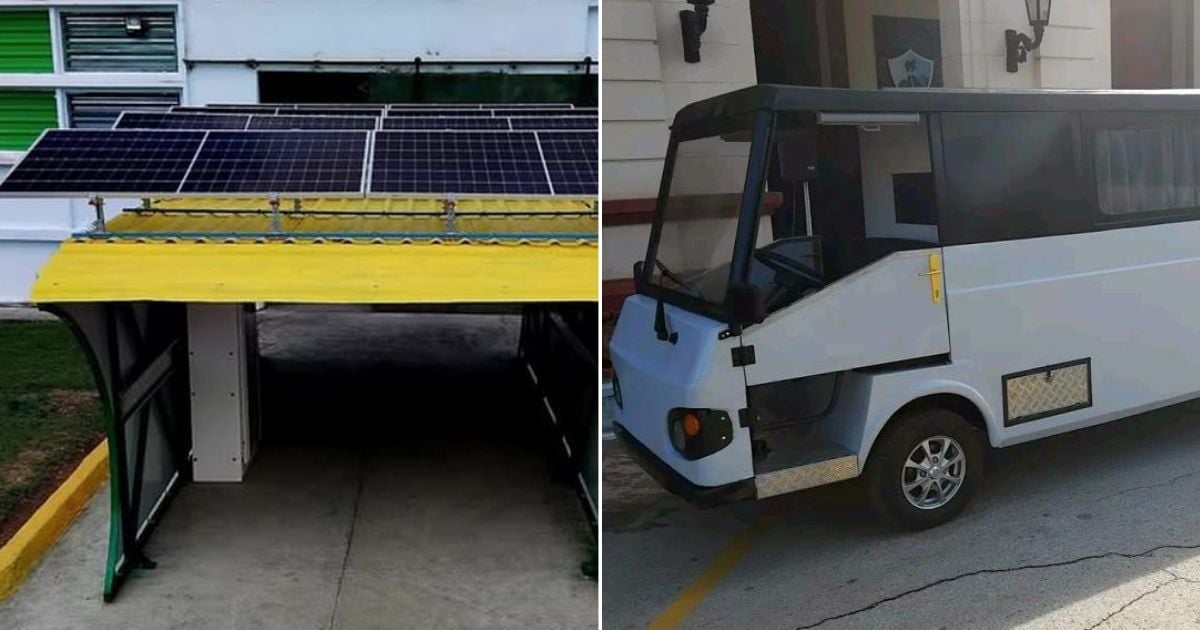
Amidst the decline of public transportation and a severe energy and economic crisis, Cuba is trying out solar-powered charging stations for electric minibuses. This experiment aims to curb reliance on the national power grid.
The state-run newspaper Escambray reported that the province of Sancti Spíritus has become the first in the country to establish a solar-powered charging station, referred to as an "electrosolinera." This facility is designed for electric minibuses, or ecomobiles, which have been developed with support from the Ministry of Science, Technology, and Environment (CITMA).
Leonel Díaz Camero, the CITMA delegate in the province, described the project as an experimental endeavor under the "Urban Transport Energy Transition" program. This initiative seeks to partially replace diesel consumption in local transport systems.
The initial station was launched at the Francisco Aguiar Military Industrial Company, with the capacity to charge only one minibus. Plans for two additional similar installations are under consideration.
"These initial electrosolineras are experimental and will help identify the most viable option. There are no existing experiences of this kind in the country," Díaz explained.
Díaz emphasized the project's goal to test the system's effectiveness and reduce the use of energy from the National Electric System, a significant step given the frequent blackouts and fuel shortages.
However, the delegate acknowledged that the project still relies on foreign currency funding and the supply of imported components such as engines, tires, and traction systems.
The plan also involves developing mobile applications (APK) for users to track the location and routes of ecomobiles, along with economic management systems to optimize vehicle use.
Currently, Sancti Spíritus operates 38 electric minibuses, distributed among the Military Industrial Company, the state-run service Taxis Cuba, and the municipality of Trinidad. Authorities aim to reach 55 units once new vehicles are delivered.
The project has engaged university students in designing software and technical improvements, while new prototypes, such as electric hearses, are being explored. One such hearse is already operational in Placetas.
Despite its eco-friendly projection, the experiment highlights the structural limitations of Cuba's so-called "energy transition," characterized by unstable funding and dependence on foreign cooperation.
Local delegations have sought support from South Korea and Brazil to expand the electrosolinera network and manufacture more vehicles, but these efforts are still under review.
Díaz assured that the goal is to achieve sustainable local production that allows for the assembly and maintenance of ecomobiles within the region.
Nonetheless, the project's progress hinges on the arrival of new resource allocations and the success of solar trials, which currently benefit a very limited number of users.
The push for electric mobility is progressing slowly in Cuba, where the government has announced plans to install around 40 charging stations across various provinces. This aims to decrease diesel reliance and promote cleaner energy sources.
This initiative is part of the national energy transition program, although its implementation faces challenges such as resource scarcity, high import costs, and a lack of stable infrastructure.
Simultaneously, Havana has started using electric vehicles in public services, including newly introduced battery-powered hearses. This experimental move seeks to prove the viability of this technology in essential sectors.
Recently, authorities declared their intention to create cities with electric transportation, integrating sustainable mobility systems, solar stations, and charging networks. However, experts warn that material shortages, technological obsolescence, and limited foreign investment hinder the achievement of these goals.
Some progress is already visible: the first electric hearses are being assembled in the country with the support of local institutions, combining national production with imported components.
Understanding Cuba's Electric Minibus Initiative
What is the purpose of Cuba's solar-powered charging stations?
The solar-powered charging stations, or electrosolineras, aim to reduce reliance on the national power grid and diesel consumption by providing energy for electric minibuses.
How many electric minibuses are currently operational in Sancti Spíritus?
There are currently 38 electric minibuses operational in the province, with plans to increase this number to 55 as new vehicles are delivered.
What challenges does the electric mobility project face in Cuba?
The project faces challenges such as unstable funding, reliance on imported components, and limited infrastructure, as well as a dependency on foreign cooperation for expansion.